Snowflake data quality explained: From native capabilities to estate-wide data trust with Ataccama

See what Snowflake’s native data quality tools do well, where they stop, and how to extend quality and governance across your entire data estate.
What is Snowflake data quality?
Snowflake is a fully-managed, cloud-based AI platform that functions as a data cloud. This data cloud allows businesses to store their data, and to process and analyze that massive data volumes quickly and effectively without a burdensome underlying infrastructure. One unique feature of Snowflake is the ability to pay for storage and usage separately, as well as the ability to turn resources “off” and pause payments on them for set lengths of time.
Snowflake data quality refers to native checks and monitors within the Snowflake platform that help validate, measure, and maintain the health of the data that is stored in the platform. Because Snowflake is a platform where analytics and AI workloads run, data quality determines whether the outputs can be trusted.
If quality isn’t enforced before data moves downstream, poor quality data that enters Snowflake rapidly propagates into every dashboard, model, and AI agent. Each layer inherits the error without knowing it. AI raises the stakes further: agents consume data directly and act on it, with no human review layer to catch mistakes before they reach a customer or a decision.
For regulated industries, the bar is still higher. Frameworks like BCBS 239 require demonstrable accuracy and traceability, making data quality in Snowflake not just an operational concern, but a compliance one.
Native Snowflake features that support data quality
Given those stakes, many ask a practical question: What does Snowflake give users to work with in terms of data quality? The platform includes a range of in-built features that help keep data accurate, complete, and reliable, so teams can catch problems close to where the data lands rather than downstream in a dashboard or model.
These native capabilities cover the essentials very well. But when an enterprise needs data it can defend in an audit, use for downstream AI, and trust for high-stakes decisions, pairing Snowflake with a dedicated data quality solution like Ataccama adds both estate-wide reach and the kind of depth those demands require: governed, fit-for-purpose rule authoring, remediation and stewardship workflows, and a traceable trail a regulator can follow.
Snowflake data profiling
Data profiling in Snowflake helps users understand the structure, content, and quality of data sets by automatically gathering statistics on them. Snowflake data profiling includes basic table profiling, such as NULLs, min/max values, most common values, and row counts. These capabilities help to spot high-level issues such as missing values, duplicate data, and data inconsistencies before moving toward implementing formal quality rules.
Snowflake data quality metrics: Data Metric Functions (DMFs) and Expectations
Snowflake provides several data metric functions right out of the box. One of these is System DMFs, which are maintained by Snowflake and available to every account. They’re the building block of Snowflake’s native data quality checks, meant to measure 40 common metrics without users having to define anything themselves across pre-defined categories: accuracy, freshness, schema, statistics, uniqueness, volume. Snowflake metrics include accuracy checks, uniqueness and duplicate checks, and more.
In addition to System DMFs, Snowflake users can create their own Custom DMFs that handle things such as business-specific rules. These custom DMFs encode business logic in SQL and cross-column conditions within Snowflake. You can associate a DMF to the table of interest and a specific column.
Snowflake users can also use Expectations. With Expectations, a DMF becomes a pass/fail check for data validation.
Snowflake’s Cortex Data Quality (Preview)
Cortex AI is Snowflake’s built-in AI layer, which allows enterprises to run large language models directly on their data instead of moving it out of Snowflake’s secure environment first.
Cortex Data Quality applies this to quality checks. It uses AI to suggest checks based on characteristics of your metadata and usage patterns, so users don’t need to define every check by hand. Suggestions run on the Cortex AI_COMPLETE function inside of Snowflake, respect existing access control, and cover only the data the user can already see.
In practice, users review the suggestions in Snowsight, edit the pass criteria, select the checks they want, and apply them.
Snowflake anomaly detection (Preview)
Another built-in feature that Snowflake offers is anomaly detection. The algorithm detects anomalies in the values returned by a DMF. Unlike checks based on deterministic rules, Snowflake’s algorithm trains it on historical data, then flags return values above or below a predicted range
One downside is that it needs weeks of history before it becomes useful, and only two system DMFs support it: ROW_COUNT (volume anomalies) and FRESHNESS (update-frequency anomalies).
Snowflake data quality monitoring in Snowsight (Preview)
Snowsight is Snowflake’s data quality monitoring tool. Snowsight’s Data Quality monitoring provides an interactive view of DMFs associated with an object and their results. The view also shows run schedules and expectations, including the pass/fail criteria defined for each check and whether the expectation was violated the last time the DMF ran.
If there is a data quality issue with impacted assets, the user can use lineage to determine what other objects may be affected.
How Snowflake handles data governance and sensitive data
Snowflake’s Horizon Catalog provides seamless metadata browsing, object search, universal search across databases/schemas/tables/views, and automatic tagging via classification and tag-based policies. Horizon Catalog supports Snowflake-native objects, Apache Iceberg tables, and has emerging support (Preview) for 5 external sources.
For organizations primarily on Snowflake, this zero-friction experience is a significant advantage. However, data quality and cataloging across non-Snowflake systems requires third-party tools.
When it comes to governance, Snowflake tags allow users to automate masking and row access for sensitive data, while tags carry technical governance metadata, not business metadata. In order to certify data as “trusted”, Snowflake must integrate with a third-party data validation tool.
Where native Snowflake data quality reaches its limits
Native DMFs cover the essentials inside Snowflake, but a few limits matter at enterprise scale.
Scale runs into hard caps first. Users can have only 50,000 total DMF associations on objects per account. Checks are still authored and associated in SQL. Column-level checks work, but each column-and-DMF binding is set per object, so a column check on one table has to be re-created on the next, making quality checks a manual, cumbersome thing to scale.
On dimensions, system DMFs map to predefined categories, and custom DMFs don’t map to DQ dimensions at all, so users cannot roll results up by accuracy, validity, timeliness, etc. to prove they are fit-for-purpose. Results also stay at the object level, with no native way to aggregate quality results across the set of tables that feeds a given report, model, or data product.
Moreover, failed records are harder to work with. Drill-down is available for system DMFs, not custom DMFs. And what you see is the state of the data at the moment the DMF runs, not a persisted snapshot of past failures. For enterprise-grade quality, users need invalid records retained across all your custom business rules, which is what lets stewards remediate invalid records at scale and gives auditors a trail to follow.
This is where an end-to-end data quality platform extends Snowflake for teams that need governed, high-quality data.
When do you need more than native Snowflake data quality?
Snowflake gives users clean data inside Snowflake. That is not the same as having clean data across an entire trusted data estate.
Enterprise data reality is messier than any platform admits. There is critical data scattered across Oracle, SAP, Salesforce, mainframes, and files, each with its own rules, owners, and definition of what “good data” looks like. The same customer might exist three times under three different spellings, or a code could mean one thing in finance and another in operations. A migration into Snowflake moves all of this forward, without correcting any of it.
Native Snowflake capabilities measure quality once data lands in Snowflake, but they do not reach the wide range of source systems where most of it lives, or the business teams accountable for it. Stakes are rising. Regulators want proof that the data behind a report is accurate and complete, and AI agents act on whatever users feed them, amplifying every unreconciled record and broken code.
Measuring quality in one platform is not the same as proving data is fit for the report, the model, or the decision that depends on it.
Data quality enforcement across the data estate
It’s impossible to successfully enforce data quality by looking at just one segment of your business. If you are only using DMFs to monitor data in Snowflake, you will miss large segments of the business where data lives, moves, and is accessed by users. Whether it’s on-premise databases like Oracle and Netezza, ERP softwares like SAP, or CRM softwares such as Salesforce, it is all outside the reach of Snowflake’s data validation rules.
Ataccama has 200+ connectors across on-prem databases, business applications, files and legacy systems, which means Ataccama can scan data assets across sources and apply governed business terms and data quality rules across them, ensuring enterprise-wide consistency.
A centralized, source-agnostic rule library in Ataccama means that the business can decide what “good” looks like. That validated data can then be pushed out to other technologies where it will be used. A key mechanism for data quality is the reusability of tech-agnostic rules: the same rule executes with pushdown processing on Snowflake, edge processing at source systems and operational databases, and in the Ataccama Cloud.
On top of Snowflake’s capabilities, Ataccama offers business glossary linkage, meaning that data quality rules can be applied to business terms. One rule scales across every asset carrying that term with no manual rewriting per object needed. It’s what delivers consistency at estate scale.
Ataccama covers data quality and observability together, for data at rest and in motion, across orchestrators and sources spanning the estate.
Ataccama also adds breadth and depth with advanced, enterprise-grade data quality and governance, data observability, reference data and master data management for the entire data estate.
Snowflake governs and measures quality mainly within its own platform. Ataccama is the trust layer beneath it, where data quality, governance, observability, and entity resolution come together across every source feeding it.
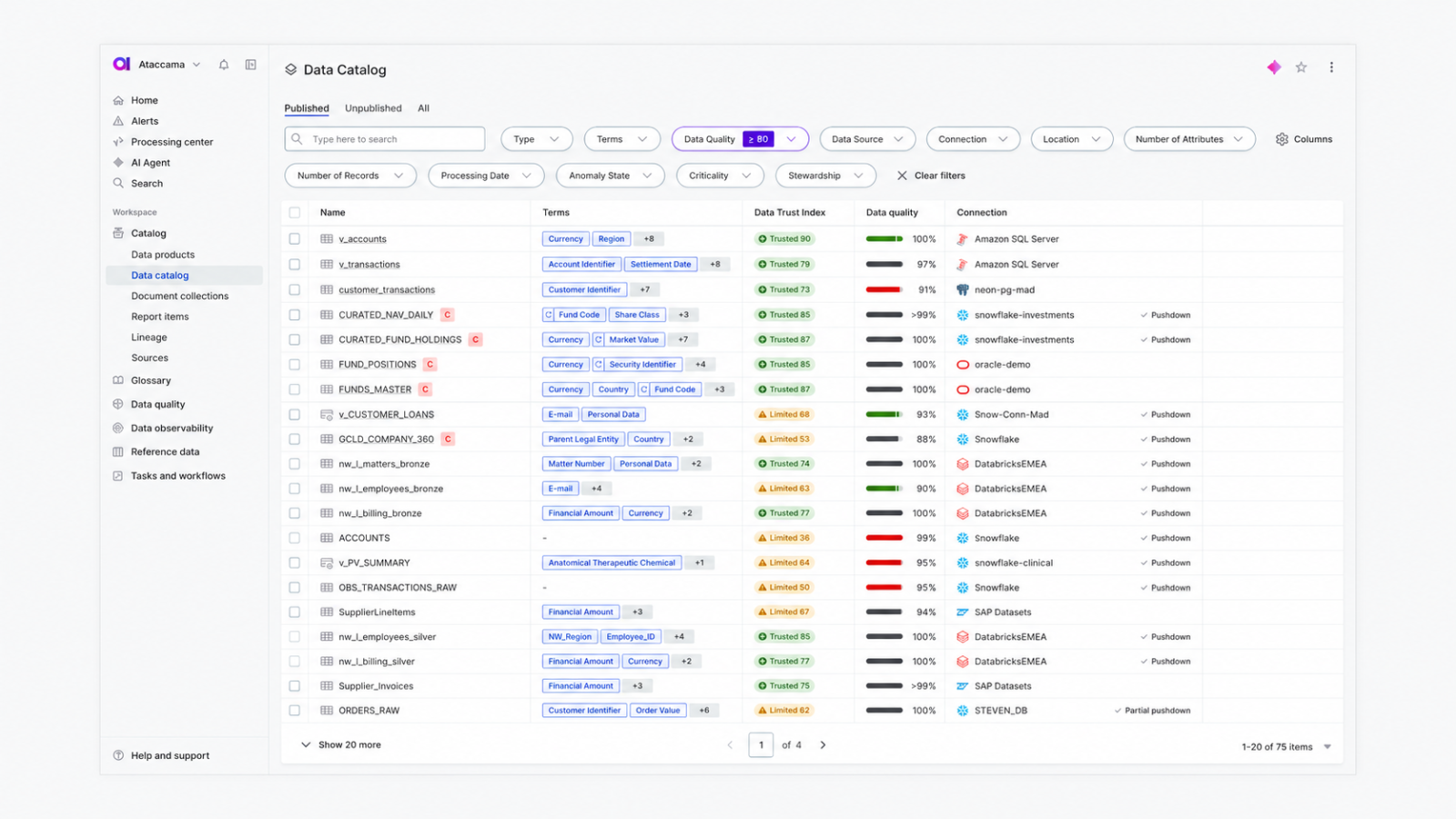
Beyond a technical catalog: business terms, DQ scores, and trust signals applied across the data estate
From engineering to stewards: when data quality moves closer to the business
Data quality cannot successfully remain an engineering-only concern. The people accountable for whether data is correct are often business stewards and domain owners, not the engineers who built the pipeline. They need to own the standards, see issues in business terms, and act on them without writing SQL. Snowflake’s native tools are built for engineers: SQL-authored DMFs, table by table, and cannot scale to a steward responsible for thousands of assets.
When non-engineers need to touch data, it helps to have plain-language access to agentic data management. Business users can ask the ONE AI Agent to manage data at scale without writing a single line of code. The ONE AI Agent can govern the assets, evaluate their data quality, find the issues and root-causes, and recommend and execute fixes. The AI agent completes entire workflows end-to-end. It sets the goal, plans next steps, and executes on them with full reasoning over metadata, supporting more than 60 agent use cases.
Other capabilities support business data stewards who own data standards day-to-day:
- Unified alerting: Ataccama detects and alerts about the issues across a wide range of potential breaches: data quality threshold breaches, freshness, volume and attribute anomalies, schema changes, and failed pipelines, across the data estate with clearly defined notification policies.
- Ataccama adds the stewardship layer: Ataccama provides user-friendly UI for business stewards with defined responsibilities for who receives, triages, and resolves alerts — and with a full audit trail. Users can set an escalation policy to auto-create a ticket in an external system based on specified conditions.
- Faster troubleshooting: All data quality findings, alerts, and issues are presented in the context of data lineage, asset and source ownership, and data relationships.
- Result: Data quality is owned by business teams. It strengthens cooperation between business stewards and data engineers that get full information about data quality issues, impacted assets, and root cause.
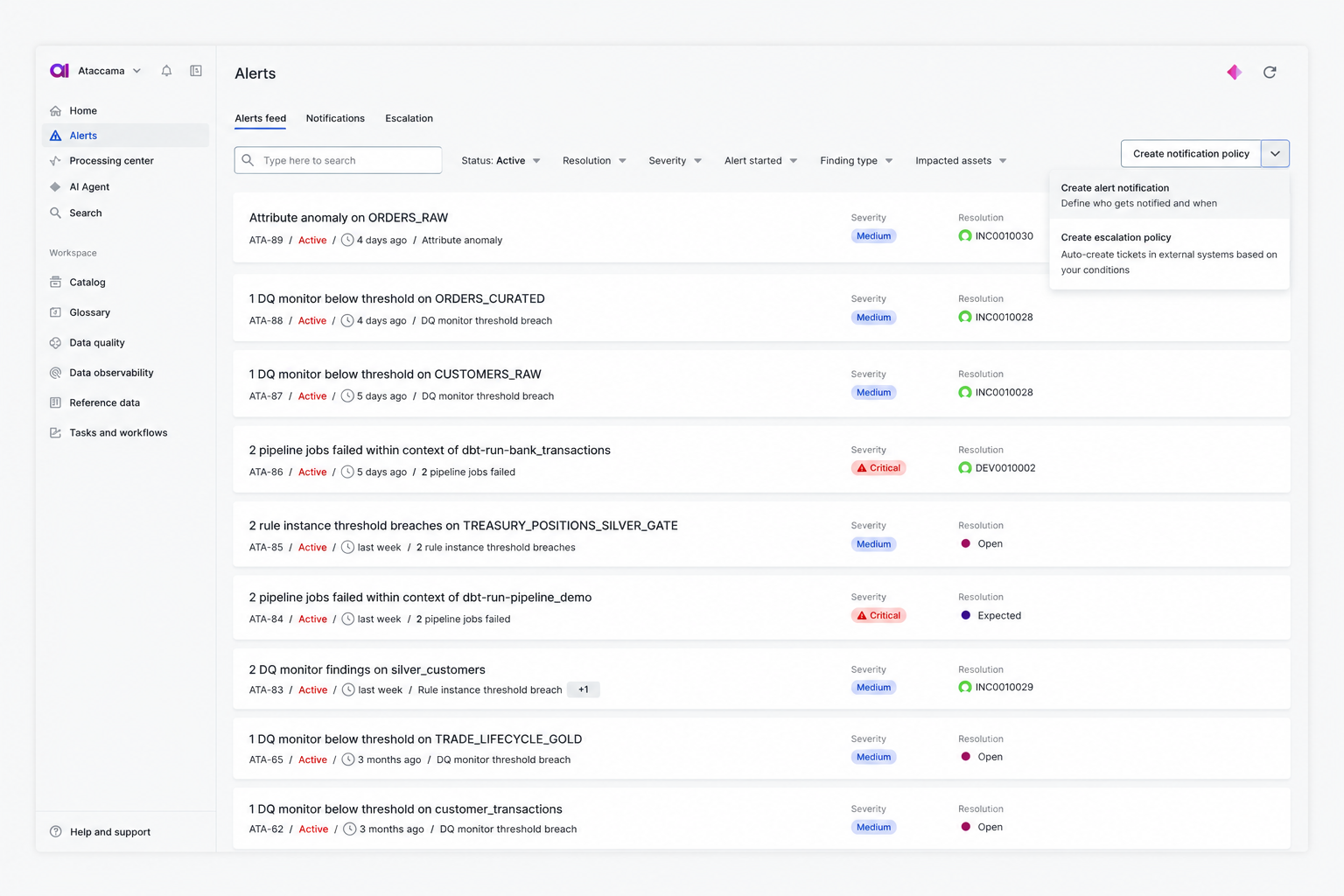
Estate-wide alerting on quality thresholds, anomalies, and pipeline failures
Audit-ready evidence for regulatory reporting and AI use cases
When it comes to having audit-ready data, Ataccama adds trust and business context to the data housed in Snowflake.
Where Snowflake’s Horizon Catalog is anchored in technical and security metadata (objects, tags, classifications, policies), Ataccama extends the metadata model with entities (business processes, domains, data products) and concepts (criticality) that map data to business context. Ataccama also provides an enterprise-grade business glossary.
Ataccama’s Data Trust Index adds immediate value as decision-makers evaluate data on its accuracy and trustworthiness. When proving data is fit-for-purpose, Snowflake’s data quality functions fall flat. They are rudimentary, with limited options of measuring custom data quality rules across dimensions. In contrast, Ataccama maps custom business rules to quality dimensions (accuracy, validity, timeliness, uniqueness, completeness) and rolls results up across assets, domains, and data products, so you can prove data is fit for the regulatory report, model, AI agent, or decision that depends on it, not just that a table passed a check.
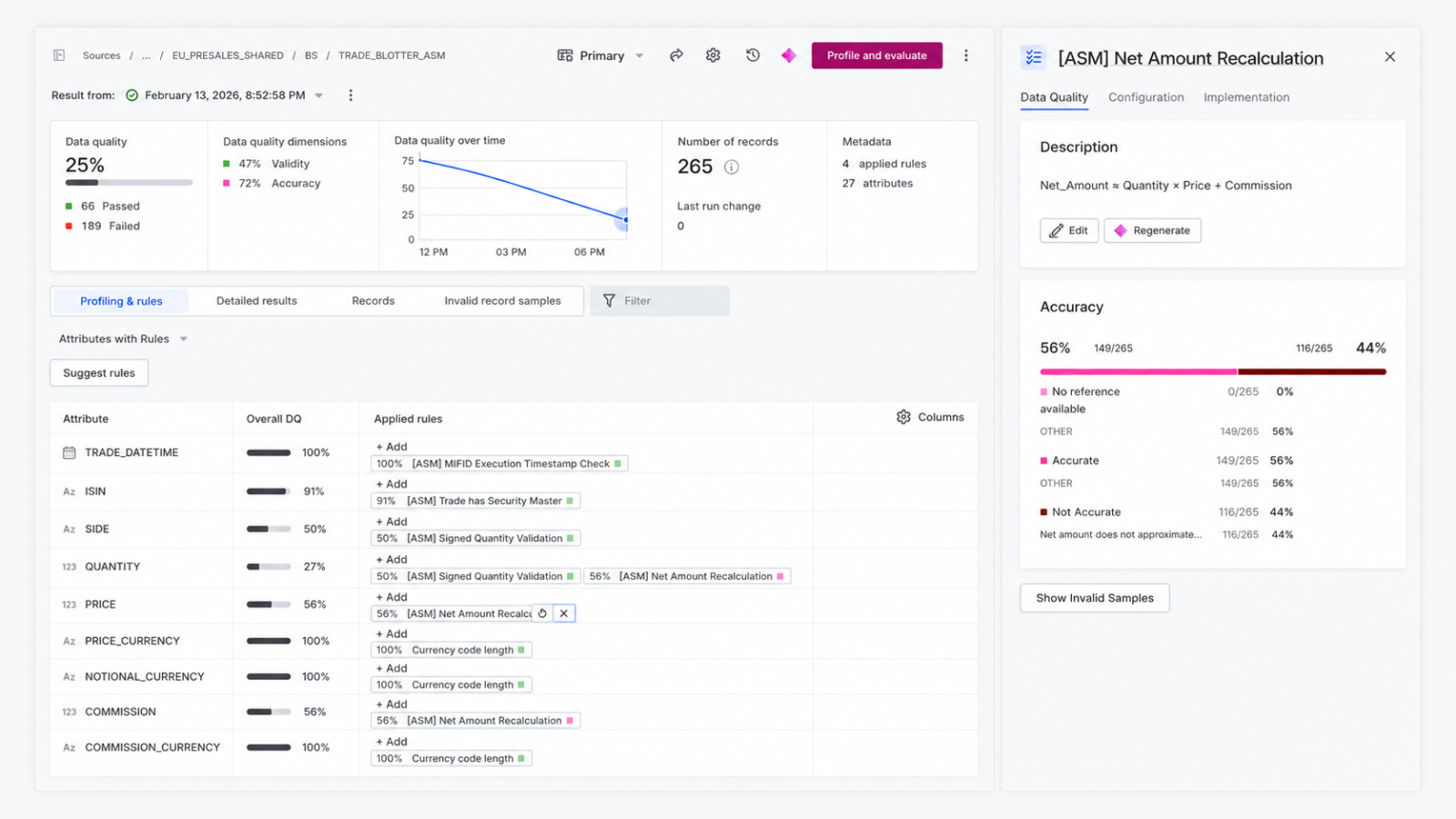
Ataccama data quality monitor showing custom business rules and their results for each attribute
Auditors need to see end-to-end lineage from source to use. Ataccama provides end-to-end cross-system lineage across 50+ technologies, including mainframe technologies. Column-level lineage displays business terms and data quality insights at the object and attribute level, exactly the level of detail you need for auditors and successful AI deployment.
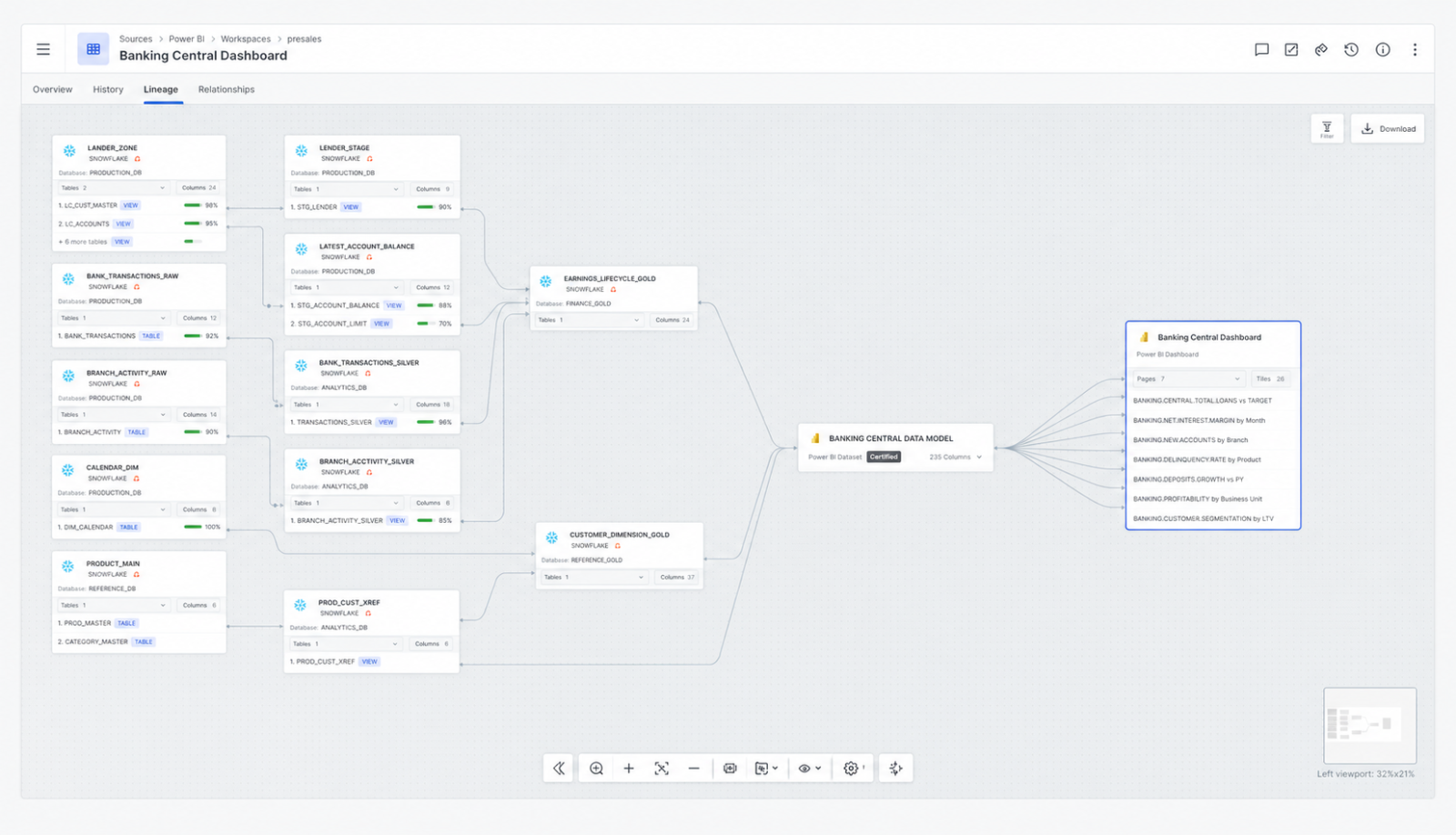
Ataccama Lineage with column-level DQ and business terms overlays
Why Ataccama and Snowflake are better together
Snowflake gives users scale, elasticity, and a place to run analytics and AI. Ataccama adds the trust layer across every source that feeds it. The pairing delivers governed data end-to-end. Ataccama Data Quality Gates and pushdown processing validate Snowflake data quality natively to increase efficiency.
Ataccama plus Snowflake can scale data management and enable production-ready data for AI and reporting. Ataccama brings clean data into Snowflake and keeps it trusted across the medallion architecture, continuously monitoring and validating data and gating what fails, with remediation and stewardship workflows that hold quality at scale.
Through Ataccama’s MCP Server, Snowflake CoWork and CoCo consume data with embedded quality and governance signals, business context, and a Data Trust Index that grounds AI development in governed, verified data. Snowflake’s CoCo Accelerated Badge validates the integration for production-scale AI workloads.
| Snowflake Data Quality | Ataccama ONE | |
| Target personas | Data engineers, data analysts | Data governance officers, data stewards, data engineers |
| Coverage | Snowflake objects, connected Iceberg tables, 5 external metadata connectors (private preview) | Whole estate; source-agnostic, including legacy systems, operational systems, 200+ connectors |
| Profiling | Row counts, NULLs, min/max, top frequency | Deep statistical profiling and cross-platform discovery. |
| Data quality checks | System DMFs & Custom DMFs in SQL; Expectations = pass/fail. Manual setup per object. | Source-agnostic, reusable rule library with full governance and versioning. Metadata-driven automation: rules bind to business terms and apply at scale. Pushdown execution in Snowflake, edge execution at the source, DQ Gates in Snowflake pipelines. |
| Dimension mapping | Only System DMFs: accuracy, freshness, schema, statistics, uniqueness, volume, map to predefined categories, Custom DMFs collapse to “Custom,” no attribution | Maps rules to DQ dimensions: accuracy, validity, timeliness, uniqueness, completeness to prove fit-for-purpose |
| Monitoring & reporting | Snowsight DQ view (Preview): results, 7-day trends | Business-friendly UI with monitoring projects and reporting across assets, domains, data products, and sources with rich data history for analysis/audit purposes. |
| AI-powered data quality | AI-suggested checks from metadata + usage patterns (Cortex Data Quality, Preview) | End-to-end agentic workflows for governance, data quality evaluation, root-cause analysis and fixes across assets |
| Data observability | ML, flags out-of-range DMF values for volume and freshness (Preview) | Volume, freshness, attribute, schema changes for data at rest, pipeline monitoring for data in motion, upstream and in Snowflake, tightly integrated with lineage and remediation |
| Invalid record export | For system DMFs only, shows results based on the state of the data at the time the function runs. | For all DQ rules, invalid records tables are available in Snowflake with a persisted snapshot of past failures. |
| Enforcement | DMFs observe + alert | Closed remediation loop: Detect, triage and fix issues, steward-friendly UI |
| Stewardship/ticketing | Not supported | Steward UI, ServiceNow/Jira integration, escalation workflows |
| Business glossary | H2 roadmap. Currently: Horizon = technical/security metadata within Snowflake | Enterprise-wide glossary, terms, trust signals, term-to-rule binding |
| Reference data/Master data management | Not supported | Governed values harmonized across systems |
| Lineage | Within Snowflake | Cross-system, column-level, incl. mainframe, with DQ scores and business-term overlays |
| Snowflake CoWork & CoCo support | Provides semantic views, privacy & security | Provides trusted data, and data quality, governance and trust signals to AI agents via MCP |
Ready to extend Snowflake data quality across your entire data estate?
See how Ataccama helps organizations validate, govern, and continuously trust data across Snowflake, SAP, Oracle, Salesforce, and 200+ other sources.
FAQ
Snowflake data quality refers to the native checks and monitoring Snowflake provides to validate, measure, and maintain the health of data stored in the platform. The goal is accurate, complete, fresh, and reliable data inside Snowflake.
To check data quality in Snowflake, the standard approach is to pair a Data Metric Function with an Expectation, turning a metric into a pass/fail check. Users can associate DMFs with specific tables and columns, then monitor results in Snowsight’s Data Quality tab, which shows current values, seven-day trends, and drill-down into failing records for system DMFs.
Teams monitoring Snowflake metrics for data quality should at minimum consider monitoring the following: accuracy (null counts and percentages), uniqueness (duplicate values, records outside accepted values or range), freshness (time since last update), and volume (row counts). For accounts on Enterprise Edition or higher, anomaly detection can flag unexpected deviations in ROW_COUNT and FRESHNESS based on historical baselines. Beyond these system metrics, teams typically add custom DMFs for cross-column consistency and domain-specific business rules.
Native capabilities monitor data inside Snowflake, but most enterprises run heterogeneous estates of on-prem databases, ERP, CRM, HR, and file systems that DMFs can’t reach. A platform like Ataccama applies the same centrally managed, tech-agnostic rules across the entire estate (with pushdown processing in Snowflake itself, so data never leaves the platform), adds a stewardship layer with business-friendly monitoring and ticketing integration, maps results to quality dimensions across assets, and provides cross-platform lineage and audit-ready evidence that native monitoring doesn’t offer out of the box.
Data Quality Gates are Ataccama’s mechanism for enforcing quality on data in motion, inside the pipeline, before unfit records move downstream. Rules are authored once centrally in Ataccama ONE, then DQ Gates exports those definitions and converts them into native platform functions that execute locally where the data runs.
On Snowflake, that means deploying rules as Snowflake UDFs, or generating Snowflake DMFs through a separate rule-to-SQL flow. The point is “define once, enforce everywhere”. DQ Gates intercept invalid records in the flow, filtering or quarantining them before they advance through the medallion layers, bronze to silver to gold, and into downstream consumption: analytics, compliance reporting, or an AI model.