What AI agents actually need from your master data

Enterprises are moving quickly on agentic AI. In How Master Data Management Boosts the Context Layer for AI Agents, Gartner cites its 2026 AI in Software Engineering Survey1, which found that more than 80% of software engineering leaders surveyed have deployed four or more agents to production. Yet adoption has outpaced a more fundamental question about the data these systems depend on: what needs to be true about that data before an organization can trust an agent to act on it?
For many organizations, that question only becomes urgent when something goes wrong. An agent recommends consolidating two suppliers that turn out to be different companies with similar names, or a customer onboarding workflow creates a duplicate because the same entity appears differently across systems. These failures expose a problem that predates AI but becomes more consequential when decisions are automated. Enterprise data remains fragmented across systems, and access alone cannot tell an agent which records represent the same entity or which information should be treated as authoritative.
The same Gartner research describes how agents operating without sufficient context can amplify existing data quality problems and compound defects as they execute multi-step reasoning (see “Insights at a Glance,” page 1, and “Cautions,” page 2). Before an agent can reason reliably about a customer, supplier, or product, it needs a mastered view in which identity has already been resolved, and the information it receives is governed and trustworthy.
Trusted AI needs more than data access
A context layer connects the governed knowledge an organization has established across its data catalog, business glossary, master data, and other enterprise systems with the immediate context an AI agent needs for the task at hand.
Gartner research points to a growing disconnect between the two. Organizations have become reasonably effective at capturing governed context, but much less effective at making it available alongside the dynamic information agents consume at runtime. Without that connection, an agent has to reason from whatever information it can access, often with an incomplete picture.

1Gartner, How Master Data Management Boosts the Context Layer for AI Agents, Stephen Kennedy, 17 June 2026. Citing the 2026 Gartner AI in Software Engineering Survey, conducted April–May 2026
Gartner research points to a growing disconnect between the two. Organizations have become reasonably effective at capturing governed context, but much less effective at making it available alongside the dynamic information agents consume at runtime. Without that connection, an agent has to reason from whatever information it can access, often with an incomplete picture.
Master data management helps close that gap by establishing the identity and facts that give the rest of an agent’s context meaning. Before reasoning about a customer, supplier, or product, an agent needs to know which entity it is dealing with and which representation it can trust.
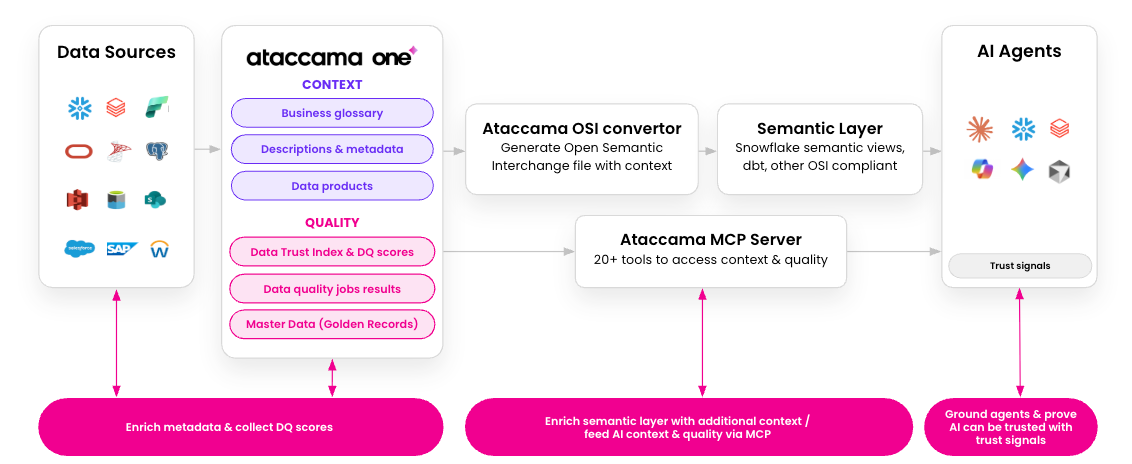
Connecting that foundation to an agent at runtime requires a controlled way to retrieve the information it needs. The Model Context Protocol, or MCP, provides one mechanism, allowing AI systems to call specific, scoped tools rather than giving them broad access to an underlying database.
Gartner research describes how organizations can deliver master data to the context layer by exposing core MDM capabilities as MCP tools and connecting them to AI applications and workflows (see “Step 1,” page 3, and “Step 3,” page 5). This addresses a question that will become more pressing as agents enter operational workflows: how does trusted data reach them with the necessary context and controls intact?
AI needs a mastered view of the business
Across most enterprises, the same customer, supplier, or product exists in several systems at once, represented according to the purpose each system serves. A supplier may have one identifier in procurement and another in finance, with attributes that vary between them. Each record may be legitimate within its source system, yet together they do not necessarily give an AI system a coherent view of the entity it needs to understand.
MDM resolves this problem by matching and reconciling records from across the enterprise into a governed master entity. AI can then work from an authoritative representation rather than deciding which records belong together or how to interpret conflicting information across operational systems.
This distinction matters as AI gains access to more enterprise data because greater access does not create consistency. Giving an agent several versions of the same supplier leaves questions of identity and authority unresolved. MDM settles those questions upstream and gives the agent a mastered representation to reason from.
Data quality starts with how the record is built
Data quality and mastering are closely connected. In some approaches, data quality receives limited attention within the mastering process, even though the accuracy and consistency of source data directly affect the records that matching, linking, and merging produce. Ataccama makes data quality an integral part of mastering, applying cleansing, enrichment, and validation as records are constructed. The relationship also works in the other direction: matching, linking, and merging can themselves be important data quality capabilities because they help identify and resolve duplicate or fragmented records.
Ataccama supports this process with dedicated validation and cleansing capabilities for data such as dates, names, addresses, phone numbers, and email addresses. These capabilities allow quality rules to directly influence how source data is resolved into an authoritative record, rather than treating quality as a separate step around the mastering process.
The resulting record therefore reflects both the quality of its source data and the controls used to construct it. Downstream systems, including AI applications, receive data that has been cleansed, validated, matched, and resolved to establish a more reliable representation of the entity.
Trust doesn’t stop at the golden record
An accurate golden record loses much of its value when separated from the context that explains why it should be trusted. Knowing a supplier’s address, for example, matters alongside knowing where that information came from, how its quality was established, and whether it fits the task at hand.
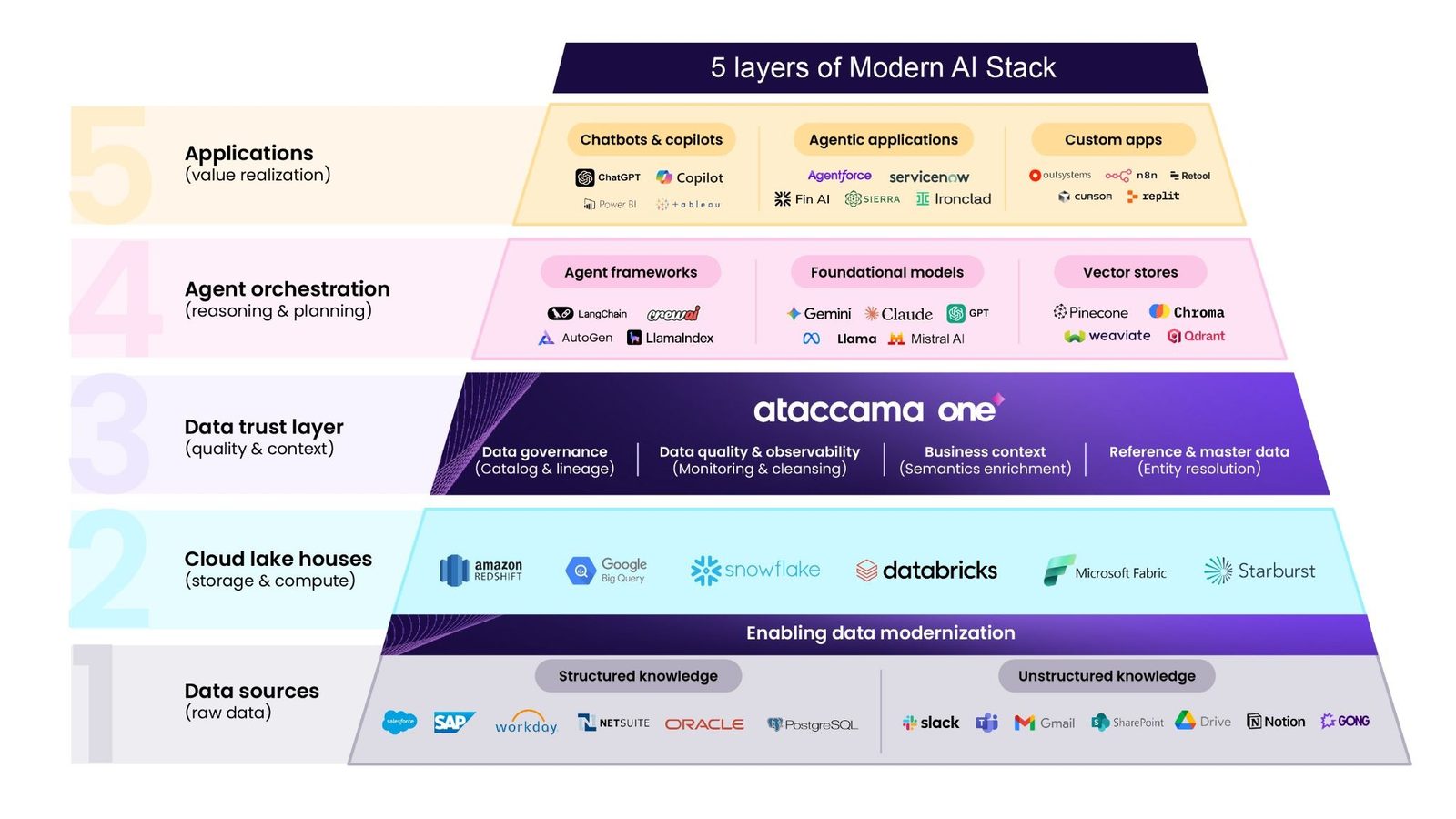
As master data moves into automated workflows, that surrounding context becomes part of its practical value. Ataccama ONE provides capabilities spanning master data, data quality, governance, metadata, lineage, and observability, helping organizations manage data and its context within a broader platform rather than across disconnected tools. For AI agents, access to governed data and relevant context can provide a clearer basis for understanding the information they receive and determining how it should be used.
AI shouldn’t be the one deciding what’s true
As AI becomes better at identifying patterns and inferring relationships, it is reasonable to ask whether it should take on more responsibility for resolving master data. The difficulty lies in the standards master data must meet. A predictive model can provide considerable value even when it does not reach the right conclusion every time. In contrast, organizations need to reproduce and explain decisions that shape authoritative records used for financial reporting, regulatory obligations, and automated business processes.
Entity resolution shows why that distinction matters. Matching has always had to accommodate differences in how the same customer or supplier appears across systems. In a governed mastering process, defined matching logic evaluates those similarities so that the same evidence produces a reproducible outcome.
More fundamentally, MDM connects the data held in enterprise systems to the real-world entities it represents. Records spread across CRM, finance, procurement, and other systems are ultimately fragments of information about actual customers, suppliers, products, and other entities the business interacts with. Mastering establishes which of those fragments belong together and creates a consistent representation of that entity. This gives AI something it cannot establish from data access alone: a governed understanding of who or what the data is actually about.
Allowing a model to infer independently that two records probably represent the same entity introduces judgment that becomes harder to explain and audit as the number of records and downstream dependencies grows. At enterprise scale, a questionable match can propagate into every process that treats the mastered data as authoritative.
Ataccama uses AI to reduce the work involved in managing and understanding trusted data while preserving the controls that establish authoritative records. For master data, Ataccama can expose MDM capabilities through MCP, allowing organizations to connect an AI agent of their choice to manage, improve, and understand mastered data. This gives teams a way to bring AI into master data workflows while keeping the reproducibility and control that authoritative data requires.
Trust has to hold beyond the master record
As AI becomes another consumer of enterprise data, MDM becomes more consequential rather than fundamentally different. Resolving fragmented source data into an authoritative, governed representation gives AI a reliable foundation for reasoning. The architectural challenge lies in delivering that mastered data with the quality, governance, and business context an agent needs to use it appropriately.
Ataccama’s MCP server makes that governed context available to AI systems through scoped tools they can call when they need trusted enterprise data. For MDM, this creates a bridge between mastered entities in Ataccama ONE and the AI applications that need to reason about them without requiring each application to reconstruct the surrounding context independently.
The context layer extends that foundation into agent workflows as they become more deeply embedded in operational systems. Gartner research describes how an MDM context delivery service can connect verified master data and its surrounding context to AI applications and workflows, and outlines measures for evaluating how effectively agents use that foundation (see “Step 3,” page 5, and “Success Measures,” pages 9–10).
Explore the Gartner framework for the context layer, MDM’s role within it, and the architecture organizations should consider as agentic AI moves into production.
Access the Gartner research
See how Gartner maps the context layer for AI agents, and where MDM fits into the architecture.
Gartner, How Master Data Management Boosts the Context Layer for AI Agents, Stephen Kennedy, 17 June 2026.
GARTNER is a trademark of Gartner, Inc. and/or its affiliates.
Ariel Pohoryles
Data and analytics expert driven by designing best-in-class data management solutions and achieving customer success. As the VP of Product Marketing, Ariel is passionate about customer engagement and finding new and innovative ways to deliver value with data to customers.