What is a context layer and why is everyone suddenly talking about it?
There’s a reliable tell that a concept has arrived in enterprise data: Gartner writes about it extensively in its reports, AWS ships a product with the name attached, and your catalog vendor rewrites its homepage around it. All of that is happening right now with two terms in particular — the context layer and the semantic layer.
If you’ve been in data long enough, your first instinct is probably a mild eye-roll. You’ve watched this movie before, with Data Fabric absorbing Data Mesh, DataOps earning a LinkedIn certification within days of anyone coining the term, and “data-driven culture” appearing in every deck until no one could say it with a straight face any longer. The pattern is numbingly consistent: a real problem gets a name, the name gets a hype cycle, and somewhere between the Gartner placement and the first summit organized around it, the actual insight gets buried under a mountain of vendor whitepapers and conference swag.
So here’s the honest version: Both the context layer and the semantic layer describe real challenges, but neither is a new idea. AI agents are simply making those problems visible enough to require a marketing term. A semantic layer tells an agent what your data means, while a context layer tells it how that meaning applies. Most importantly, neither is worth much of anything if the underlying data is wrong.
Sitting beneath both layers, doing most of the load-bearing work while getting a fraction of the attention, is the trust layer. It’s what validates, resolves, governs, and certifies data before any agent acts on it. In a world that’s quickly marching to an agent to agent (machine to machine) setup, it’s an ever-more-critical part of the modern stack.
What is a semantic layer?
Of the context layer, semantic layer, and trust layer, the semantic layer is the most established of the three. Its job is to answer one question consistently: What does this metric mean, and how is it calculated? “Revenue,” for example, can be defined as SUM(amount) WHERE status = 'completed' AND refunded = false. Or an “active user” can be defined as anyone with at least one core action in the trailing 28 days.
It sounds mundane, but the semantic layer solves a painful problem, especially in data analytics. Without it, every BI tool, dashboard, and analyst applies slightly different logic, and the same question returns three different numbers depending on who asks. A semantic layer standardizes definitions in one place so that humans and AI get consistent answers.
Its strength is also its limit. A semantic layer is built for stable business definitions, not dynamic operational reality. It tells you how “revenue” is calculated, not whether the number is current, where it came from, who owns it, or whether the pipeline feeding it broke last night. That’s the gap a context layer begins to fill, and underneath it, the gap a trust layer closes.
What is a context layer?
The context layer picks up where the semantic layer leaves off. What makes the context layer more than a semantic layer is the richness of what it holds. It captures not just what data means, but when, how, and under what rules that meaning applies. “Revenue” isn’t only a formula, but a definition that becomes authoritative at a specific point, carries a known exception for contract restructurings, and is owned by a team responsible for keeping it current. That temporal and operational dimension is what separates a context layer from a semantic layer.
The easiest way to see that dimension in action is to look at where it already lives: in people. Your best data analyst, the one who has been with the organization for years, is irreplaceable because of what they carry in their head. They know which “revenue” figure the CFO actually trusts, that the Q4 spike was a one-time contract restructuring rather than a trend, which system became the source of truth for customer records after last year’s migration, and the exception to how churn is calculated in the enterprise segment. They absorbed years of institutional context that never got written down anywhere useful.
That analyst is your context layer. But they’re one person, will likely leave the company at some point, and they can’t be in the context window of every AI agent running queries across your enterprise at once.
At its core, a context layer is a governed, persistent structure that maintains business meaning, relationships, policies, and institutional memory, kept current as a living asset rather than rebuilt from scratch on every query.
How is a context layer built?
If the context layer is the thing, context engineering is the work of building and maintaining it. It’s the emerging discipline of deciding what business meaning, relationships, rules, and history an AI system actually needs, then structuring and curating that information so an agent can retrieve exactly what’s relevant at the moment it acts. Much of the current semantic layer vs context layer conversation is really a conversation about this practice of capturing institutional knowledge once and making it reusable across every agent. Like any engineering discipline, it’s only as good as the material it works with, which is why the quality and trustworthiness of the underlying data matters just as much as the context wrapped around it.
The overlooked part of the hype: The trust layer
Everyone in the industry agrees context and semantics matter. Far fewer are asking a more important question: Is any of this actually correct?
An AI agent operating on stale data, broken lineage, unresolved entity records, or a dataset validated by quality rules that no one updated after last year’s migration is risky. It will answer confidently, fluently, and incorrectly. Rich context and clean semantics are not enough; they can’t make an agent reason accurately on inaccurate data, and they won’t flag the foundational data trust issues. With reduced humans in the loop, greater operational speed, and agent proliferation across decentralized systems, risks grow significantly.
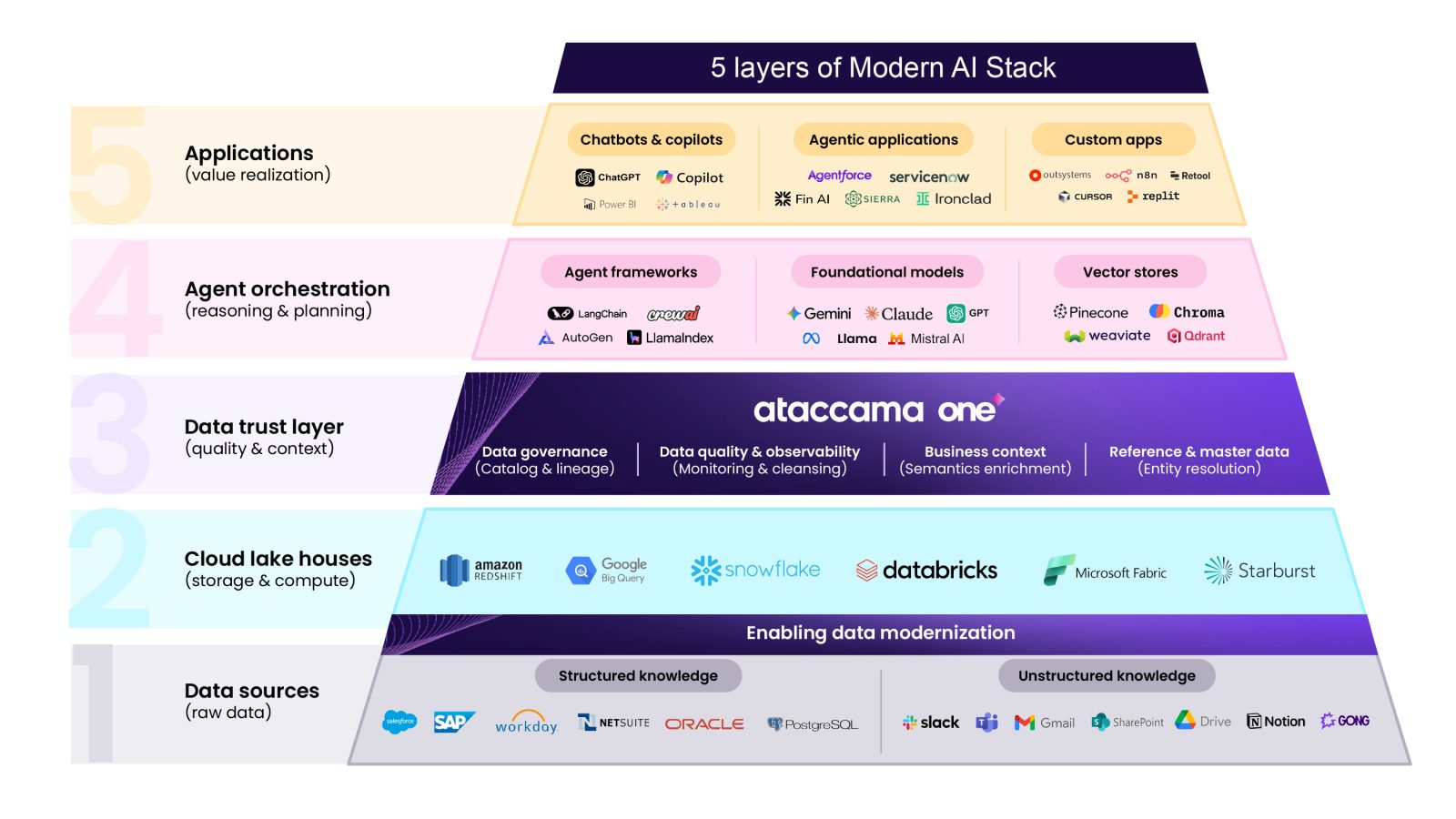
The layer that matters most is the one getting the least attention. A trust layer is the foundation beneath the other two. It sits between your data and the AI systems that act on it, validating, governing, resolving, and certifying data before any agent is permitted to execute against it. While a semantic layer says what data means and a context layer says how that meaning applies, a trust layer answers: Can this data actually be relied on right now?
What a trust layer requires
A trust layer is a set of integrated capabilities working together. Building it might sound like a heavy lift, but for the most part, it doesn’t require anything new. Capabilities that make up a trust layer are disciplines that serious data organizations, including Ataccama, have been delivering for years. And in an AI-first world, these capabilities are more important than ever.
- Data quality and observability is the load-bearing foundation. If the underlying data is wrong, nothing above it is trustworthy. That means profiling, validating, and fixing data across the entire estate — at rest and in motion, not just inside a single cloud platform — with continuous monitoring for anomalies, freshness, and schema drift before they reach downstream agents.
- Entity resolution and reference & master data turn conflicting records into a single authoritative version of a customer, product, or supplier, so an agent isn’t choosing between five definitions that are each “correct” in their own system.
- Data catalog, business glossary, and end-to-end lineage form the semantic and provenance backbone. Without lineage, context has no provenance. An agent can’t explain where its answer came from or whether anything upstream has changed. The catalog and business glossary captures both technical and business metadata used to enrich context for both humans and agents.
- Data products are how trusted context is managed. A data product isn’t just a dataset, however. It’s a reusable package of data and business context, ready to be consumed under a clear contract of ownership, quality, and trust.
Harnessing the above capabilities to deliver better AI at the speed of AI requires two additional capabilities:
- An MCP Server is the delivery mechanism. Any MCP-compatible agent, whether your own agents, Snowflake Cortex agents, or third-party AI tools, can query governed data without custom integration work. The Ataccama MCP Server exposes governed, context-rich data, complete with Data Trust Index signals, to any AI tool in the stack.
- Automated stewardship keeps the trust layer always up to date. Increasingly, AI agents handle the continuous work (profiling data, generating documentation, flagging anomalies, suggesting fixes) so the trust layer stays current without a proportional increase in headcount.
Context layer vs semantic layer vs trust layer
The three layers presented here aren’t competing options; they stack. A semantic layer feeds a context layer, and the context layer is only as reliable as the trust layer beneath it. You need all three, but it’s the trust layer that decides whether any of it is safe to hand to an autonomous agent.
| Semantic layer | Context layer | Trust layer | |
| Primary question | What does this metric mean? | How does that meaning apply — relationships, rules, and memory? | Is this data verified, current, and reliable enough to act on? |
| Persistence | Static definitions | Maintained as a live, governed structure | Continuously scored and re-validated |
| Tracks changes over time | Limited | Yes — temporal validity and lineage | Yes — real-time quality, observability, and lineage |
| Governance | Partial — metric definitions | Business meaning, relationships, policy | Full — business meaning, relationships, policies, quality, observability, entity resolution, ownership, and more |
| AI agent suitability | Structured analytics | Multi-step agentic workflows | Autonomous action |
| Key limitation | Requires stable definitions | Requires trusted underlying data | Only as strong as its coverage. Must span the whole data estate, not one platform |
The bottom line: What a trust layer unlocks
Strip away the vendor noise and the argument is simple. The context and semantic layers are having their moment, and both are real, but neither is worth anything if the data underneath is wrong. The trust layer is what makes the other two safe to build on, and it’s why the AI use cases everyone actually wants stop being risky bets.
- Production-ready AI: For most organizations, what stands between an impressive demo and a system running in production isn’t the model; it’s trust in the data underneath. AI programs stall because no one can stand behind the data an agent would act on. Clear that blocker and teams can finally put production-grade AI to work, realizing the business gains they’ve been promising and taking on use cases that were previously too risky to try.
- Autonomous action you can trust: With a clear and explicit trust score, AI agents have a basis to act on, hold back, or escalate, rather than proceeding on blind faith, all while showing exactly why the data behind any action was fit to use. Grounding an agent in verified, governed data also curbs the failure everyone fears most: an agent that hallucinates, or confidently acts on data that was wrong to begin with.
- Trusted data delivered wherever agents work. With trust signals that travel with the data through the MCP Server, any agent in the stack — your own, a Snowflake Cortex workflow, a third-party tool — can consume governed, context-rich data without a custom integration built for each one.
Ataccama has been building the pieces of that trust layer, including data quality, observability, governance, lineage, and reference and master data, for years, long before the industry had a name for it.
The right foundation for your AI initiatives
Download your copy of our e-book, The modern AI stack: A blueprint for trusted agentic AI, produced in partnership with Snowflake and Deloitte.
FAQ
A context layer is a governed, persistent structure that holds the business meaning, relationships, policies, and institutional memory an AI system needs to interpret data correctly. It is not just about what a metric means, but when, how, and under what rules that meaning applies. It’s the infrastructure that gives an agent the same situational knowledge a seasoned analyst carries in their head, kept current rather than reconstructed on every query.
A semantic layer standardizes what your data means: the definitions and calculations behind metrics like “revenue” or “active user.” A context layer goes further, capturing when, how, and under what rules those meanings apply, including temporal validity, relationships, exceptions, and ownership. Put simply, the semantic layer defines the metric; the context layer governs how it behaves in the real world.
Yes, if they want AI agents to act reliably. Without a context layer, every agent has to reconstruct business meaning on the fly, which leads to inconsistent and often wrong answers. But a context layer alone isn’t enough — it’s only as trustworthy as the data beneath it, which is why a trust layer sits underneath it, validating and certifying that data before an agent acts.
It’s less a greenfield platform than a consolidation exercise: most of the meaning you need already exists, scattered across catalogs, glossaries, runbooks, and analysts’ heads. The work is to inventory where it lives and structure it — relationships, rules, exceptions, sources of truth, ownership — on top of your semantic layer into one governed layer kept current as a living asset. That curation is context engineering, and since a context layer is only as reliable as the data beneath it, it’s built on top of a trust layer, not in place of one.
Trusted context is business context that has been validated, governed, and certified as reliable enough to act on. It combines the meaning a semantic layer provides and the rules a context layer adds with the verification a trust layer supplies, so an agent isn’t just working with rich context but with context grounded in AI-ready data.
Context debt is the accumulated gap between what your data actually means and what’s written down anywhere an AI system can use. It builds up every time a definition changes, a system becomes the new source of truth, or an exception gets absorbed into someone’s head instead of a governed structure. Like technical debt, it stays invisible until an agent acts on stale or missing context and gets it confidently wrong.
Anja Duricic
Anja is our Product Marketing Manager for ONE AI at Ataccama, with over 5 years in data, including her time at GoodData. She holds an MA from the University of Amsterdam and is passionate about the human experience, learning from real-life companies, and helping them with real-life needs.