Closing the lineage gap: how Ataccama and Rocket Software deliver true end-to-end lineage
Data lineage has become one of the most critical capabilities in modern data management. It shows where data came from, how it was transformed along the way, and where it ultimately lands. That makes it essential for impact analysis and, more recently, for accurate AI agent reasoning. But lineage carries a hidden condition that’s easy to overlook until it bites: it’s only useful when it’s complete.
Most enterprises don’t run on a single, tidy stack. A typical estate spans cloud data warehouses, on-premises databases, streaming platforms, ETL tools, reporting layers, and, in many organizations, decades of mainframe and legacy systems that still power critical business processes. For many enterprises, the lineage challenge begins in these source systems, where customer transactions, financial records, claims, payments, and other operational data originate. Lineage has to stretch across all of it. The moment one of these environments falls outside lineage coverage, the graph fragments, and an incomplete graph can’t reliably answer the questions employees, regulators, and AI systems rely on it to answer. That is the gap the Ataccama and Rocket Software integration is built to close.
Lineage breaks when source systems aren’t covered
Ataccama ONE ships with built-in scanners for the platforms most enterprises use every day — Snowflake, Oracle, dbt, Power BI, and many other common technologies. For a large share of modern data environments, that native coverage delivers very strong lineage visibility. The challenge is that most enterprises don’t run on modern platforms alone: critical customer, transaction, financial, and operational data often originates in mainframe and legacy environments, and complete lineage requires visibility across that entire journey.
That reliance runs deep. These environments typically support the core business processes enterprises depend on most, so when lineage doesn’t extend through them, visibility breaks down right at the source. What looks like end-to-end lineage is often a partial view, with gaps between operational systems and the downstream analytics, governance, and AI platforms that rely on them. For teams using that lineage to validate a regulatory report or trace a data quality issue back to its origin, those gaps introduce risk exactly where certainty matters most.
These gaps translate into real cost, and they land in exactly the places lineage was meant to protect. A figure that can’t be traced back to its origin can’t be confidently defended to a regulator, which turns a coverage gap into compliance risk with the potential for costly penalties. A pipeline that skips over a disconnected node keeps pushing bad data downstream, and the data team burns hours tracking down where things went wrong. Every time someone hits a blind spot, trust erodes, adoption quietly stalls, and people fall back on the manual tracing the platform was supposed to replace.
That’s why completeness isn’t a refinement you add later. It’s the whole game. Complete, accurate, end-to-end lineage is the difference between a lineage project people trust and one they quietly work around.
Rocket Software as a native lineage source
To close that gap — and make sure lineage is genuinely traced end to end, with every system in the enterprise estate covered — Ataccama partners with Rocket Software to extend the reach of its lineage scanners into the mainframe and distributed systems where much of that critical customer, transaction, financial, risk, and operational data originates. But the value goes beyond making mainframe and legacy systems visible in the lineage graph. The real gain is connecting those systems to downstream cloud, analytics, and AI platforms, and understanding how data moves across the entire ecosystem.
Within Ataccama ONE, Rocket’s scanners function as fully supported lineage sources. That’s the important part: with native integration, lineage metadata from Rocket is indistinguishable from lineage produced by Ataccama’s own scanners. Both appear in the same graph and the same interface, governed by the same platform, and benefit from the same enrichments — data quality overlays, transformation context with AI-generated explanations, metric calculation breakdowns, and more. The people consuming it don’t need to know where it came from. They just see a complete picture.
How it works
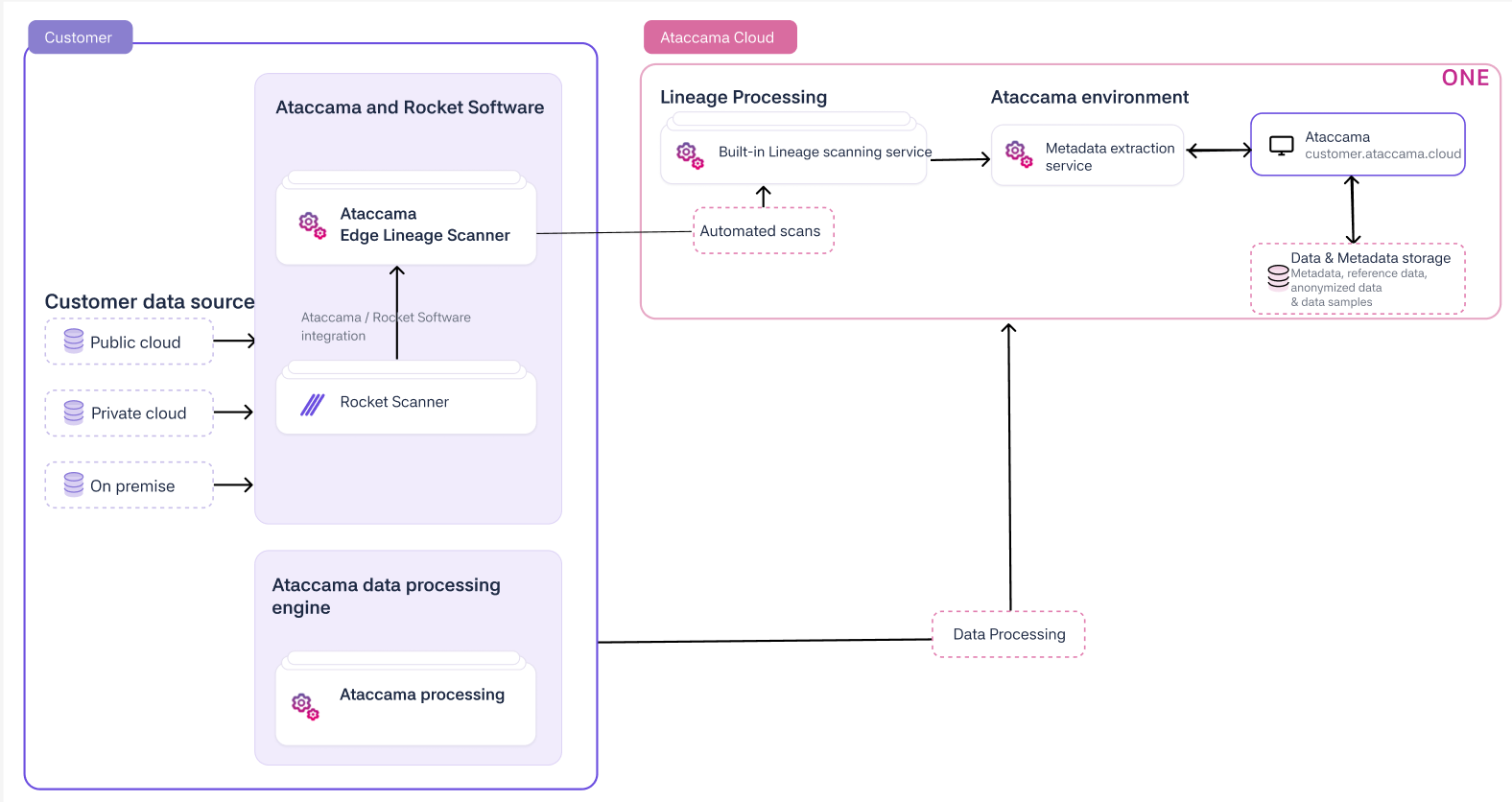
Behind that unified experience, the integration architecture is deliberately loosely coupled. There’s no direct runtime connection between Rocket’s scanners and Ataccama ONE, which better suits the restricted, security-conscious environments where these systems typically live.
From the user’s perspective, Rocket is configured like any other lineage source, with its own scan plan. When a scan runs, Ataccama’s Edge Lineage Scanner — running inside the customer’s own environment — triggers the Rocket scan, collects the results as a standard Ataccama lineage package, and propagates that metadata to Ataccama exactly as it would for any built-in scanner. The exchange happens through a well-defined, file-based contract, which keeps the boundary clean and the deployment predictable.
The result is one lineage graph with a materially wider reach.
The coverage this unlocks
The practical value of the integration is the breadth of data sources it brings into the lineage scope. Two broad categories are worth highlighting.
Lineage for distributed and non-mainframe technologies, including but not limited to:
- Informatica and IBM DataStage
- Teradata (and Teradata SQL scripts)
- Kafka and the Java Kafka API
- MongoDB, MySQL, and PostgreSQL / Greenplum / Redshift
- MicroStrategy and MS SSRS
- Python, DB2 (non-mainframe), and SAS
Lineage for mainframe and legacy systems, including but not limited to:
- COBOL for z/OS, CICS, JCL, Db2 for Z, and Assembler for z/OS
- IMS (DB and DC), ADABAS, NATURAL, and CA-IDMS/DB
- IBM MQSeries and scheduling tools such as Control-M and CA-Autosys
- The AS/400 family: RPG, COBOL, DB2 schema and stored procedures, and the library file system
This coverage extends lineage across the technologies where critical operational data originates and the modern platforms where it is analyzed, governed, and consumed. The result is a continuous lineage graph that spans mainframe, distributed, and cloud environments.
Why this integration matters
The benefits come down to three things.
Complete end-to-end lineage. Extending coverage across legacy, distributed, and mainframe technologies closes the gaps that fragment the graph and enables teams to connect and trace data continuously from all source systems through downstream warehouses, analytics platforms, reports, and AI applications.
A single place to consume lineage. The people who use lineage day to day — analysts, stewards, data and application engineers — get one connected picture inside Ataccama ONE without needing to reconcile tools or work out which technology produced which segment.
Faster time to value. Instead of building custom solutions to reach data siloes, customers can draw on Rocket’s proven scanning capabilities inside Ataccama today and put complete lineage to work immediately.
What complete lineage lets you do
With the full picture in place, the integration directly strengthens the use cases teams care about most:
Data quality and root-cause analysis. Trace data back to its source, proactively spot broken pipelines, and remediate quality issues before they spread. The payoff is a more efficient data team that spends less time hunting for where things went wrong and more time delivering trusted data to the business.
Trusted reporting and AI. Understand data origins and transformations, and validate calculations end-to-end. When the lineage is complete, the reports — and increasingly the AI — built on top of it are ones the business can actually trust for decisions.
Data governance and compliance. Validate reports before regulatory submission, streamline audits, and demonstrate responsible handling of sensitive data across the full data journey. The result is lower compliance risk and fewer costly surprises.
Pipeline impact analysis. See how a proposed change ripples across systems and downstream consumers before it breaks something, making change management safer and less disruptive.
Data modernization. Plan and execute migrations with clear visibility into legacy data flows, transformations, and dependencies. This is where Rocket’s mainframe and legacy coverage is especially compelling. Modernization becomes far less risky when organizations can trace dependencies across mainframe, distributed, and cloud environments and understand how data flows between them before making changes.
Ataccama as the central lineage and governance hub
Most lineage problems in complex enterprises aren’t a failure of the platform — they’re a coverage gap in a hard-to-reach corner of the estate. The Ataccama and Rocket Software integration is designed to close exactly those gaps, so that Ataccama ONE can serve as the single, central hub for lineage and governance no matter how heterogeneous the underlying landscape is.
To see how Ataccama lineage delivers it end-to-end, explore Ataccama’s lineage capabilities.
Anja Duricic
Anja is our Product Marketing Manager for ONE AI at Ataccama, with over 5 years in data, including her time at GoodData. She holds an MA from the University of Amsterdam and is passionate about the human experience, learning from real-life companies, and helping them with real-life needs.