Your cloud data migration is also your AI readiness program

By building semantic context and data trust into the migration, you go live with data that is ready for AI agents from day one.
TL;DR
- A cloud migration is usually judged on arrival: data moved, reports reconcile, legacy systems switched off. Organizations like banks planning to run Cortex AI on the Snowflake AI Data Cloud need it judged on two more things.
- Semantic context from Snowflake gives every team and agent the same definition of each metric. Data trust from Ataccama confirms that the value behind that definition is correct at the time of decision.
- The migration is the one program that touches every critical data element, with budget and executive attention already committed. That makes the sign-off the natural place to require both.
- This is the joint case for building semantic context and data trust into the move, with an AI-ready sign-off a steering committee can use.
The client who arrived three times
The steering committee closes the migration on schedule. Every table reconciled, every scheduled report matched its legacy twin, and the last batch job on the old platform was switched off on a Friday. By every project measure, the program succeeded.
Three months later, the bank pilots its first Cortex Agent for relationship managers. One of them asks for a commercial client’s total exposure across lending, treasury and cards. The agent answers in seconds, with confidence.
The risk team can’t stand behind the figure. The client exists as three records: one from the core banking system, one from a treasury platform inherited in an acquisition, and one from cards. Each carries a slightly different legal name, and the agent’s total covered only one of them. The client’s real exposure was higher than the answer.
Nobody made a mistake during the migration. The three records existed before the move, and the program carried them over exactly as specified. It answered the question it was given, which was whether the data arrived. The migration did its job. What it wasn’t scoped to check was whether the data was ready for an agent to act on.
Migrated and AI-ready are two different finish lines
Data is migrated when it lands and reconciles. It is AI-ready when an agent can use it without a person checking the answer first. For most organizations like the bank in this example, that second finish line has two parts.
The first is meaning. Does “total exposure” or “active client” resolve to the same definition for every team, report and agent? The second is trust. Is the value behind that definition complete, current and free of duplicates at the moment an agent reads it?
Snowflake answers the first with semantic context built into the Snowflake AI Data Cloud, typically in form of semantic views. Ataccama answers the second with data trust that runs natively in Snowflake. Each question needs its own answer, and a migration that delivers both gives the bank data an agent can act on and compliance can trace.
Why the migration is the moment to build both
Few programs give organizations a better opening to build meaning and trust into their data than the migration itself. Three reasons make it the right moment.
Every critical data element is already in scope. The program has to map, move and reconcile each critical data element (CDE) anyway. Defining it once and setting its quality standard adds a step to work already on the plan, instead of launching a new initiative later.
The sponsor, budget and team are already in place. A migration has an executive sponsor, a steering committee and a funded delivery team. After go-live, the same work competes for a new budget line against every other priority.
The AI roadmap starts where the migration ends. Cortex AI use cases are often planned to begin once data lands in Snowflake. Whatever the migration delivers is what those agents inherit on their first day.
Adding meaning and trust to the sign-off makes the migration the first phase of the AI program.
The business stakes: AI ambition is outrunning readiness
Only 17% of organizations have deployed AI agents so far, and more than 60% expect to within two years, according to Gartner’s 2026 Hype Cycle for Agentic AI. Gartner places agentic AI at the Peak of Inflated Expectations, with agentic AI governance and security still maturing: adoption intent is running ahead of readiness.
The business stakes are rising. Agents automate decisions at machine speed, before anyone can intervene. Budget goes to AI projects that never reach production, while AI regulation and security expectations grow at enterprise scale. Building a data trust layer into the migration protects the data modernization investment and makes the data AI-ready sooner. That takes two layers built into the move: semantic context from Snowflake, and a trust layer from Ataccama.
Semantic context: What Snowflake builds into the move
Semantic Views, the native semantic layer built into the Snowflake AI Data Cloud, give each business metric one governed definition inside the platform. “Total exposure” is defined once, with its calculation, its synonyms and a plain-language description, and every team, report and Cortex Agent that asks for it uses the same logic. The migration is the natural point to create them, because each metric’s logic is already being rebuilt for its new home. Semantic View Autopilot generates and maintains Semantic Views from query history and usage signals, so definitions keep pace as teams start working on the new platform.
The code moves on the same path. SnowConvert AI translates legacy SQL and stored procedures for the Snowflake AI Data Cloud, so the logic behind each metric arrives in Snowflake ready to be modeled as a Semantic View instead of being reverse-engineered after go-live.
Horizon Catalog governs who can see what. Sensitive data classification identifies client attributes such as tax IDs and account numbers, and tag-based masking and row access policies protect them. Built into the migration rather than deferred to a later phase, those policies are in force from the first query. Horizon lineage and access history record where each dataset came from and who, or which agent, used it.
Cortex Agents work inside the same boundaries. When a relationship manager asks a question in Snowflake Intelligence, the agent answers from governed Semantic Views through Cortex Analyst, and from documents such as credit policies through Cortex Search, using that user’s role and access policies. Cortex AI Guardrails and AI Agent Identity keep agents inside the boundaries the bank sets and make each agent’s actions attributable. Through the Snowflake-managed MCP Server, the same governed definitions also reach AI assistants and agents the bank runs outside Snowflake.
Semantic Views are also the reference implementation of Apache Ossie (incubating), the open semantic standard Snowflake helped found. Definitions built during the migration stay portable to the BI and AI tools across the bank’s estate as it grows.
What semantic context does not do is check the values underneath. A Semantic View can define total exposure perfectly and still sum one of the client’s three records. That is the job of the trust layer.
Joint reference architecture
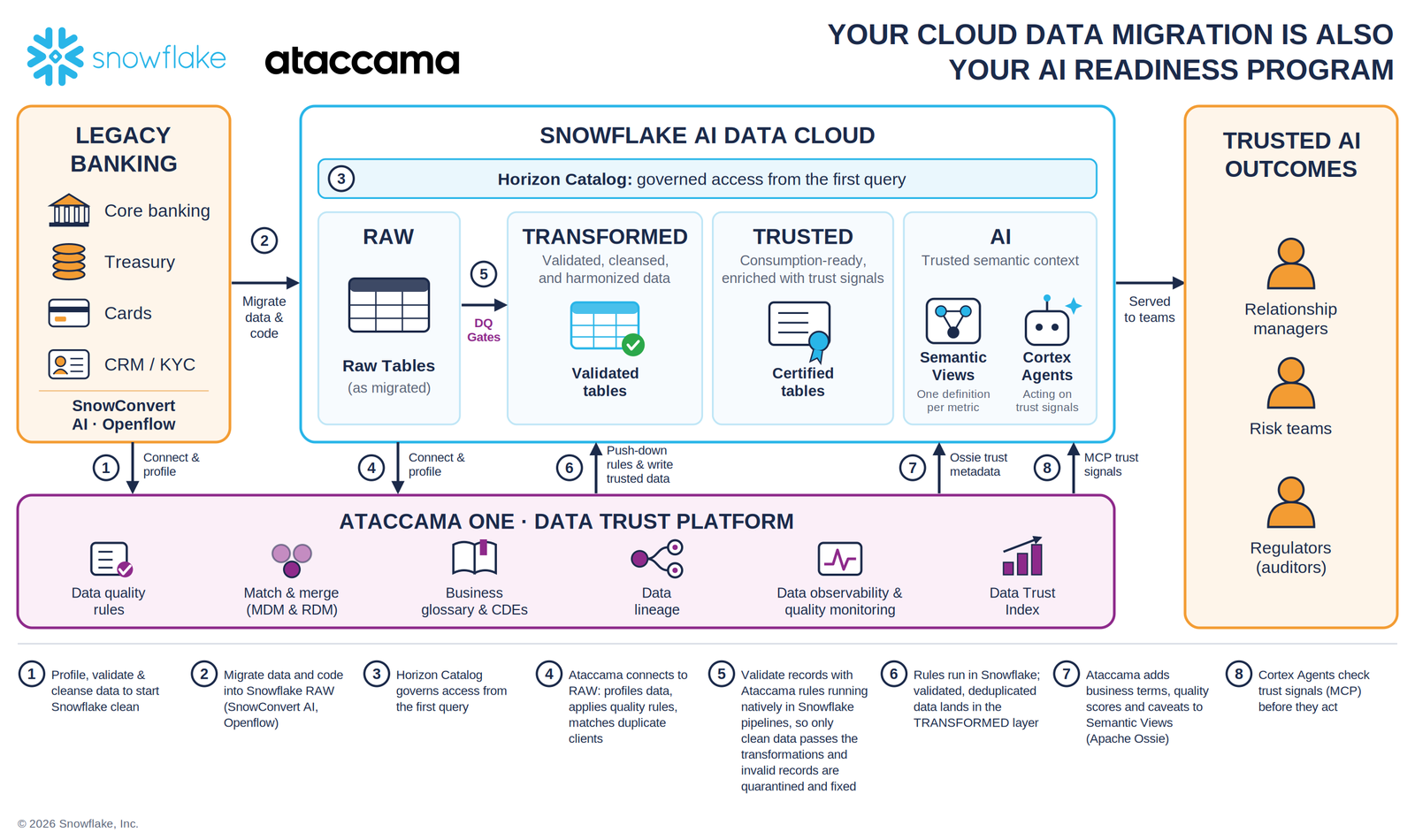
Trust layer: what Ataccama builds into the move
When you migrate data, semantic context is only half of the story. Ataccama provides the other half: a trust layer that makes sure the data and metrics beneath those definitions can actually be trusted. With both halves in place, AI-powered analytics can give answers that are unified, consistent and trusted. So what does the trust layer add? Before an agent acts on migrated data, the trust layer makes sure it meets five conditions:
- Scored against business needs. It is scored on the quality dimensions the decision needs, such as accuracy, completeness, validity, timeliness and uniqueness, rather than simply passed or failed. That precision means agents make decisions only on data that is complete, timely and accurate enough to meet business requirements. The rules behind each score are created once, governed, versioned and applied wherever the data resides.
- Real-time trust signals. It gives agents quantifiable trust signals they can act on and proactive monitoring flags any score that drops below its threshold before an agent uses the data. Pipeline observability covers the rest: it watches for data drift, freshness and volume changes, and checks that every pipeline ran successfully.
- Governed business context. Every critical data element maps to a business term with a named owner, a business definition and the governance policies that apply to it, so agents get the business context along with the data.
- One golden record. Each core entity, such as a customer or employee, resolves to one golden record, with duplicates across source systems matched and merged.
- Cross-platform lineage links each value back to its source system, with its quality results and business context attached, so a discrepancy can be explained, not just found. That trail is also what makes agent decisions auditable: when a regulator or auditor challenges one, the bank can show which data the agent relied on, where it came from and whether it passed its quality checks at the time.
Ataccama builds those conditions in before, during and after the move, then certifies the result for AI.
Before the move. Ataccama profiles source systems in place, whether on premises or in the cloud, and cleanses data before it lands in Snowflake. Known issues are fixed at the source instead of being migrated, which protects the data modernization investment: the program does not stall on low-quality migrated data, and neither do the AI projects built on it.
During and after the move. Governed match and merge resolves duplicate clients into one master record, so the three versions of a client in the opening scenario become one. Quality rules are managed centrally in Ataccama ONE and applied across the data estate, including in Snowflake, where they run as Snowflake Data Metric Functions, and DQ Gates enforce them inside pipelines. Only clean data reaches consumption-ready tables. Invalid records are isolated before they get there, then remediated and re-ingested.
Agents only amplify why quality has to be proactive: problems must be caught and resolved before agent uses the data. Ataccama keeps monitoring data quality and pipeline health across the estate. When a check fails, the issue goes to the business steward who owns the data, with the failing records, the rule that broke, the affected assets and their lineage attached. Unfit records stay held back while the fix is applied, and each step is logged for audit.
Ready for AI. AI agents need data they can trust and explain. At the consumption layer, the Data Trust Index certifies datasets as ready for production use, and they are published as certified data products. Ataccama gets trust signals to agents in two ways. First, it feeds them into Snowflake Semantic Views through an open-source converter for Apache Ossie (incubating), the open standard for sharing semantic metadata.Each view gains curated business terms, quality scores as of the latest sync and plain-language caveats in its custom instructions for datasets flagged with quality issues.. Any AI tool reading the model then knows which numbers to treat with caution, and a low data trust index can trigger human review. Second, Ataccama delivers real-time trust signals directly to Cortex Agents via MCP, so an agent can check that a number is certified before it acts on it, instead of acting on unverified data.
Why banks feel this first
Banks are modernizing their data platforms and rolling out AI in the same window. When KPMG surveyed 200 banking executives for its 2026 Banking Technology Survey, data quality and data readiness came up among the three biggest obstacles to deploying AI across the enterprise.
In banking, the client record is the data element everything else depends on. Exposure, KYC, AML monitoring and regulatory reporting all assume the bank knows which records belong to the same client. Mergers leave that assumption at its weakest.
Truist, a major U.S. bank, faced exactly that after the BB&T and SunTrust merger: two sets of systems, two definitions of CDEs, and quality logic spread across several legacy tools. With FDIC reporting and AI initiatives both accelerating, Truist made Ataccama the data trust layer on Snowflake, validating CDEs continuously and routing remediation to business stewards instead of central IT. The program now covers 55+ profiled data sources, 11,000+ governed CDEs across 8 business units and 15,000+ quality rules, with a 97% quality pass rate and 6+ Cortex AI use cases built on the result. FDIC reporting moved from reactive fire drills to a managed, audit-ready operation.
Four ways AI readiness slips after go-live
Each of these starts as a scoping decision during the migration and surfaces later as a business problem.
- No quality baseline before the move. Without a profile of the source data, issues surface only after the data has landed in Snowflake. Teams then have to clean it up and work out which problems were migrated and which were created, and AI readiness waits until they finish.
- Duplicate clients carried over. If client records are not resolved into one master record, exposure, KYC and onboarding answers depend on which record an agent happens to read.
- Governance deferred to phase two. Adding classification, access policies and lineage after go-live means changing and retesting pipelines that reports and agents already depend on. In Snowflake, tags and policies can be applied domain by domain as each one lands, so governance moves with the migration waves instead of waiting for the last one.
- Monitoring that ends at cutover. Reconciliation proves the data was right on the day it moved. New feeds, schema changes and upstream fixes start the next day, and without continuous checks, trust erodes without anyone noticing.
The AI-ready sign-off: three checks for the steering committee
A standard go-live sign-off confirms that data arrived and reconciles. An AI-ready sign-off adds three checks, so the steering committee approves data the AI program can use from day one.
| Check | What it confirms | Evidence at sign-off |
|---|---|---|
| Semantic context | Each metric the first use cases rely on has one governed definition, sensitive data is classified, access policies apply from the first query | Semantic Views in place, Horizon Catalog classification and policies |
| Data trust | Governed CDEs meet agreed completeness, accuracy, validity, timeliness and uniqueness thresholds, each client resolves to one master record, continuous monitoring is running from day one, and lineage is documented for every dataset AI will consume | Quality scores per CDE, match and merge results, monitoring and alerting live with named owners, cross-platform lineage |
| AI consumption | Each dataset the first use cases read carries a published trust signal that agents can check before they act | Data Trust Index and other trust signals reaching Cortex Agents via MCP or Apache Ossie |
Five questions for the sign-off meeting
- Which CDEs will our first Cortex AI use cases read, and have they met their quality thresholds?
- Does every client exist once in Snowflake, and who decides when two records conflict?
- Does each metric those use cases rely on have one definition in Semantic Views that finance, risk and the business agree on?
- If an examiner asks what data an agent acted on, can we trace it to its source and show its quality at the time of decision?
- Who is alerted when quality drops after go-live, and how quickly does the issue reach the accountable person?
- When an agent answers, does it see only what the person asking is entitled to see?
Snowflake and Ataccama: A go-live your AI program can build on
Snowflake brings the meaning, the governance and the AI platform. SnowConvert AI moves the logic, Semantic Views, the native semantic layer built into the Snowflake AI Data Cloud, define each business metric once, Semantic View Autopilot keeps those definitions current, and Horizon Catalog governs access and traces usage from the first query. Cortex Agents and Snowflake Intelligence put that governed data in front of relationship managers and risk teams.Ataccama brings the trust: data quality monitoring, pipeline observability and a Data Trust Index and other trust signals for every dataset that AI consumes.
For banks, that means the steering committee signs off on data that relationship managers, risk teams and Cortex Agents can use from day one, and that compliance can trace at the time of decision.
The two work together natively. Ataccama rules run as Snowflake Data Metric Functions, and trust signals reach Cortex Agents via MCP. For banks with data on more than one platform, Apache Ossie (incubating) carries the same definitions across the estate, with Semantic Views as its reference implementation.
Talk to a Snowflake + Ataccama expert
Go live with data that’s ready for AI agents from day one.