Modernizing Your Data Estate for Agentic AI Execution
Cloud modernization solves for scale. It doesn’t solve for trust, and trust is what agentic AI actually runs on.
Most enterprises have spent the last several years modernizing their data estates, moving workloads into platforms built for scale and speed. That investment was never designed to answer the question enterprises are asking now: is this data trustworthy enough for an autonomous agent to act on without a person checking its work?
What you’ll learn in this webinar
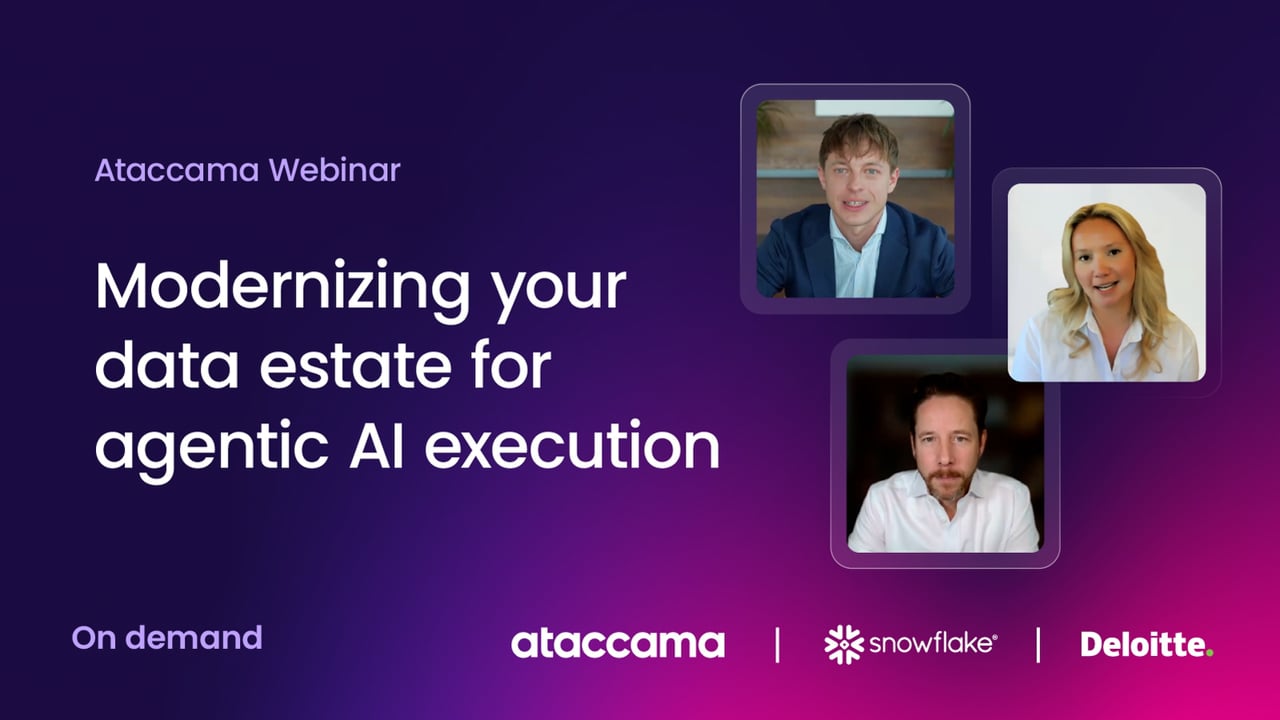
This session brings together Ataccama, Snowflake, and Deloitte to walk through the Modern AI Stack blueprint, including the parts this article intentionally leaves open.
- The complete five-layer architecture diagram, and where the Data Trust Layer sits relative to orchestration and centralization
- How the insurance duplicate-claim scenario actually gets caught before it compounds across thousands of records
- The specific materiality thresholds Deloitte recommends for routing automated decisions to human review, by risk level
- What point-in-time lineage and a defensible evidence chain look like in practice, mapped to a real claims workflow
- How to calculate and apply a Data Trust Index inside an existing data platform
- The organizational and platform changes that need to happen together, not sequentially, to sustain continuous certification
That question didn’t matter as much when AI meant generating a dashboard or drafting a summary. It matters enormously now that agents are approving refunds, routing compliance decisions, and updating customer records directly inside operational systems, at machine speed, without a human reviewing every step. The pilot phase of enterprise AI is over. Production is the new baseline, and production exposes a gap that pilots never had to face: most data estates were modernized for storage and access, not for continuous, verifiable trust.
The modernization bottleneck nobody priced in
When organizations lift and shift legacy workloads into a modern cloud platform, they typically move the data as it is. Duplicates, stale values, inconsistent definitions, and orphaned records move right along with everything else. In an analytics-only world, a human analyst caught most of this before it reached a report. That safety net doesn’t exist the same way once agents are executing decisions on their own.
The result is a quiet tax on the modernization investment itself. Bad data moving into a modern platform doesn’t become good data because the platform is faster or better governed at the infrastructure level. It becomes bad data that moves and compounds faster, eroding the return on the modernization project and stalling the AI initiatives built on top of it. The gap isn’t in the model. It’s the missing layer of the architecture responsible for resolving data quality debt before an agent ever touches it.
Why does AI fail with trusted-looking but incorrect data?
Generative AI and agentic AI carry different risk profiles, and the difference matters more than most current AI conversations acknowledge. A generative system produces an output a person reviews. An agentic system takes an action, often several actions in sequence, and often without a person reviewing each one.
Agents are genuinely good at catching data that’s obviously wrong: malformed values, dates in the future, fields in the wrong format. What they consistently struggle with is data that’s wrong but looks right. A stale address. A duplicate customer record sitting quietly beside its twin. A contract status that was accurate last quarter but isn’t accurate today, with the agent still operating on the outdated version because that’s what’s sitting in its context window.
This is a genuinely different failure mode than a hallucinated fact. It doesn’t announce itself. Because agentic systems are probabilistic, an agent won’t necessarily make the same decision twice given the same inputs, which means a log of what a model did in the past is not a reliable guarantee of what it will do next.
As Jessie Smith, VP of Product Management at Ataccama, puts it: “No amount of model judgment is going to help if the evidence isn’t in the context window for how the agent is operating.”
Insurance is one of the sharpest examples of how this plays out. Deloitte’s Jiri Zarsky, Director on the firm’s AI and data team, described a live client scenario during our panel: two companies merge, customer records get duplicated in the process, and agents processing claims independently, without visibility into each other’s context, can act on the same underlying case twice.
“I imagine it happening over thousands of records, at machine speed,” he said. “This can cause real damage.” What actually breaks the process, and what it takes to catch it before it compounds, is one of the scenarios we walk through in full on the panel.
Why isn’t a data catalog enough for AI readiness?
A common assumption inside data organizations is that centralizing and cataloging data is functionally the same thing as making it AI-ready. A catalog is genuinely useful. It tells stakeholders, human or agentic, what a dataset is supposed to be: its schema, its lineage, its owner, its intended use. What a catalog does not tell you is whether that dataset is currently true.
A perfectly cataloged table can still be full of duplicate entities, expired values, or records that drifted out of sync with the systems that feed them. That distinction, between describing data and verifying data, is where a lot of AI-readiness plans quietly stall. Closing that gap requires a governance layer that does proactive data quality and profiling continuously, not a governance team doing periodic cleanup after the fact.
Matt Harris, Principal AI Strategy Architect at Snowflake, frames the underlying shift this way: agents today are “like brilliant interns: super intelligent, know a ton of stuff, highly motivated, but lacking in experience and judgment, which equals a lack of trust.”
A catalog can tell an intern, or an agent, what a dataset is. It can’t give either of them the judgment to know whether to trust it today.
What is a Data Trust Layer?
A Data Trust Layer is the piece of enterprise architecture that sits between a modernized data platform and the agents acting on top of it, and that certifies data as currently accurate before it reaches the point of execution, rather than after the fact. It’s the layer that turns “this data was validated once” into “this data is validated right now.”
In practice, this changes how the traditional medallion architecture gets used. The gold layer in a classic medallion setup was built for human consumption: a curated, business-ready layer a BI team could report from. In an agentic architecture, that same function increasingly gets absorbed by a semantic and trust layer sitting directly on top of foundational data products, skipping the transformation layers that existed mainly to make data legible to people. What matters at that layer is real-time metadata and current data profiles, because the agent consuming the data needs to know not just what the data is, but whether it’s still accurate right now.
As Matt Harris put it on the panel, describing this as intentionally provocative: “There’s no such thing as a harmless upstream edit.”
A useful way to think about certification at this layer is through five experiences a data product needs to support before it’s considered trustworthy: it needs to be discoverable, accessible, analyzable, shareable, and decisionable, meaning an agent or a person can act on it directly. The first four are largely platform functions. The fifth is where governance, quality, and business context come together, and it’s the piece that has to scale as fast as the rest of the estate does.
What does a defensible evidence chain require?
When an agent makes a decision inside a regulated process, the accountability for that decision sits with the organization, not with the model or the vendor supplying it. That means enterprises moving agentic workflows into production need to be able to reconstruct, months later, exactly why a given decision was made.
That requires more than a reasoning trace showing how an agent talked through its decision. It requires linking that reasoning to the specific evidence the agent had at the moment it acted: the exact version of the record, the exact policy in force, the exact data snapshot, tied together the way data lineage ties a report back to its sources. The EU AI Act has already turned this from a best practice into a legal obligation for high-risk use cases, and organizations elsewhere are treating it the same way regardless of jurisdiction.
A practical companion to this evidence chain is a machine-readable trust signal known as a Data Trust Index, which lets an organization set materiality thresholds for automated decisions and route lower-confidence cases to a person before they execute. Where those thresholds should sit, and how they change by industry and risk level, is one of the more tactical questions the panel gets into directly.
What is the Modern AI Stack, and what does continuous certification mean?
The Modern AI Stack is a five-layer architecture blueprint co-authored by Ataccama, Snowflake, and Deloitte, built around the idea that most enterprise AI strategies focus heavily on data cloud centralization and agent orchestration while skipping the layer in between: the Data Trust Layer responsible for certifying data before agents act on it.
Continuous certification is the operating model that layer runs on. Data doesn’t stay trustworthy because it was accurate once. Pipelines change, upstream teams edit and drop tables, and definitions drift, often without anyone downstream noticing until an agent has already acted on outdated information. The organizations furthest along in production AI have stopped treating data quality as a project with an end date and started treating it as a loop: detect issues, triage them, remediate them, and recertify the data on an ongoing basis.
That loop also has to extend to the agents themselves, not just the data feeding them. Monitoring whether an agent’s behavior is drifting, whether it’s approving a different proportion of cases than it was a week earlier, is its own discipline, distinct from monitoring the data. Organizations that skip this tend to find out something changed only when the business impact is already visible, which is generally too late to be the first signal.
Watch the full session
The architectural shift toward agentic AI is not optional for enterprises already committed to production-scale automation, and the data strategy underneath it can’t be an afterthought. Watch the full panel discussion with Ataccama, Snowflake, and Deloitte to see the complete Modern AI Stack framework, including the evidence chain, thresholds, and monitoring approach that don’t fit in this article.
Watch the full webinar on demand.
Speakers