Managing Critical Data Elements (CDEs) at scale – the playbook
Not all data deserves the same level of care. Here’s how to concentrate governance on the data that matters most and keep it trustworthy over time.
Key takeaways
- Roughly 20% of your data drives 80% of your business outcomes. Governance programs that treat all data equally stall; the ones that hold up start by prioritizing business use cases.
- Critical data elements (CDEs) are the output of that prioritization — the data identified as mission-critical because of the decisions, operations, and obligations it feeds — and they are managed at a deliberately higher level of rigor than everything else.
- Deciding what’s critical is a business call, but locating where that data lives and propagating criticality across your assets can be automated — and that’s what makes governance scalable.
- AI Agents deployments raise the stakes: critical data now needs explicit, machine-readable trust signals
Prioritize use cases first, the data follows
Every large enterprise holds far more data than it can govern with equal rigor: thousands of attributes spread across hundreds of systems, and a governance team that will never be large enough to watch all of them. The instinct to respond with a comprehensive program — catalog everything, define everything, monitor everything — is exactly what causes those programs to collapse under their own weight.
In practice, roughly 20% of an organization’s data drives 80% of its business outcomes. The regulatory submissions, risk calculations, credit decisions, and customer-facing operations get the data wrong there and it costs you. You find that 20% by ranking what the business actually does. Which reports carry regulatory exposure? Which decisions move money? Which operational processes or autonomous agents would visibly break if their inputs were wrong? Prioritize those use cases first — driven by internal business needs, external requirements such as regulatory compliance, or new agentic AI deployments— and the mission-critical data reveals itself: it’s whatever feeds them. That data is then formalized as your critical data elements and managed at a higher level of rigor than the rest of the estate.
See how you can govern and manage CDEs at scale: how criticality is set, propagated across terms and assets, and then monitored through data quality, lineage, and incident-level alerts.
What is a critical data element?
The industry definitions converge on the same idea.
- DAMA-DMBOK2 specifies CDEs through their usage in regulatory reporting, financial reporting, business policy, ongoing operations, and business strategy.
- BCBS 239 — the banking standard — defines CDEs as data critical to enabling the bank to manage risks, support risk data aggregation, and make critical decisions about risk.
- Steenbeek (CFO.University, 2024) puts it plainly: data critical for managing business risks, making business decisions, and successfully operating a business.
Notice what all definitions have in common: none of them describes a property of the data itself. Criticality lives in the usage. The same customer address field is trivial in a marketing preference table and critical in a KYC process. That’s the definitional backbone of the use-case-first approach — an element becomes a CDE because a prioritized business usage depends on it, and it stops being one when that dependency goes away.
Why the discipline exists
Three drivers justify treating CDEs differently from everything else:
- Practical necessity. No organization can treat every attribute equally given the volume of entities, attributes, and data involved.
- Value optimization. Concentrating quality, protection, and stewardship spend on the data that matters maximizes data value while minimizing data management, quality, and security costs — and makes governance more efficient.
- Risk management. The failures that would hurt most are the ones you’re actively watching, which raises organizational trustworthiness while mitigating risk efficiently.
Identifying CDEs: from prioritized use case to scored element
Deciding what’s critical stays a collaborative business exercise and it should be objective and repeatable.
Core criteria. Criticality drivers vary by industry, but organizations typically evaluate candidates against criteria such as protected personal information, internal and external financial-reporting usage, regulatory-reporting requirements, master data / identifying information, critical decision-making elements, and organizational performance measurements.
The Factor Rating Method. When more than one stakeholder has a say — which is almost always — the objective approach is to score each candidate. Determine the factors that matter (e.g., Regulatory, Compliance, Accounting, Operation), assign each a weight by importance, rate each element 0–3 for its impact against each factor, and compute Score = Weight × Rating. Anything above a defined threshold qualifies as a CDE. That’s what turns “this feels important” into a documented, defensible decision: a customer number scoring 26 against a threshold of 10 is a CDE; a mobile-phone field scoring 1 is not. In more complex estates, scoring runs at business, technical, and aggregated levels across business process areas, so an element that recurs across many processes and systems ranks higher.
Scope and approach. CDEs can be identified at a corporate level (enterprise-wide strategies, cross-vertical initiatives, platform implementations, governance policies) or a local level (project-, process-, or system-driven). Identification can be proactive — built into new business-process definitions, data-integration and platform projects, MDM implementations, and analytics/ML model development — or reactive, analyzing existing processes and systems using catalog, discovery, profiling, usage, and lineage metadata.
Review and sign-off. Once CDEs are identified, scored, and ranked across the defined scope, run them through a formal approval process. On the Data Governance Council, organize a multi-party sign-off committee of the underlying data owners and business-process-area stakeholders (Risk, Marketing, Servicing, BI, Compliance), and use the data catalog to implement a transparent, auditable approval workflow.
The operating loop: governing and maintaining CDEs
Governing a CDE at enterprise scale is challenging. Most institutions govern several hundreds of CDEs at the business-term level, depending on size and regulatory scope. Ataccama, for example, worked with a major UK bank that, as part of BCBS 239 compliance program, governed over 900 CDEs across 190 source systems to support 78 risk metrics. That’s the typical shape of the problem in regulated reporting: hundreds of critical elements, each mapped to many more physical attributes across source systems, each with its own set of data quality rules, and DQ execution coordinated across multiple platforms. And this work isn’t a one-off task but a continuous loop: in the sequence below, the first steps establish CDEs, the later ones keep them trustworthy, and they repeat for as long as the data stays critical, which is precisely what BCBS 239 demands.
Start with the milestones that phase the whole program over time. Establishing and managing CDEs across a large estate is a phased program, not a single push — so before working through the steps, set the milestones that define how many CDEs reach what depth of management by when. A typical shape:
- Milestone 1 — the top N CDEs identified, catalogued, and assigned an owner and stewards (roughly a quarter in);
- Milestone 2 — the CDEs within the most critical business process or system brought under full operational management, with risk impact assessed, continuous DQ monitoring and upstream remediation running, lineage recorded with root-cause and impact analysis, and observability with anomaly detection in place(around half a year in);
- Milestone 3 — all remaining CDEs brought to that same managed state (by year-end).
Phase 1: Defining scope and identifying CDEs
First define the scope. CDEs can be identified at a corporate level or a local level, and prioritized within that scope by internal business needs or external requirements such as regulatory compliance. Then run the process: select a critical business process within the chosen area, map its data domains and key attributes as CDE candidates, analyze how those attributes are actually used across the relevant data flows and consumers, score and rank them, then repeat across every process until the area is covered — and expand to the next area. Steps 1–5 execute that process for each CDE.
[Diagram: The end-to-end CDE governance lifecycle]
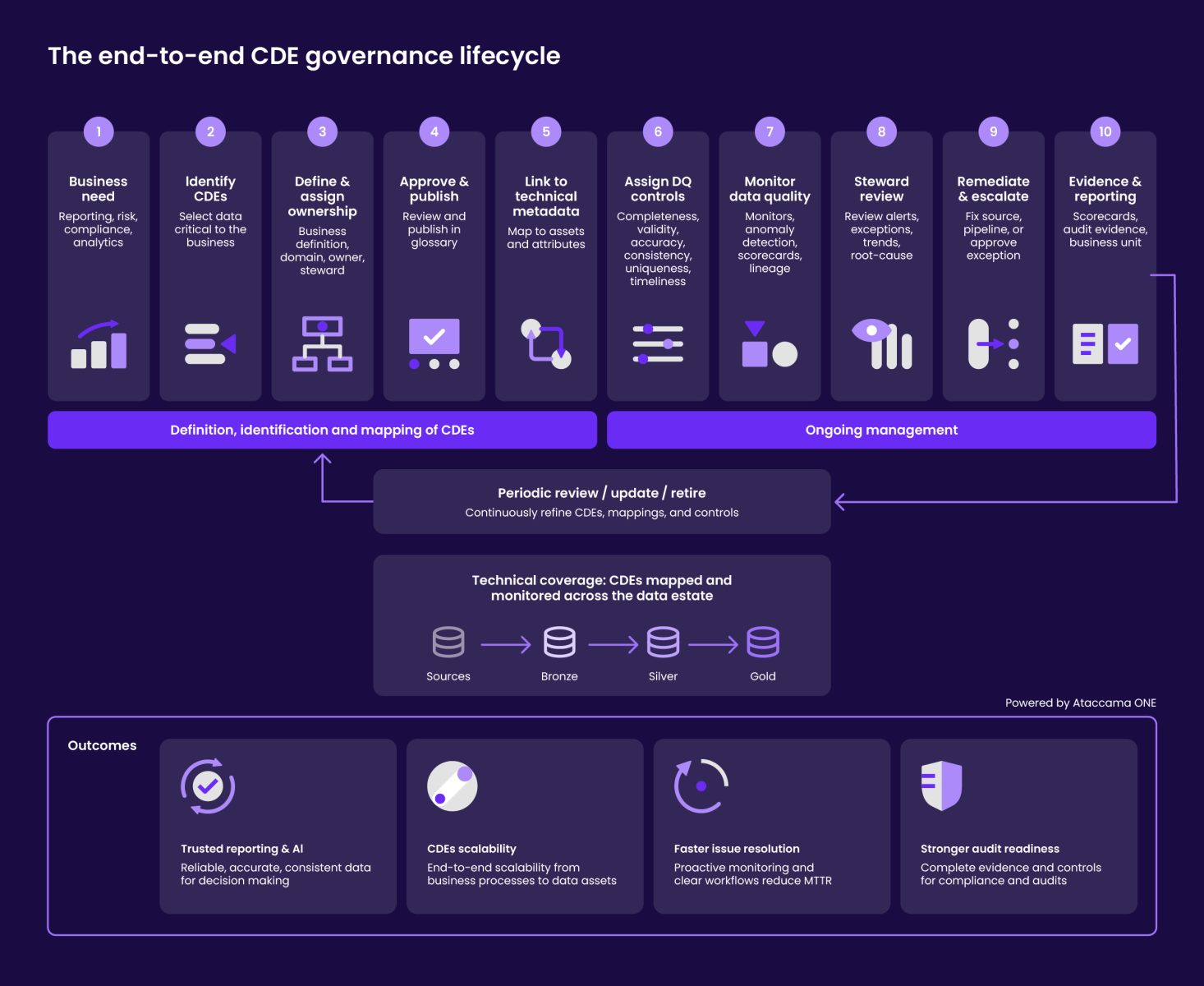
1. Start from a business or regulatory need. Governance should trace back to a concrete use — a specific report, an analytics use case, a compliance obligation, an agentic workflow. Anchoring CDEs to the business processes they serve is what justifies the criticality; when someone asks why an element is governed at this level, the answer is the decision or obligation it supports.
2. Identify the elements that feed it. With the business process defined, work with the business to determine which data elements actually feed the outcome. This is the collaborative Factor Rating exercise from above — business and data teams scoring each candidate against the weighted criticality factors and flagging anything above threshold.
3. Define the element and assign ownership.
Give the CDE a clear business definition, place it in a domain, and associate it with the business process it serves. That definition takes the form of a business term — a logical attribute that captures what the data element means in business language. In Ataccama ONE the term becomes part of a data product: a data product is a trusted, reusable asset that packages data with the context needed to use it confidently, with ownership, stewardship, business terms, and quality standards defined once on the product and applied to every catalog item connected to it.
4. Approve and publish it. Run the CDE through your approval process and publish it to the business glossary, which acts as a shared single source of truth for definitions across every asset and system. That’s what ensures consistency at scale: the same term means the same thing to every team that uses it, no matter where the data physically lives, so consumers across the organization can find it, understand it, and see that it’s formally managed.
5. Link the business term to physical assets. A definition means little until it’s connected to the actual tables and columns that implement it, often in many places at once. That’s the job of a detection rule: logic that describes how to recognize a term in metadata or physical data — the value patterns, formats, or profiles that signal, say, a customer identifier — and then scans your systems to find every column that matches. Where a column clears a configurable confidence threshold, the rule proposes the term automatically. Detection proposes, a steward confirms. This is what lets you discover where critical data lives at scale rather than tracing it by hand — one rule finds every instance of a term across the assets you’ve profiled, instead of a steward hunting them down table by table.
Phase 2: Ongoing management (steps 6–10)
Once a CDE is established, it moves into governance-driven treatment for as long as it stays critical: each CDE has a designated owner and active stewardship, continuous observability and DQ monitoring with an escalation process for anomalies and drift, proactive/preventative DQ handling to keep it fit for purpose, maintained lineage and usage statistics, and defined KPIs.
6. Apply data quality controls. With the CDE mapped to physical data, attach quality checks across the dimensions that matter — completeness, validity, accuracy, timeliness, uniqueness, and consistency. Some controls are simple attribute-level rules; others are cross-table reconciliation checks, like confirming a reported balance ties back to the source ledger, or that an identifier is unique across systems that are supposed to agree. The controls should reflect the element’s real fitness-for-purpose requirements. Keep CDEs fit for purpose through proactive, preventative DQ management — a DQ firewall, ongoing standardization, cleansing, and enrichment.
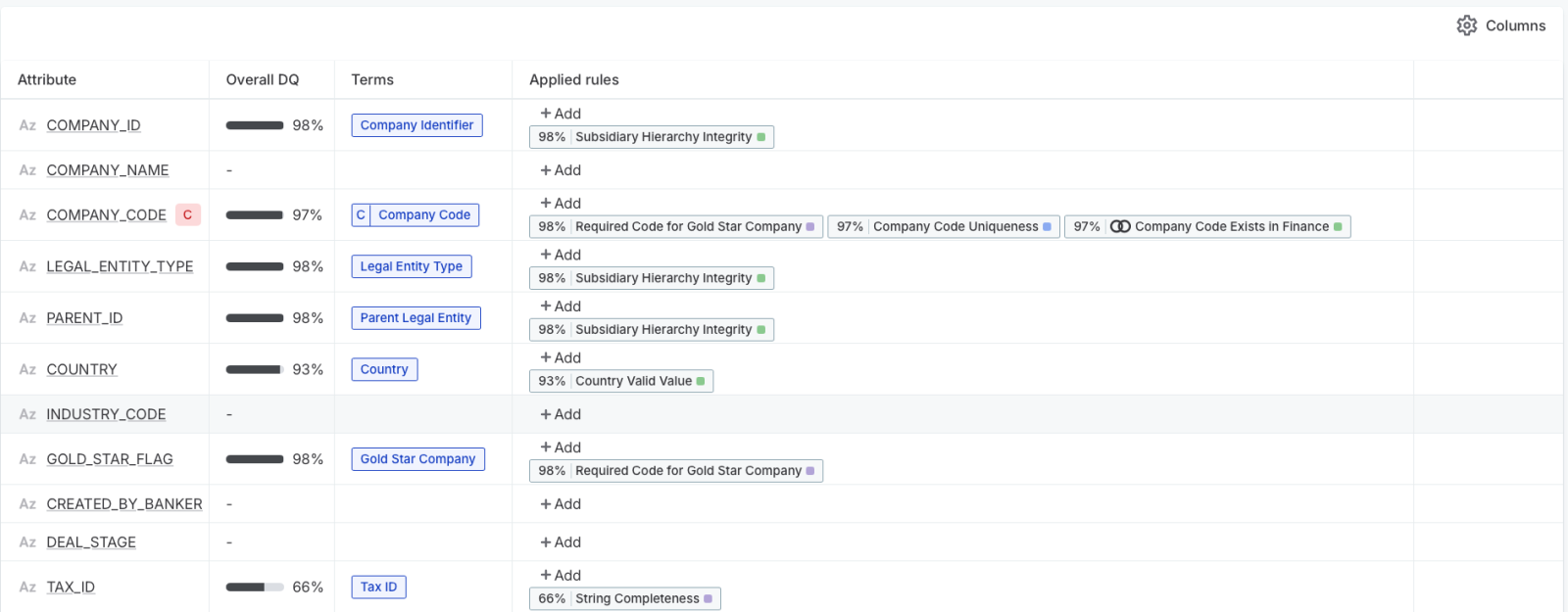
Critical data element – Company code – with active completeness, uniqueness and cross-table checks
7. Monitor it continuously. Governance becomes real when quality is watched over time. Monitor CDEs in one place — with DQ monitors that track each element against defined quality thresholds, anomaly detection for drift and unexpected change, and alerting that notifies the assigned steward the moment an element falls below its threshold, so problems reach the person accountable for them. Lineage shows the end-to-end path each element travels, so you can see where it’s consumed downstream and what would break if it failed — and trace a problem back upstream to its root cause.
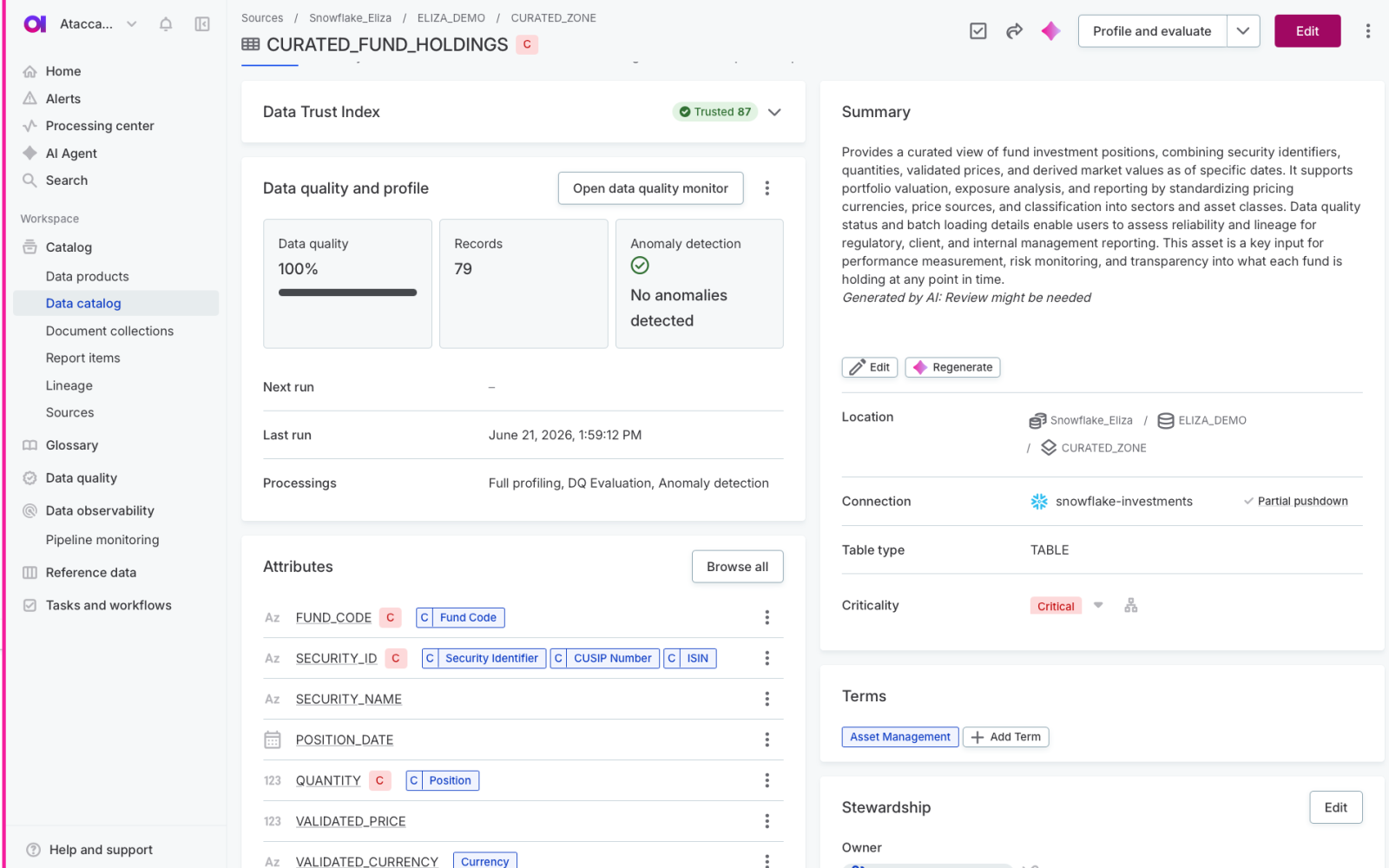
This catalog item has assigned criticality, critical data elements, active DQ monitoring, stewardship, and is marked trustworthy by Data Trust Index.
8. Review through stewardship. Continuous monitoring produces signals; stewardship turns signals into actions. Stewards work through quality issues, digging into root causes. This is the human judgment layer of the loop — deciding whether a dip is noise or a real problem.
9. Remediate and escalate. Most real fixes happen at the source, so the steward rarely resolves them alone — the issue is routed to the data engineers who own the pipeline or system, often as a tracked ticket in Jira or ServiceNow so the work has an owner, a status, and a deadline. Every action along the way is recorded, producing an audit trail that shows not just that an issue was found but how it was handled.
10. Produce evidence. Close the loop by making the state of your critical data provable. Quality scorecards, audit trails, lineage, and an explainable trust signal give regulators, executives, and downstream teams confidence that critical data is genuinely under control — and give you the documented history to show how it got there. Evidence is also what makes the whole program legible to the business, turning invisible governance work into a visible measure of data health.
Read those ten steps as one continuous cycle. Steps one through five you perform when a CDE is established, and revisit when it needs updating. Steps six through ten you perform for as long as it stays critical.
Phase 3: Review and updates
A CDE only stays trustworthy if it’s watched and corrected as sources and processes change, so the list itself needs continuous, event-driven maintenance. Trigger a review on any relevant change: new or changed business requirements, business-process changes in definition or scope, data-domain modifications, system additions or eliminations (source or consumer), or data-flow modifications. On a periodic basis, review each CDE to decide what to update or retire — and reassess elements that are not CDEs against data-minimization and security principles (e.g., GDPR storage limitation) for potential elimination.
Keeping CDE governance sustainable at scale
Flagging each critical element by hand doesn’t scale, and hand-maintained lists fall out of date the moment a source moves or a process changes.
Ataccama ONE handles this with data products and inherited criticality. Instead of tagging assets one by one, you set criticality once at the top of the chain — typically a business process — and it can be set to be propagated automatically through the model: to the business terms that process relies on, and from each term to every attribute, catalog item, and data product that carries it.
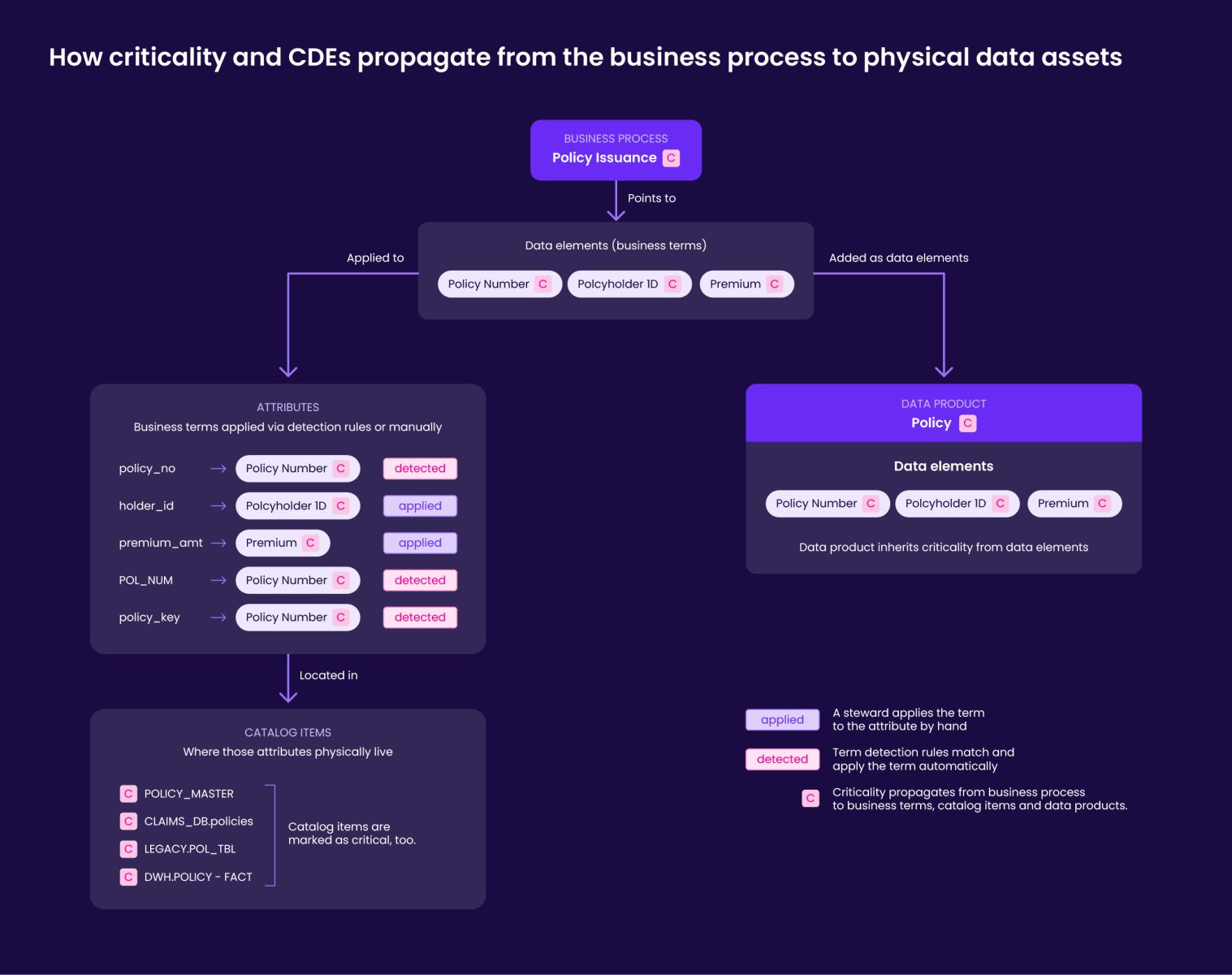
To make that concrete, say Policy Issuance is a business process, you mark it critical, turn on propagation, and it runs like this:
- The business terms the process relies on — Policy Number, Policyholder ID, Premium — inherit criticality.
- Each term is connected to the physical attributes that implement it, either applied manually by a steward or matched automatically by detection rules that find columns nobody linked by hand.
- Every attribute a critical term is applied to becomes critical, and the catalog item holding that attribute inherits the status.
- Data products carry it the same way: a product that includes critical data elements inherits their criticality.
One decision surfaces a scoped set — the term, its attributes, the catalog items and data products downstream of it — as candidates ready for a steward to confirm, rather than hunt down table by table.
Governing CDEs for AI and agentic workloads
AI agents change what “trustworthy” has to mean in practice. A human analyst who pulls the wrong version of a customer table often senses something is off; an agent does not. It acts on whatever it’s handed with the same confidence, and at machine speed. For agentic workflows, ambiguity at the data layer isn’t a nuisance; it’s a direct path to confidently wrong outputs.
Governed CDEs answer that by giving agents an explicit, machine-readable basis for trust. Exposed as a data product, a critical element arrives with its owner, its criticality, and a trust score already attached. Ataccama expresses that trust score as a Data Trust Index: a weighted, explainable measure across data quality, ownership completeness, and business context, anchored to the recommended asset and available as a structured input via API today, with MCP support in upcoming releases.
Truist is a working example of what that looks like. The bank arrived at AI readiness from the opposite direction: it started with a regulatory problem and ended up with an AI foundation. When BB&T and SunTrust merged, the bank’s data estate doubled overnight, with two sets of systems and inconsistent definitions of critical elements, while regulators kept watching. As part of its modernization onto Snowflake, Truist mapped and monitored roughly 9,700 CDEs for regulatory reporting, including FDIC Call Reports, backed by more than 15,000 data quality rules deployed on Ataccama validating data from 50+ source systems before it lands in the platform.
The defensive results came first: regulatory reports delivered 4.2x faster, pipeline failures down 73%, quality incidents down 60%, and a 97.1% quality pass rate across those rules. Then came the part nobody had to build twice. Because the critical data was already mapped, owned, monitored, and provable, Snowflake’s Cortex AI capabilities could run on it. More than six Cortex use cases now operate on data that was validated and certified before any model touched it. The foundation built for regulatory compliance turned out to be the same work that makes AI viable.
That’s the pattern worth generalizing. The requirements regulators impose on critical data, defined ownership, documented quality, auditable lineage, are the same properties an agent needs to act safely.
Maintaining trust through modernization
Multi-year data modernization projects are precisely when CDE governance is most fragile, because the data landscape is in motion the entire time. The goal isn’t only to relocate data to a modern platform — it’s to avoid losing definition, control, and regulatory readiness intact while data moves across platforms and operating models.
During a transition the same critical element rarely lives in one place — it can exist simultaneously across legacy source systems, on-prem and hybrid environments, cloud storage, cloud lakehouse landing and curated layers, business reporting extracts, and data products, each potentially in a different state of quality. Trust has to hold continuously across all of those layers throughout the transition, not just at the final reporting layer, where problems surface too late to fix cheaply. Checking quality upstream stops defects from propagating into the layers everyone builds on, which matters most for regulatory data, where a late failure becomes manual rework and missed deadlines.
Not all of that data moves at once, and some never moves at all and a cross-platform trust layer keeps your CDEs governed and trusted wherever they live at each stage of the journey.
FAQ
A critical data element is data an organization depends on to manage risk, make decisions, and run its operations — data whose inaccuracy or unavailability would cause business or regulatory harm. What makes an element critical is its business consequence, not its technical properties, so the same column can be critical in one context and not in another.
CDEs are governed through a continuous lifecycle: defining and publishing them, linking them to physical data, applying quality controls, then monitoring, stewarding, remediating, and periodically reviewing them. The maintenance is ongoing, because a CDE only stays trustworthy if it’s watched and corrected as sources and processes change.
Conclusion
Identifying CDEs takes business judgment: you prioritize the use cases, decide what’s critical and record it. Pulling the practices together, sustainable CDE governance rests on five things:
- A structured, phased approach to identification — defined scope, priorities, and milestones, rather than a big-bang attempt to govern everything at once.
- A clear governance framework — ownership, stewardship, and an auditable approval process.
- Regular maintenance and updates — event-driven and periodic review that keeps the CDE list honest.
- Stakeholder engagement — the business and data teams deciding criticality together and signing off through the Data Governance Council.
- Continuous monitoring and improvement — observability, DQ monitoring, remediation, and evidence, running wherever the data lives.
What carries these practices programs to enterprise scale is automation: identification of CDEs, continuous monitoring, and ongoing governance running as automated processes rather than manual effort. That investment pays off twice — because regulators, in demanding owned, measured, provable data, wrote the specification for AI-ready data years before anyone asked for it. Teams that built the loop already have the foundation for both, because trustworthy turned out to mean the same thing to a regulator and to an agent.
Want to learn how Ataccama helps you detect, monitor and govern CDE as you modernize your data?