Ataccama launches data products: Governed, trustworthy data for AI and business
TL;DR
- Most data product initiatives improve discoverability and ownership but leave a more important question unanswered: whether the data can actually be trusted when decisions or AI agents depend on it.
- A data product without an embedded trust signal is a repackaged dataset with better documentation.
- Ataccama ONE now lets you define business-aligned data products, govern them with ownership and criticality, and surface a live trust score — all from a single platform.
- For teams building AI pipelines, governed data products with embedded trust signals delivered via MCP are what make AI outputs reliable, auditable, and grounded in verified context.
The data product promise has a trust problem
“Data as a product” has crossed the chasm from concept to corporate initiative. The phrase appears in board-level strategy decks. It shows up in every major vendor’s positioning. Organizations have been appointing data product owners, and restructuring their governance around domain ownership.
Yet most data product initiatives haven’t delivered what they promised.
The gap isn’t architectural. Organizations generally understand the model: treat data as something that needs to be built, packaged, and maintained to meet consumer needs. The failure point is almost always the same — and it rarely gets named directly. Even when governance programs are thorough, business glossaries are complete, and ownership is assigned, organizations still can’t reliably answer the question that actually matters: Can this data be trusted and used with confidence, right now?
This is the gap Ataccama set out to close with this launch. The industry has built sophisticated infrastructure for organizing, classifying, and describing data. What it hasn’t done is make trust a first-class citizen in the data product itself; measurable, explainable, and surfaced wherever data is consumed. That changes today.
What we’re launching (and why it matters)
Ataccama ONE now delivers trusted data products: a reusable package of data and business context, ready to be consumed under a clear contract of ownership, quality, and trust. Governance teams can now define what your critical data concepts are, tie those to business processes, govern them with clear ownership, anchor them to verified physical data, and carry a live Data Trust Index score that makes trust explicit and explainable.
On top of that, through Ataccama’s MCP Server, trusted data reach the AI tools and workflows your teams already use, without requiring anyone to switch context or learn a new interface.
That combination matters more than it might sound. Most platforms treat data products as a cataloging and access problem. Ataccama treats them as a trust problem that also needs cataloging and access. The architecture reflects that philosophy.
Here’s what that looks like in practice.
Business-aligned data products, not just physical assets
The foundational shift in this release is what a data product actually is in Ataccama ONE.
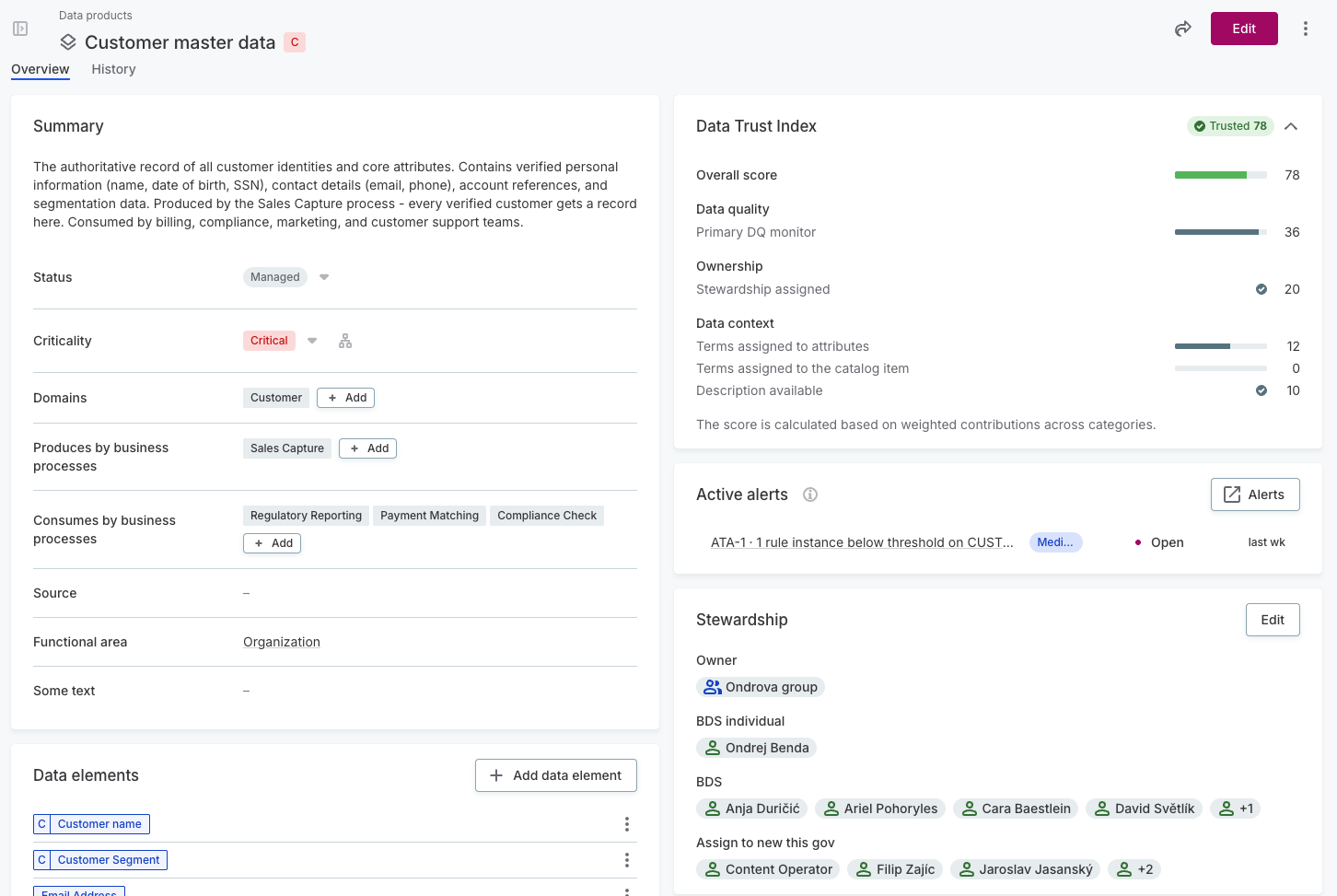
Rather than governing physical tables and columns, organizations now define business concepts — “Customer,” “Transaction,” “Booking” — as first-class entities, independent of where or how the data is physically stored. A single data product maps to the relevant physical data assets across systems. Ownership, stewardship, criticality, and business context are assigned at the concept level, not scattered across dozens of tables that may not even communicate what they contain.
Three new building blocks make this work:
Business Processes represent real workflows in your organization — Sales Capture, Transaction Recording, Payment Matching, and more. Linking a data product to a business process answers two questions at once: where does this data come from, and what work does it support? It also introduces criticality flags, so governance teams can prioritize consistently rather than treating everything equally.
Data Products Objects are the central governed objects. Each one carries a business description, assigned ownership and stewardship, criticality settings, links to the business processes that produce and consume it, and mappings to the physical data elements in the catalog. One place for the authoritative answer on what this data is and who is responsible for it.
Data Domains provide organizational scoping — Finance, Customer, Operations — grouping related data products into logical structures that can mirror how your organization is actually built. They’re the boundary that makes governance scalable rather than ad hoc.
Together, these structures mean governance teams can govern a concept once and apply it consistently, rather than managing fragmented definitions across every system that stores a version of “Customer.”
Live trust scoring
The Ataccama Data Trust Index continuously scores each data product based on data quality, ownership completeness, and governance context. The score is live rather than static, and it’s explainable — consumers can see exactly why a product scores the way it does, not just what the number is.
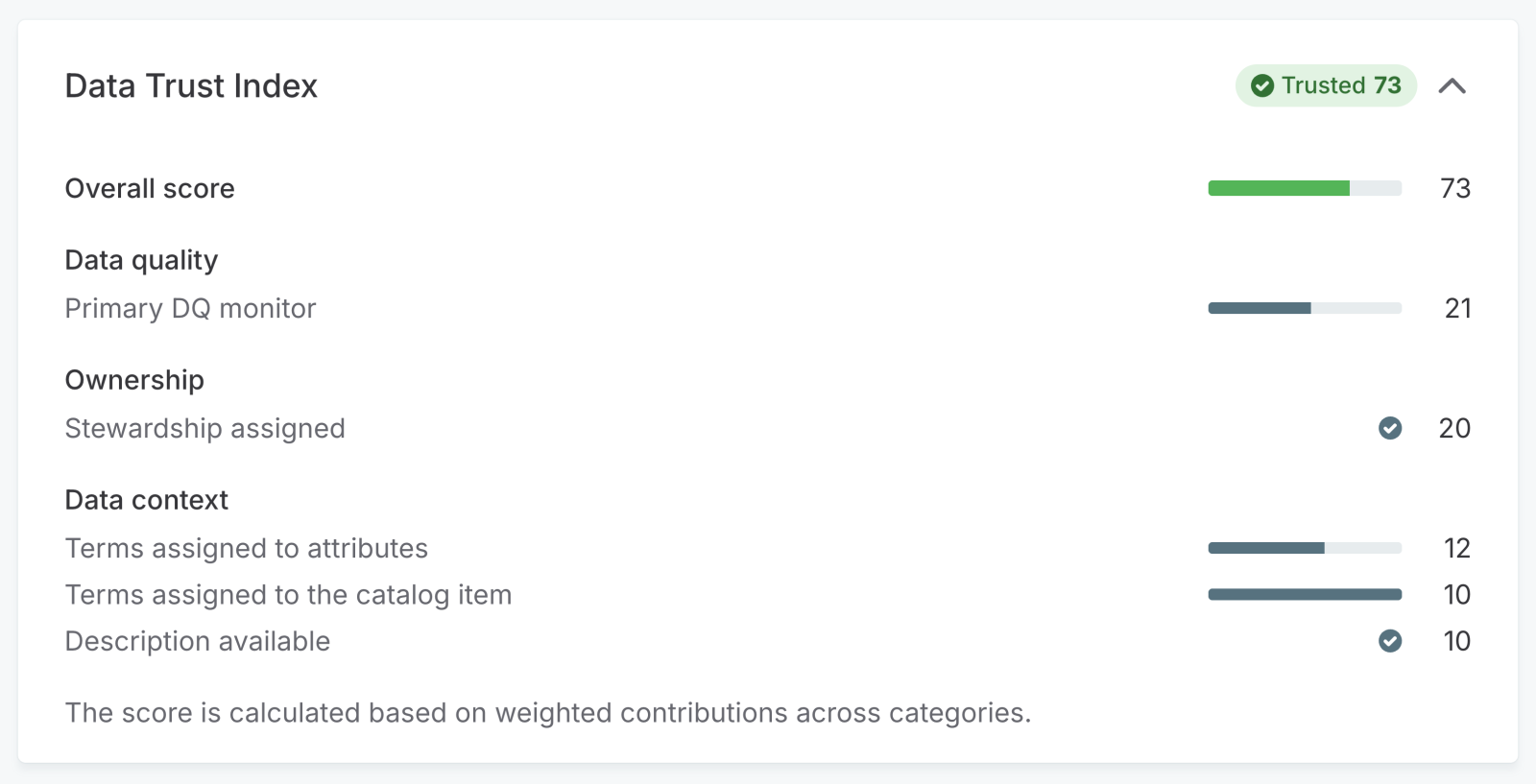
This is what governance alone can never provide: a trust signal that is live, explainable, and attached to the data itself.
The distinction matters particularly for regulated industries. SSEN Transmission framed this directly: “Knowing which version of a critical asset concept to trust, and being able to prove to a regulator that the answer is right, was the challenge that drove everything. Defining what a concept like “substation” means to the business, connecting it to the right data, and seeing a clear signal of whether that data is fit for use — that’s the capability that makes governance defensible rather than decorative.” said Susan Spence, Senior Data Product Analyst
MCP Server: injecting trust signals inside AI workflows
Defining and governing data products is the foundation. But getting data trust signals and governance context into the tools and workflows where people and AI actually work is what operationalizes the value.
Ataccama’s MCP Server does this. It delivers live Data Trust Index scores, governance metadata, and quality signals directly into AI tools, including Claude Code, Snowflake CoCo, Snowflake CoWork, and Databricks Agent Bricks so AI systems and people can evaluate the reliability of data before acting on it. Rather than having every AI team independently assess data quality, they get verified trust signals surfaced at the point of use.
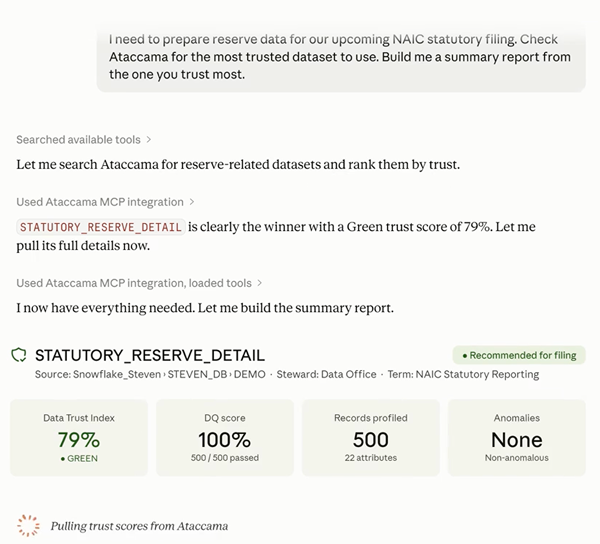
This is what makes Ataccama more than a cataloging layer. When an AI tool or a business analyst query data through the MCP Server, they receive the business context, and the trust signal that governance teams have already established. The AI doesn’t operate on documentation. It operates with confidence that the data it’s reaching for has already been verified.
For organizations where AI pipelines can’t reliably distinguish a trustworthy dataset from a problematic one — and that’s most organizations — this is where the risk compounds. AI scales whatever it’s given. Ataccama ensures what it’s given is worth scaling.
Why trust is the missing layer in most data product strategies
The industry conversation about data products has been dominated by two themes: discoverability and self-service access. These are real problems worth solving, but they rest on an assumption that is frequently wrong: the underlying data is reliable enough to be worth discovering.
Consider what a data product catalog looks like in an organization that hasn’t addressed trust. It’s a well-organized index of business concepts that may or may not be accurate, may or may not be fresh, and may or may not reflect the physical data that’s actually being used. Consumers learn quickly which products can be trusted and which can’t. Tribal knowledge replaces the catalog. The investment in governance delivers a fraction of its potential value.
The architectural mistake is building the context layer before building the trust foundation.
Ataccama’s approach closes this gap. Data quality rules, profiling, and observability are connected to data products from the start. A data product in Ataccama ONE carries its trust score with it, calculated from actual measurements across data quality and governance signals rather than inferred from a steward’s best judgment. Consumers can see the score, understand why, and know whether the product is currently meeting its standards.
This is particularly urgent in AI contexts. A human analyst who pulls the wrong table might catch the problem — they’ll see numbers that look strange, or ask someone who knows better. An AI pipeline doesn’t have that judgment. It processes whatever it receives without hesitation and scales the result across every downstream output. If governance doesn’t lead to quality, and quality doesn’t translate into trust, the risk compounds with every AI use case an organization adds.
Ataccama’s trusted data products are the mechanism that breaks that chain.
Get started with data products in Ataccama ONE
Data products only deliver on their promise when the data inside them can actually be trusted. Ataccama ONE gives you the structure to define them, the governance to own them, and a live trust signal that makes confidence measurable.
Ready to see it in action? Explore the interactive data products walkthrough or request a demo below.
Anja Duricic
Anja is our Product Marketing Manager for ONE AI at Ataccama, with over 5 years in data, including her time at GoodData. She holds an MA from the University of Amsterdam and is passionate about the human experience, learning from real-life companies, and helping them with real-life needs.