TDWI Blueprint Report: Governing Emerging and Diverse Data in the Age of AI
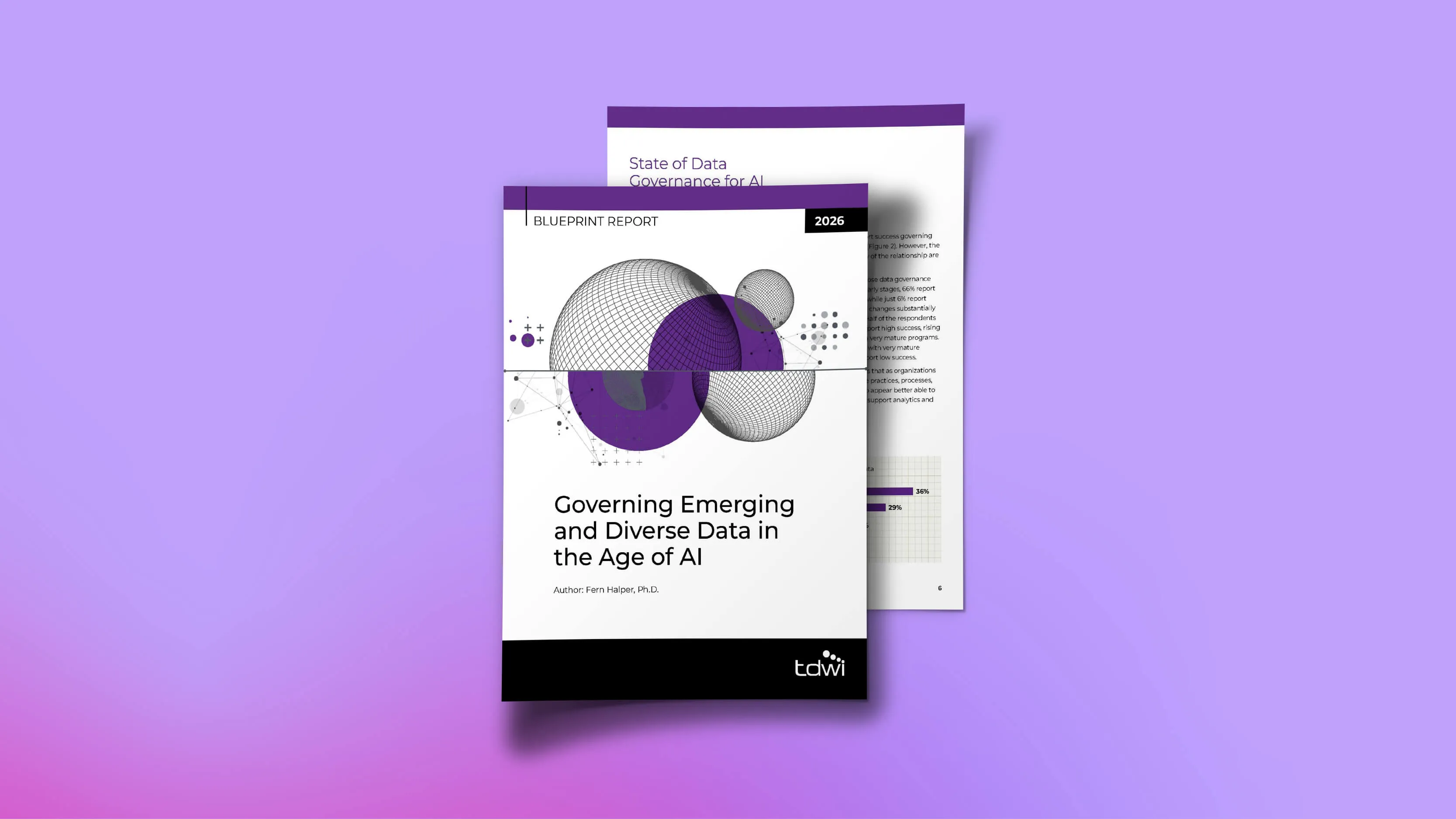
Governing emerging and diverse data in the age of AI
AI initiatives increasingly draw on documents, email, chat conversations, images, audio, and video alongside structured data. TDWI research suggests governance practices have not necessarily kept pace. In a survey of 179 organizations with active AI initiatives and a data governance program, governing unstructured data was the most frequently cited challenge, named by 44% of respondents.
In this TDWI Blueprint Report, Fern Halper, Ph.D., compares organizations reporting high and low governance success and presents a framework for extending established governance practices to emerging data types.
Governance has to follow the data
Unstructured content rarely reaches AI in its original form. A policy document may be parsed, chunked, embedded, and then retrieved by an agent. A call recording becomes a transcript, and then extracted entities and sentiment. Each transformation can introduce errors or lose the access permissions that applied at the source.
The TDWI Blueprint organizes governance into four interconnected components, from Source and Origin through Consumption and Use, supported by cross-cutting disciplines and an organizational governance foundation.
- 51% vs. 11%: High-success vs. low-success organizations using metadata tagging to govern unstructured data
- 55% vs. 11%: High-success vs. low-success organizations bringing governance in during planning and design
What you’ll learn
- Where governance of diverse data stands today. See how the data organizations collect compares with the data they actively govern, especially for images, audio, and video.
- What higher-success organizations do differently. Explore the timing and controls that distinguish them, including metadata tagging and data quality monitoring.
- The TDWI Blueprint for governing emerging and diverse data. Understand the four components and four cross-cutting disciplines for governing information from source to consumption.
- How to make data trust usable by AI agents. Hear Ataccama President Jay Limburn on turning quality assessments into trust signals that agents can act on.
“Everyone’s talking about semantics and context. They are important, but they mean nothing without quality, because without that, all you’re getting is a confidently wrong answer.”
Jay Limburn, President, Ataccama, in the TDWI Blueprint Report
Fill in the form to access the full report.
TDWI Blueprint Report: Governing Emerging and Diverse Data in the Age of AI, Fern Halper, Ph.D., [date]. This report reflects TDWI’s independent research and analysis. Ataccama is a sponsor of the report.