Purview data governance is retiring. Don’t just replace the catalog, upgrade the stack

On November 12, 2026, Microsoft announced it is retiring Purview Data Governance. Support ends on November 12, 2027.
The retirement covers the Unified Catalog, Data Map, Workflows and classic Azure Purview. New data governance accounts can no longer be created, and existing capabilities are now in maintenance mode.
For every team that built its catalog, glossary or stewardship workflows on Purview, moving is no longer optional. The real question is where to go, and whether to use the move to fix more than the catalog.
What’s changing, and what isn’t
Not all of Purview is going away. Purview Data Security and Purview Compliance are unaffected, including sensitivity labels, data loss prevention, eDiscovery and Audit.
If your security and privacy teams rely on those capabilities, their investment is safe. The retirement affects the governance side only: the catalog, the data map, the glossary and the workflows your stewards use every day.
That distinction matters for planning. Your first job is to separate what is retiring from what stays, so a governance migration does not accidentally disrupt security controls.
Why Microsoft is doing it
Microsoft’s reasoning is coherent. It argues that governance should live inside the data platform, not in a separate tool. A separate catalog means every policy, label and lineage update has to bridge two systems.
It also argues that AI agents need governance (meaning, permissions and trust) sitting right next to the data they use. And since most Purview governance customers already run Microsoft Fabric, the OneLake catalog in Fabric becomes the named destination, with governance included in Fabric capacity.
The result is a cleaner split: Purview protects data, and Fabric governs it. For organizations whose data lives mostly in Fabric, that can be a sensible path. It is the same embedded-governance approach other lakehouse platforms have taken.
The gap: a discovery surface, not an enterprise governance platform
The OneLake catalog works well inside Fabric. Most enterprises, though, don’t live only inside Fabric. Early analyst commentary on the announcement points to four gaps that data leaders should weigh.
- Coverage beyond Fabric. Governing Databricks, Snowflake, SAP, AWS, GCP or on-premises systems depends on shortcuts, mirroring and partner integrations. That makes it hard to use as a single view of governance across the whole estate.
- Lightweight governance. In the near term, the OneLake catalog is centered on discovery for developers and data engineers. Business stewards who need glossaries, ownership, quality and approval workflows will still need more.
- Less neutrality. Tying metadata management to Fabric storage and compute deepens dependency on a single platform. Multi cloud organizations either centralize everything in Fabric or keep a separate governance layer anyway.
- A cost that moves rather than disappears. “Included in Fabric capacity” means governance scanning and queries draw on the same capacity units as Power BI refreshes and production pipelines. Without guardrails, governance work competes with revenue-critical analytics at peak times.
None of this makes the OneLake catalog the wrong choice for a Fabric-centric team. It does mean that for most enterprises, it covers part of the job, not all of it.
This is a stack decision, not a catalog swap
Most teams used Purview Data Governance as a catalog. Data quality, lineage, observability, master data and reference data usually lived somewhere else. Rebuilding governance is the moment to ask where all of that should live. In practice, there are three realistic paths.
- Move to the OneLake catalog. This is a good fit for Fabric-centric estates as we mentioned already, with light governance needs. The trade-offs are thinner coverage outside Fabric, shared capacity costs and a new platform dependency.
- Swap in another stand-alone catalog. This replaces what Purview did. It still leaves data quality, observability, reference data, and master data in separate tools, so the stitched-together stack stays stitched together.
- Consolidate on an independent trust layer. This uses the forced move to bring catalog, quality, lineage, observability, master and reference data into one platform that spans every system you run all the way to your agents.
The first two paths could solve the immediate problem. The third one solves it while giving you the option to expand your foundational solution as future needs arise. Whatever you choose next should survive your next platform decision, so you don’t face this migration again or a complex stack integration in three years.
A practical checklist before you commit
Whichever path you lean toward, these six steps will give you a defensible decision.
- Inventory what you actually use. List your scans, classification rules, business glossary, lineage graphs, stewardship workflows and dashboards. Separate technical metadata that can be rediscovered automatically from business context your stewards curated by hand, because the second is what’s hard to rebuild.
- Separate security and compliance from governance. Sensitivity labels, DLP, eDiscovery and Audit stay in Purview. Make sure your migration plan doesn’t touch them.
- Map your estate inside and outside Fabric. Estimate how much of your critical data sits in Databricks, Snowflake, SAP, other clouds or on-premises systems. The larger that share, the bigger the gap a Fabric-native catalog leaves.
- Model the full cost. Include compute for metadata scanning, mirroring and governance queries under Fabric capacity pricing, not just license fees. Ask what happens to Power BI refreshes and pipelines during peak scanning.
- Benchmark against your real requirements. Test each option on multi cloud scanning, cross-platform lineage, business glossary and stewardship workflows, data quality and policy enforcement.
- Start procurement now. Enterprise evaluation, procurement and change management take months. A 12-month support window is shorter than it looks.
Where Ataccama fits
Many Purview Data Governance customers already run Ataccama for data quality. The retirement is a chance to bring catalog and governance into the same independent trust layer, rather than rebuild a two-tool setup around a new catalog. Here’s what that layer brings.
- One platform, not a stitched stack. Ataccama ONE brings catalog, data quality, lineage, observability, master data and reference data together. Users can start with one area of the platform and naturally expand to others as needs and maturity evolves.
- Truly cross-platform. Write a data quality rule once and Ataccama enforces it where the data lives, across Azure, AWS, GCP, on-premises and SAP. That includes pushdown SQL in Snowflake and PySpark on Databricks.
- Stewardship that scales with AI. Ataccama ONE AI speeds up cataloging, classification, rule creation, monitoring and remediation. Custom skills go further, turning your stewards’ own processes into instructions the agent follows the same way every time, whoever asks.
- Trusted data for any AI agent. Ataccama Data Trust insights, served through the Ataccama MCP Server and the Apache Ossie converter, give agents a machine-readable trust signal that isn’t tied to one vendor’s ecosystem.
- Predictable cost. Ataccama applies soft limits on your usage so exceeding a limit doesn’t trigger charges. This allows you to start with the right size you need and adjust to changing needs without any spikes in costs or back charges.
Together, these capabilities change what a data team can get done. On top of that, routine work that used to take stewards weeks, such as moving metadata, linking assets and cleaning up records, can now be handed to AI that follows the organization’s own rules. That frees people to focus on decisions rather than busywork. One large North American utility saw this in its first tests, with most of a real data management process completed automatically. As its team put it:
“We aren’t just putting AI next to data management. We are beginning to put our data management processes into AI… an important step toward making stewardship more automated, consistent, and scalable.”
Recognized by analysts, proven by customers
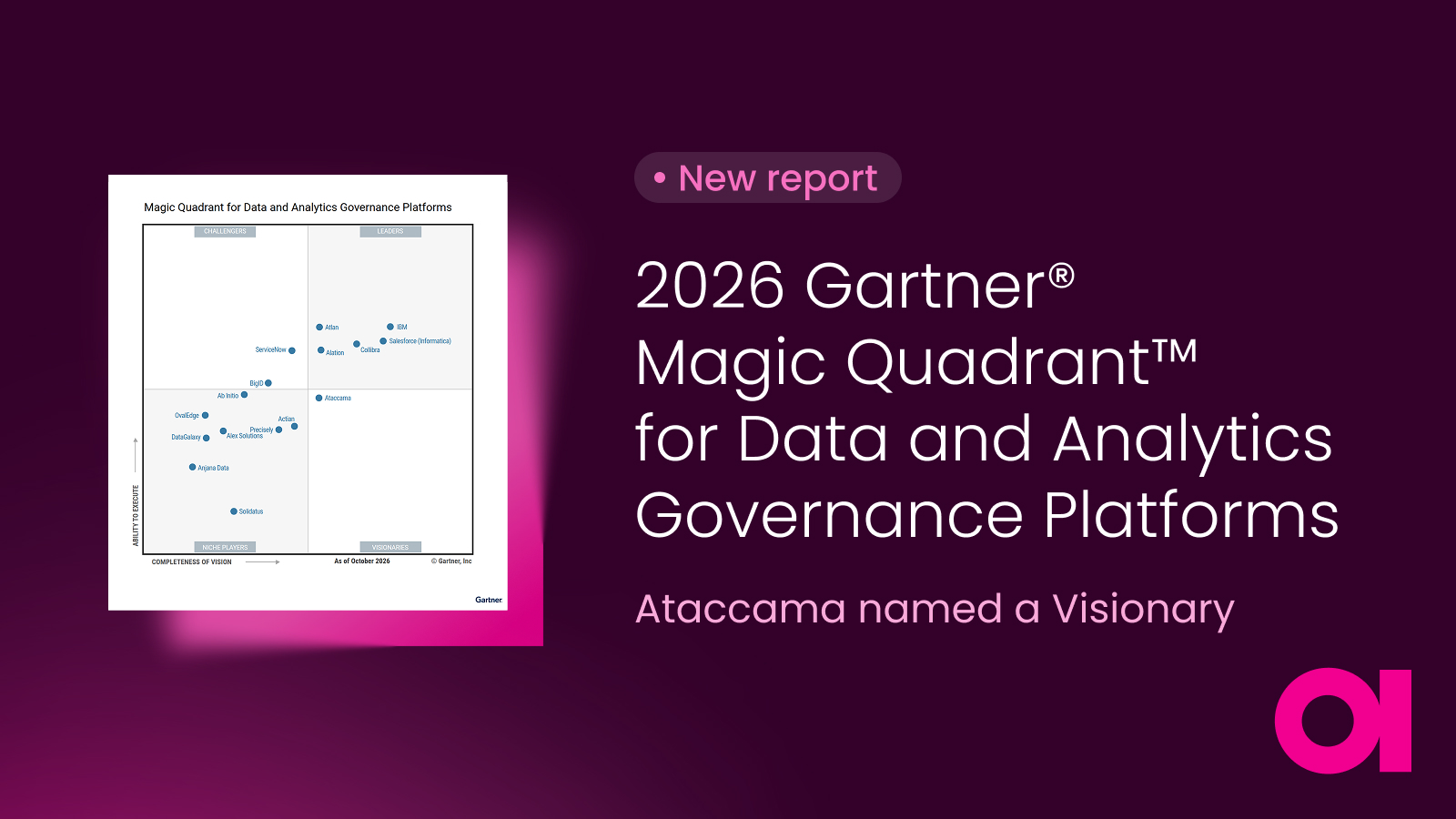
Industry analysts have taken note of this approach. Ataccama is the only Visionary in the 2026 Gartner Magic Quadrant for Data and Analytics Governance Platforms, up from Niche Player the year before. It is also a Leader in the 2026 Gartner Magic Quadrant for Augmented Data Quality Solutions, for the fifth consecutive time.
Customers are already acting on it. A US manufacturer that ran Purview as its catalog, with Ataccama handling data quality, had already made Ataccama its governance tool of choice even before the end of life was announced. A European retail group is on the same path, consolidating its Purview catalog into the Ataccama platform it already relied on for data quality.
Why waiting is the riskiest option
Maintenance mode means no new capabilities between now and November 2027. Every month spent waiting is a month of governance standing still while the rest of your data platform moves on.
The calendar is tighter than it looks. Evaluation, procurement, migration and change management for enterprise governance usually take most of a year. Teams that start in early 2027 will be best set up for long term success.
Let’s talk about your next step
If consolidating on an independent trust layer sounds like the right path, talk to our team about your post-Purview plan. We’ll look at your estate, your requirements and your timeline with you, and show you what your new stack would look like.

Jessie Smith
Jessie Smith is Chief Product Officer at Ataccama, bringing more than a decade of experience across enterprise data management, AI, and product development. She leads Ataccama’s product strategy, focused on helping enterprises improve data quality and build the trusted data foundation needed for AI.