Certified, agent-ready data: A practitioner’s guide to the data trust layer on Snowflake
How to operationalize a data trust layer for AI using integrated Snowflake capabilities
In this paper, you’ll learn:
- Why AI initiatives succeed or fail based on the quality and certification of the data they use
- How to certify data continuously so AI agents can make trusted decisions with confidence
- How to transform raw enterprise data into certified, AI-ready data through continuous trust gates
- How to operationalize a data trust layer inside Snowflake using integrated platform capabilities
- How to build a scalable foundation for trusted AI, one domain at a time
Executive summary
AI has changed the role data quality plays inside the enterprise. When analytics primarily informed human decisions, data quality improved reporting accuracy and helped people make better decisions. AI systems operate differently. They reason over enterprise data and take action without stopping for someone to verify that the underlying records are complete, current, or correct. As AI becomes part of operational workflows, confidence in the data itself becomes a runtime requirement.
As Ataccama, Snowflake, and Deloitte argued in The Modern AI Stack: A Blueprint for Trusted Agentic AI, available data and certified data are fundamentally different. Enterprise AI depends on more than access to information. It depends on continuous evidence that the data has been validated against business rules, remains fit for purpose, and can be trusted when it’s used.
Snowflake provides the foundation for modern data engineering and AI. This paper explores how organizations build on that foundation with Ataccama to operationalize continuous data certification across their Snowflake environment. It explains how Ataccama brings data quality and trust checks into modern ELT pipelines, making certification part of normal data operations rather than a one-time migration exercise, and how organizations can introduce these capabilities incrementally, one business domain at a time.
Modernization changes the moment when trust matters
For most organizations, AI doesn’t begin with a model. It begins with modernizing the data estate.
Migrating from legacy warehouses, fragmented ETL pipelines, and disconnected data platforms to Snowflake requires inventorying, profiling, transforming, and mapping every dataset into a modern architecture. In the process, organizations gain something many haven’t had in years: a comprehensive view of their enterprise data.
That visibility quickly exposes more than aging infrastructure. Duplicate customer records, inconsistent business definitions, stale reference data, and years of accumulated quality debt all surface during migration. Organizations can treat those discoveries as problems to clean up later, after the data lands in its new environment, or resolve them while they are under examination, before those issues propagate into analytics, AI, and downstream operations.
Modernization is a once-in-a-decade opportunity to eliminate data quality debt before AI scales it.
That decision has consequences well beyond the migration itself. Snowflake provides the foundation for modern data engineering through cloud-native ELT, open architectures, and native platform services. The opportunity is to make trust part of that modernization effort rather than treating it as a follow-on project. Instead of validating data once after cutover, organizations can establish continuous certification as data moves through ingestion, transformation, and consumption, ensuring trust is maintained long after migration is complete.
This guide explores that approach. It focuses on how to operationalize continuous certification inside Snowflake so analytics, applications, and AI systems consume data that has been validated continuously, not simply migrated successfully.
Data trust, as used throughout this paper, describes data that has been profiled at its source, validated against business-defined rules, monitored as it moves through transformation, and certified with a timestamped record traceable to its origin. Trust is earned incrementally through those checks. It isn’t inherited simply because the data now resides on a modern platform.
Treat every migration as a data quality audit with a deadline
Snowflake migrations are often framed as infrastructure projects, but the organizations that extract the most value from them see something more: a rare opportunity to understand the true condition of their enterprise data.
Years of acquisitions, application upgrades, and evolving business processes inevitably leave behind duplicate customer records, inconsistent reference data, placeholder values, and business definitions that have quietly drifted apart. Those issues rarely interrupt day-to-day operations where data isn’t used outside of source systems, so they often remain invisible until every dataset is profiled, mapped, and prepared for migration. The visibility created during that process is frequently more valuable than the migration itself.
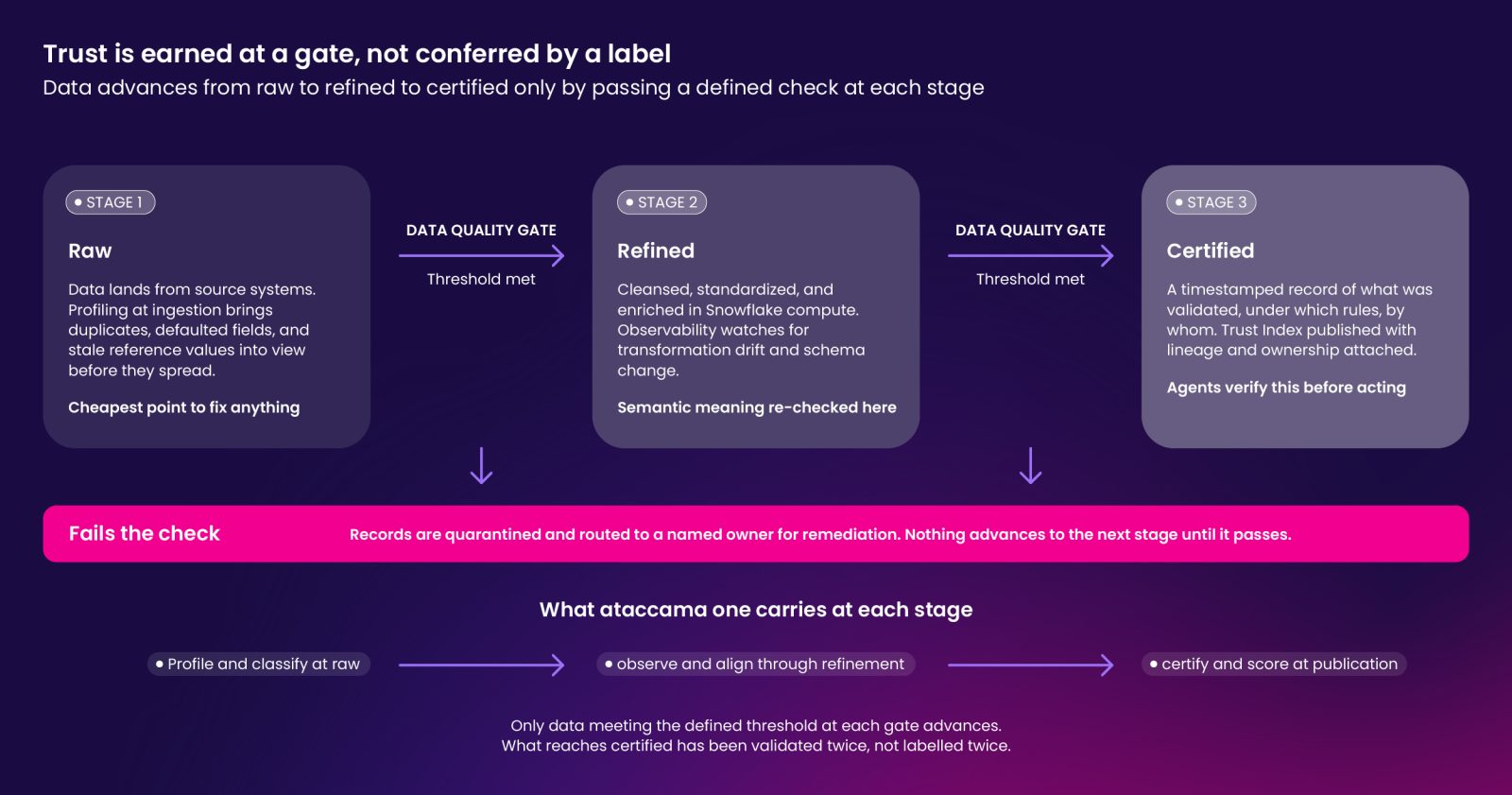
The question is what organizations do with what they discover. Some treat migration as a lift-and-shift exercise, carrying existing quality issues into a modern platform and dealing with the consequences later. Others use the migration window to resolve those issues before they propagate into analytics, operational systems, and the AI workloads that increasingly depend on them. In almost every case, the latter proves less costly than finding the same problems months later, after they’ve already influenced reports, models, and automated decisions.
Whether the initiative is driven by regulatory reporting, a customer 360 program, or enterprise AI, the principle remains the same. The cheapest time to improve data quality is when the data is already under examination. Modernization simply creates the opportunity to do it comprehensively.
| Where quality issues surface | If caught before advancing | If it surfaces downstream |
| Duplicate or fragmented customer records | Resolved once, at the source, before feeding any model | Fraud or personalization models act on the wrong profile |
| Reference data drifted from current definitions | Corrected against a governed lookup before use | Categorization and reporting quietly diverge across systems |
| Fields defaulted rather than genuinely populated | Flagged and routed for remediation | An agent treats a placeholder value as a real signal |
Data quality becomes runtime infrastructure
For years, data quality existed primarily to support human decision-making. Reports needed to be accurate enough that analysts, executives, or regulators could trust what they were seeing, with people serving as the final checkpoint before action was taken.
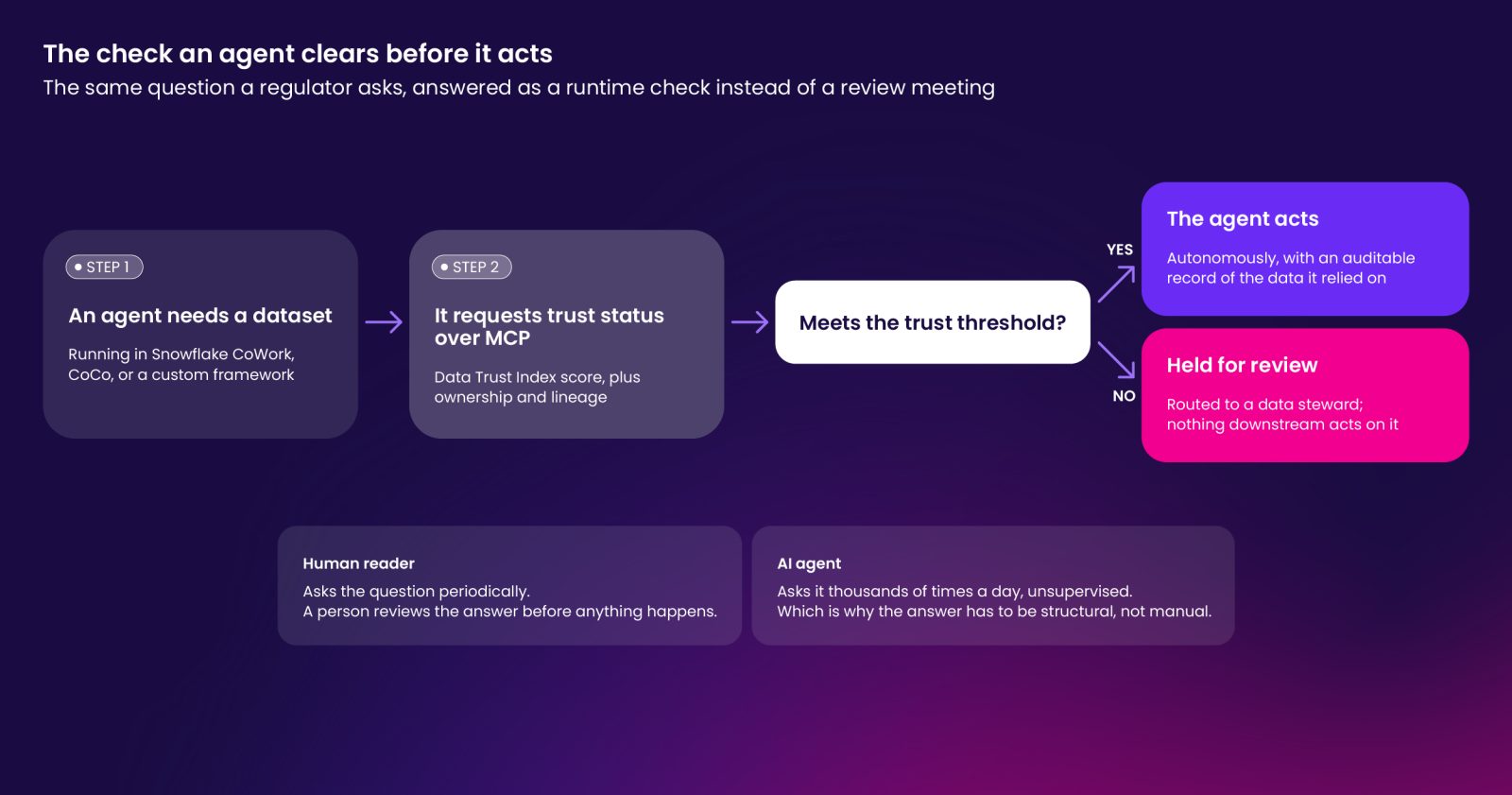
Agentic AI removes that checkpoint. An agent connected to Snowflake through CoWork, CoCo, or another framework doesn’t pause for someone to verify the data before routing a claim, adjusting a price, or responding to a customer. It reasons over the information available to it and acts immediately.
That shifts data quality from supporting human judgment to enabling autonomous decision-making. The fundamental question hasn’t changed: Can we trust this data? What has changed is when that question must be answered. Instead of relying on periodic reviews or downstream validation, AI systems need continuous, machine-readable evidence that the data they’re about to use has already been validated and certified. In other words, data quality moves from a periodic governance activity to part of the runtime infrastructure that AI depends on.
The remainder of this guide explores how organizations operationalize that model inside Snowflake using integrated platform capabilities.
Bronze, silver, and gold represent trust, not storage
Most data teams already organize data into some version of a bronze, silver, and gold progression. The model has endured because it describes something universal: trust is earned over time, not inherited simply because data moves through a pipeline.
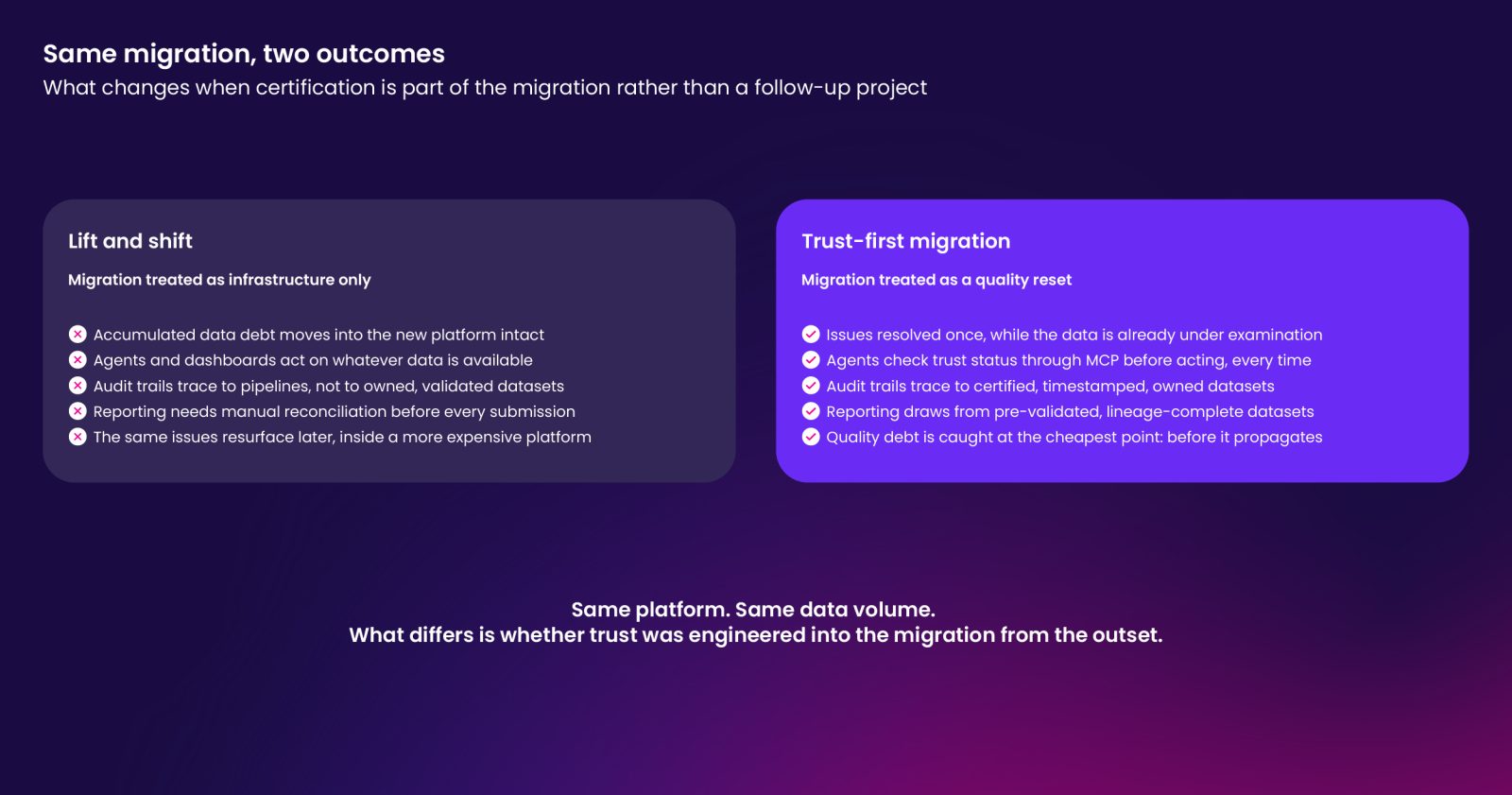
What matters is how those stages are interpreted. Too often, they become little more than storage tiers or naming conventions. In practice, each stage should represent a checkpoint that data must pass before it advances. Moving a dataset into a new layer doesn’t make it more trustworthy; validating it against defined business and technical requirements does.
At the raw stage (i.e., bronze), the priority is identifying issues before they spread downstream. Profiling at ingestion surfaces duplicate records, incomplete fields, and stale reference data while remediation is still relatively inexpensive.
At the refined stage (i.e., silver), the emphasis shifts from the data itself to the transformations applied to it. Schema changes, joins, standardization rules, and evolving business definitions can all introduce new inconsistencies, even when the underlying records passed earlier quality checks. This is also where semantics become critical. Data can satisfy every technical rule yet still represent something different from what the business intended.
By the time data reaches the certified stage (i.e., gold), the objective is no longer simply to prove it’s clean. It’s to establish that it can be trusted for operational use. Certification creates a verifiable record of what was validated, which rules were applied, who approved them, and when those checks occurred, giving analytics, applications, and AI systems evidence that the data is fit for purpose.
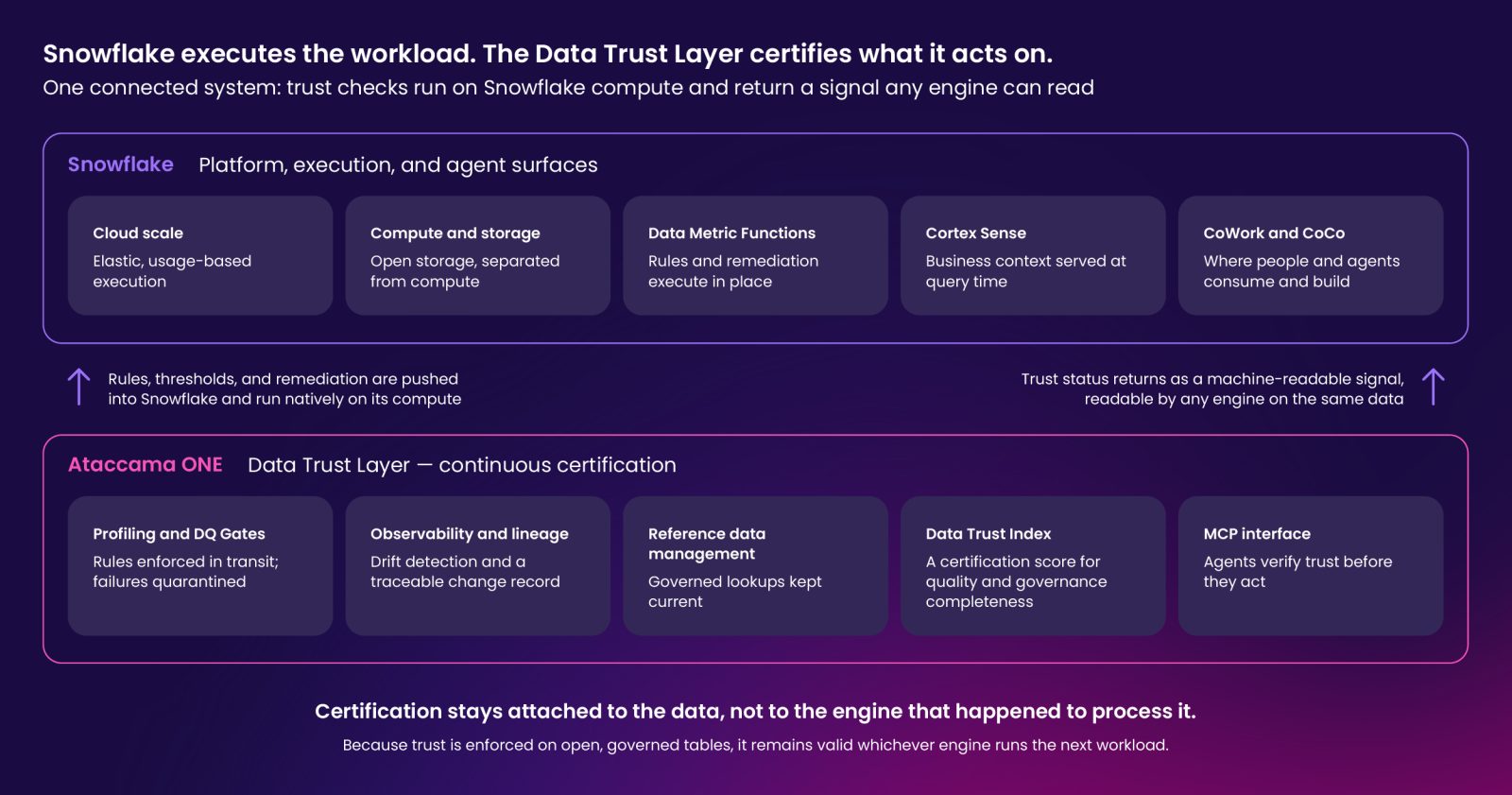
Ataccama operationalizes those checkpoints as part of a single continuous process. Data Quality Gates validate data as it enters the pipeline, observability detects drift as data changes, and the Data Trust Index publishes a machine-readable trust signal that AI systems can verify through MCP before acting. For Snowflake practitioners, the important question isn’t how those capabilities work internally, but where they integrate with Snowflake’s native pipeline, which the next sections explore.
Trust has to extend beyond Snowflake
Modern data architectures don’t stop at a single platform, and neither do AI workloads. Data increasingly moves across open table formats, multiple compute engines, and specialized processing frameworks as organizations choose the right technology for each workload. If trust has to be recreated every time data crosses one of those boundaries, it quickly becomes another integration project instead of a scalable operating model.
Snowflake’s support for open architectures reflects that reality. Technologies such as Apache Iceberg separate storage, metadata, and compute, allowing organizations to use multiple engines without duplicating data. The same principle should apply to trust. Certification, lineage, and governance shouldn’t be tied to a particular platform; they should remain attached to the data itself, regardless of where it’s queried or processed next.
That’s what allows trust to scale across an enterprise. A certification that’s meaningful only inside one platform loses its value as soon as data moves elsewhere. By contrast, trust grounded in lineage, governance, and continuous validation remains intact whether the next workload runs in Snowflake, Spark, Trino, or another engine. As modern data estates become increasingly heterogeneous, portable trust becomes an architectural requirement, rather than a convenience.
This is also where DataOps becomes essential. Lineage, governance, cataloging, and change management aren’t separate disciplines layered on top of data quality; together, they create the context that makes certification durable over time. A dataset can be accurate today yet impossible to explain six months later if no one can answer what changed, who changed it, or why. Certification without lineage is a snapshot. Certification with lineage becomes an auditable record that evolves alongside the data.
For Snowflake teams, implementing that model means enforcing trust where the data already lives. Data Quality Gates and continuous observability run natively through Snowflake Data Metric Functions, making validation part of the pipeline itself rather than an external process. The same checks applied during ingestion continue through transformation and consumption, making continuous certification part of normal execution instead of something teams remember to do later. That’s what separates a production-ready architecture from one that exists only on a whiteboard.
Why AI needs certified data before it acts
AI agents are changing how organizations interact with enterprise data. Platforms such as Snowflake CoWork, CoCo, and Cortex Sense allow agents to reason across business context and take action, whether that’s routing a claim, adjusting a price, or responding to a customer. They can’t independently determine whether the data they’re reasoning over is accurate, current, and fit for purpose.
That distinction becomes critical as organizations move from AI-assisted analysis to AI-driven execution. An agent working from uncertified data can produce an answer that is internally consistent, logically reasoned, and entirely wrong. Unlike a failed query or a broken dashboard, nothing about the output signals that the underlying data was incomplete, outdated, or inconsistent.
Consider an insurer using an AI agent to triage auto claims for fraud. The agent retrieves a customer’s policy history and household risk score from a reference table that hasn’t been reconciled since a merger several months earlier. A closed policy is still marked as active, making the household appear overexposed. Acting on that information, the agent flags a legitimate claim for investigation instead of payment. The reasoning is sound. The underlying data isn’t.
This is why certification has to become part of runtime. Before taking action, an AI agent needs a machine-readable way to verify that the data it depends on has already been validated against the organization’s quality and governance requirements. Through MCP, that trust signal can be exposed to CoWork, CoCo, or any compatible AI framework, allowing agents to verify a dataset’s certification status before acting and to route uncertain cases for human review when appropriate.
AI doesn’t fail because it lacks context. It fails because it can’t verify what it reads.
That single verification step fundamentally changes how AI operates. Without it, organizations still depend on people to review AI-generated recommendations before they can be trusted, reintroducing the very bottleneck automation was meant to eliminate. With it, AI agents can operate autonomously against certified data while people focus their attention where it delivers the greatest value: investigating exceptions rather than validating every routine decision. That’s the difference between accelerating a workflow and automating one.
Compliance-heavy industries illustrate the challenge most clearly because their traceability and auditability requirements are already well defined. Banks operating under frameworks such as BCBS 239 must demonstrate that risk data is accurate, governed, and traceable. Insurers subject to Solvency II face similar expectations. As AI becomes part of operational decision-making, those obligations don’t disappear. If an AI agent routes a fraud alert or approves a claim, organizations still need to demonstrate that the data behind that decision was validated, owned, and fit for purpose.
The same principle extends well beyond regulated industries. Whether the outcome is a regulatory filing, a customer interaction, or an AI-driven business process, every decision ultimately depends on the quality of the underlying data. An AI agent is only as trustworthy as the least-certified dataset it touches.
Certification provides the evidence that bridges that gap. Rather than assuming data is trustworthy because it exists inside a modern platform, organizations can verify that it has been validated against defined business rules, remains traceable to its source, and meets the standard required for the decision at hand. That’s what allows AI systems to operate with confidence, and gives the people responsible for them confidence as well.
Where certification actually runs inside Snowflake
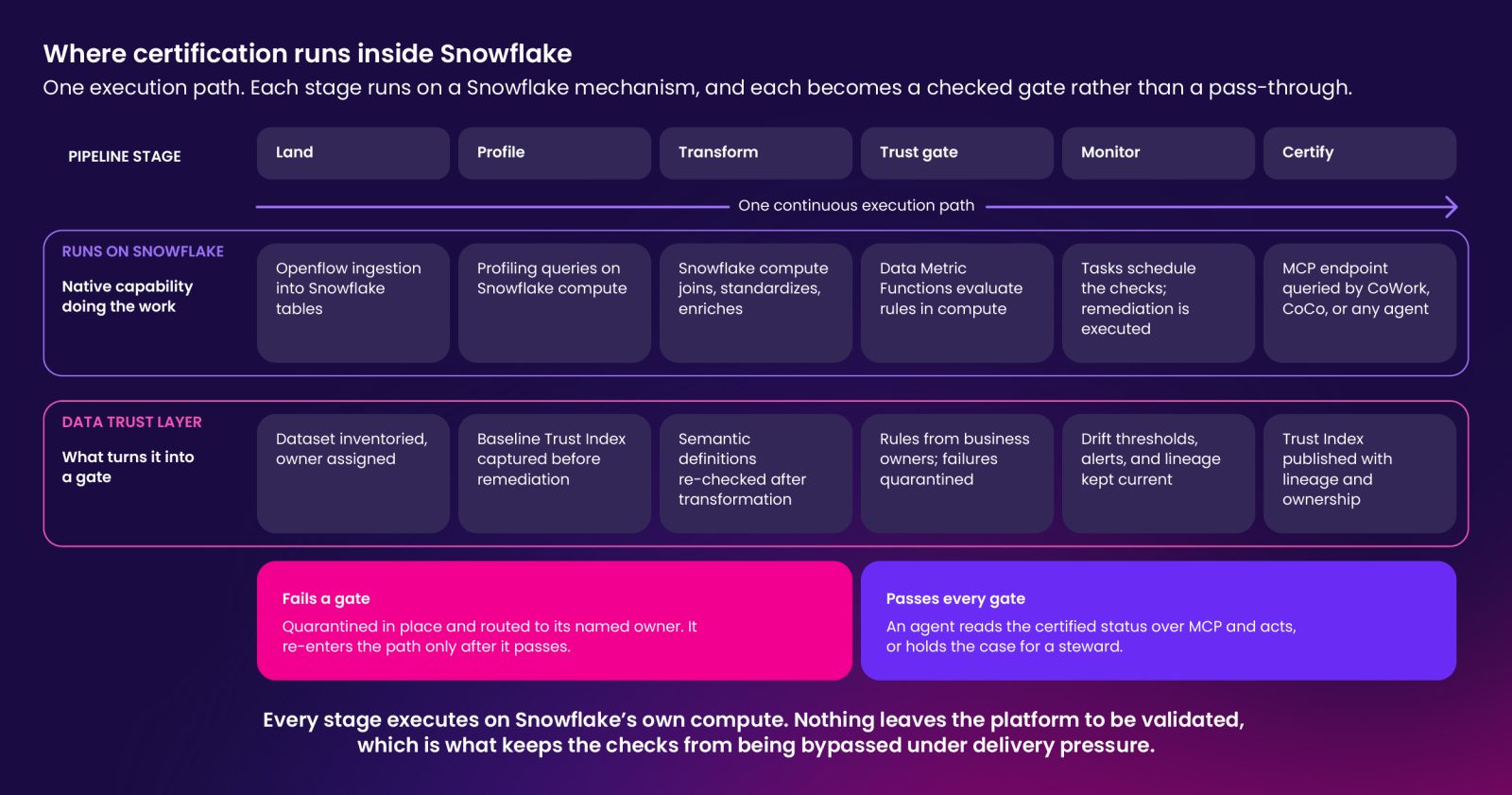
By this point, the architectural principles should be clear. The practical question is how continuous certification becomes part of a Snowflake implementation rather than a separate process running alongside it.
This paper focuses on three questions:
- Where certification runs within a Snowflake environment.
- Which native Snowflake capabilities support it.
- How those capabilities work together to make continuous certification part of the execution path.
The answer isn’t a single integration point. Snowflake provides integrated capabilities that enable validation, orchestration, and AI verification where the data already resides. Data Metric Functions run quality rules directly in Snowflake compute, keeping validation close to the data. Snowflake Tasks and OpenFlow orchestrate remediation and automation without requiring a separate workflow engine. MCP exposes certification as a machine-readable signal that CoWork, CoCo, and other compatible AI frameworks can verify before taking action.
Together, these capabilities make certification part of normal pipeline execution rather than an activity performed before or after it. That distinction matters in production. Validation that depends on exporting data to another platform inevitably introduces friction, and under delivery pressure, teams often bypass it. Validation embedded directly within the execution path is far more likely to remain continuous, consistent, and enforceable.
Scaling certification one domain at a time
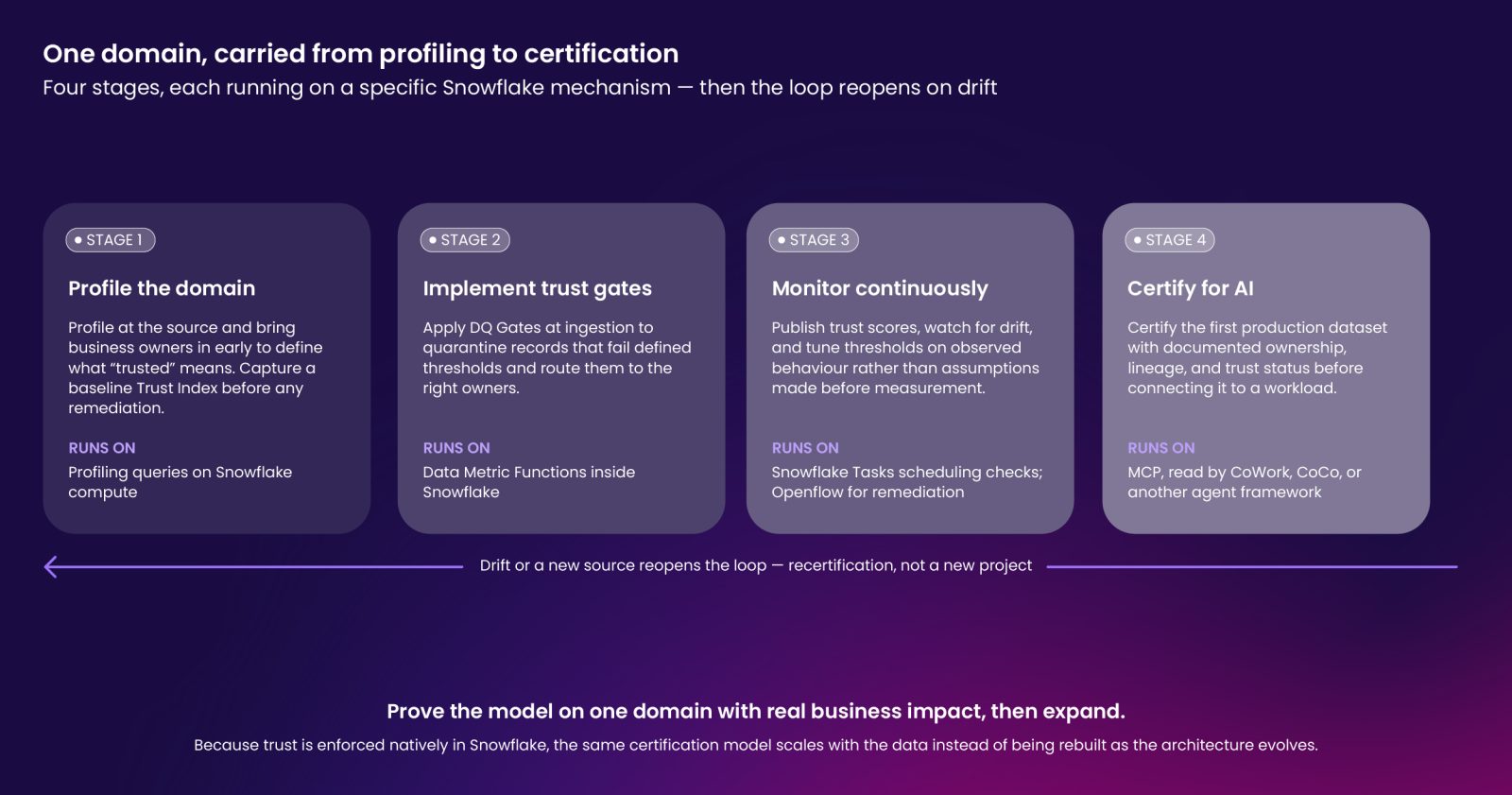
Organizations rarely succeed by attempting to certify every dataset at once. The most effective programs begin with a single business domain, demonstrate measurable value, and expand from there.
Choose a domain that matters to the business rather than one that’s simply convenient to implement. Customer data supporting a CoWork use case, claims data feeding an AI workflow, or another high-value operational dataset provides a far more meaningful proof point than an isolated technical exercise.
From there, the implementation follows a straightforward progression:
Establish a baseline. Profile the data at its source, work with business owners to define what “trusted” means for that domain, and capture an initial Data Trust Index before remediation begins.
Embed validation into the pipeline. Apply Data Quality Gates during ingestion to identify and quarantine records that fail defined thresholds, then extend those checks through Snowflake Data Metric Functions so validation continues as data moves through transformation.
Monitor continuously. Publish trust scores, detect drift as data changes, and refine validation thresholds based on observed behavior rather than assumptions made before the data was measured.
Certify for production. Before connecting a dataset to an AI workload, establish documented ownership, lineage, and certification status. Whether the consumer is CoWork, CoCo, or another agent framework, the principle remains the same: AI verifies the dataset’s certification through MCP before taking action.
This isn’t a one-time implementation cycle. As data changes, monitoring identifies drift, remediation restores certification, and the process repeats. Organizations that succeed treat certification as an operational capability that grows alongside the data estate, not a migration project with a finish line. Because validation runs natively within Snowflake, the same operating model scales from one domain to the next without being redesigned for every new workload.
Key takeaways
- AI changes when data quality matters. Data no longer supports decisions after they’re made; it shapes decisions before they’re executed. That makes continuous certification a runtime requirement rather than a governance exercise.
- Modernization is the ideal time to establish continuous certification. Every migration to Snowflake creates a rare opportunity to identify and resolve data quality debt before it propagates into analytics and AI.
- Certification belongs inside the execution path. Snowflake-native capabilities such as Data Metric Functions, Tasks, OpenFlow, and MCP enable validation, remediation, and AI verification where the data already resides.
- Trust must scale with the data. As organizations adopt open architectures and multiple compute engines, certification, lineage, and governance need to remain attached to the data rather than any single platform.
- Start with one domain and expand from there. The most successful organizations prove value on a high-impact business domain, then extend the same operating model across the enterprise.
Continue the conversation
This guide focused on how organizations operationalize continuous certification inside Snowflake using native platform capabilities.
The broader architectural principles behind that approach are explored in The Modern AI Stack: A Blueprint for Trusted Agentic AI, which examines how continuous certification, governance, observability, and AI work together as a unified operating model.
FAQ
A data trust layer continuously profiles, validates, monitors, and certifies data before it is used, giving dashboards, applications, and AI agents a machine-readable way to verify that data can be trusted. It complements platforms like Snowflake rather than replacing them.
Governance defines who owns data and what rules apply. It does not, on its own, provide a machine-readable answer an AI agent can verify before acting. Certification is what turns governance into something a system can enforce at runtime.
Governed data has documented ownership and policies. Certified data has passed those policies at a specific point in time, with a traceable record of what was validated, under which rules, and by whom. Certification is governance being continuously enforced, not simply documented.
Snowflake provides the native capabilities to execute quality checks close to where data lives, including Data Metric Functions, Tasks, OpenFlow, and MCP. A Data Trust Layer adds continuous certification, lineage, ownership, and machine-readable trust signals that AI agents can verify before they act.
As close to where the data is stored and queried as possible. Inside Snowflake, that means enforcing trust through native capabilities such as Data Metric Functions and Data Quality Gates, rather than exporting data to another platform for validation.
MCP provides AI agents, whether running in CoWork, CoCo, or another compatible framework, with a standard way to verify whether a dataset has been certified and meets the trust threshold required for a given workflow before taking action.
AI agents act without a person reviewing every decision. If the underlying data has never been validated, an agent’s confidence says nothing about whether its conclusion is correct. Certification gives AI systems evidence that the data they’re about to use has earned trust before they act.