Trusted data is what lets AI scale on Snowflake. Here’s how to build it.
Most AI pilots succeed, and that’s precisely what makes them misleading, because a pilot runs on a narrow, hand-picked slice of data under controlled conditions and tells you almost nothing about whether the same system holds up across the full scale of production, where data arrives constantly and changes by the hour. The teams scaling AI on Snowflake have learned to separate data that’s merely available from data they can actually trust, since only the second kind survives production at scale.
That distinction is the real work left over from Snowflake Summit 2026. The keynotes were convincing on where enterprise AI is heading, with Cortex CoWork putting a capable agent in front of every business user and Snowflake CoCo giving builders a data-native way to work. What decides whether your organization actually gets there is harder to see from a keynote stage, because your agents will only ever be as good as the data underneath them, and keeping that data trustworthy as it moves at scale is what turns an impressive pilot into a system the business can rely on.
Why the pilot worked and production asks more
A pilot earns its results in controlled conditions, on a narrow, hand-picked dataset with confirmed joins and a window where nothing breaks, which is exactly how you prove a model and an agent can do the job. Those same conditions are why the pilot tells you so little about production, where data shifts hourly, arrives late, changes shape, and drifts away from the business rules the agent quietly assumes are still true.
A system that works once has proven a concept, while a system that stays right as its inputs change has earned a place in production, and most AI initiatives that lose momentum after Snowflake Summit lose it somewhere between those two states. The teams that keep moving plan for the changing case from the outset, so their data holds up after launch and someone is always confirming that it does. That reliability is what protects the executive confidence you’ve built and keeps budget flowing toward the next use case rather than toward cleaning up the last one.
What trusted data actually means
Trust is worth defining precisely, because the word gets stretched until it means nothing. Trusted data is data you can confirm is fit for a specific purpose, measured against the rules that define what correct means for your business, and it holds that standard as it changes. Availability is where you begin and trust is what you maintain, so an agent doesn’t need data that was clean last quarter, it needs data that is still right at the moment it acts.
Monitoring and data quality both contribute here, and seeing how they differ is what separates a genuine capability from a dashboard. Monitoring and observability tell you that something moved, whether a row count dropped, a distribution shifted, or a column went null more often than it should, and that visibility is worth having. Continuous data quality answers the question that visibility raises, because a change only matters when it breaks a rule that affects how the data gets used. Data quality validates data against the rules your business actually runs on, resolves the issues those rules surface, and confirms the data is fit before an agent ever reaches it, so where monitoring shows you what changed, data quality tells you whether you can still rely on what you have. Reliable AI depends on both working together.
The semantic layer rewards getting the data right first
The semantic layer drew much of the Snowflake Summit conversation, and deservedly so, because a shared semantic model is how an agent learns that revenue means the same thing to finance and to sales, and how you stop three teams from deriving the same metric three different ways. It’s among the most valuable things you can build on Snowflake, and it raises the return on getting the underlying data right beforehand.
A semantic layer multiplies whatever sits beneath it, so when it’s built on data that has been validated and proven trustworthy, it scales reliability to every agent, dashboard, and decision that touches it, which is the entire reason to build one. A Cortex CoWork agent querying a well-governed semantic layer returns consistent, trustworthy answers across the business, and everyone downstream inherits that confidence. Establishing trust in the data before the layer goes live is what makes the semantic model a multiplier for reliability across every AI and analytics workload you put on top of it.
What it takes to be ready before you scale
Readiness is something you can work through deliberately before committing to scale, and four questions tell you most of what you need to know about any given use case. The first is rule coverage, which asks whether enforced quality rules exist for the specific data products your AI will consume, the kind that capture what correct actually means for your business. The second is monitoring scope, which asks whether those data products are watched continuously as data moves through transformation, so issues surface early enough to stay ahead of them. The third is ownership, which asks whether someone owns the trustworthiness of each data product with the authority to maintain it, and whether the handoff between the data team and the AI team is deliberate rather than assumed. The fourth is proof, which asks whether you can confirm a dataset is fit for its intended purpose right now and show the evidence.
Answer all four confidently for your highest-priority use case and you’re ready to scale it with momentum, and where an answer is still taking shape, you’ve found your pre-production work early, while it’s quick(er) to address. The move that pays off most is aligning whoever owns the AI initiative with whoever owns the data behind it around a single shared definition of ready, because getting that handoff right is what lets every use case after this one move faster.
How Ataccama and Snowflake work together
Snowflake is where the work happens, since your data lands there, your agents run there, and Cortex CoWork and Snowflake CoCo operate there, so the opportunity is to make the data those workloads depend on trustworthy enough to carry what you’re building and to keep it that way as the data changes underneath.
Ataccama provides that data trust layer. As data moves through transformation, Ataccama continuously monitors for the anomalies, schema changes, and freshness issues that observability tools surface, and it goes further by validating data against your business rules and resolving quality issues before they reach the semantic layer, the agents, or the reporting leadership relies on. It runs where your Snowflake data already lives rather than as a separate system you reconcile afterward, and it produces the trust signals that tell an agent whether the data it’s about to act on is fit for the job. The result is a repeatable way to turn available data into trusted data, so readiness becomes something you can demonstrate rather than something you hope for.
What this looks like running at scale
Enact Mortgage Insurance, a Raleigh-based private mortgage insurer where data drives underwriting accuracy, regulatory compliance, and risk management, shared their story on stage with us at Snowflake Summit, and it offers a concrete picture of what the work produces once it is in place.
Enact set out from a familiar starting point, with no single version of the truth, data quality handled reactively, and trust that depended on IT to vouch for it. Working through a multi-year effort to move onto a governed, cloud-based foundation and then onto Ataccama ONE for data quality, observability, and cataloging together, the team reached a state that is difficult to argue with. Their environment now runs tens of thousands of cataloged assets, hundreds of anomaly detection checks, and thousands of data quality rules, executing thousands of jobs a day.
As Christopher Scott, Senior Manager of Data Management at Enact, put it from the stage, this is not a pilot; it is daily operational control.
The point worth drawing from that is not the size of the numbers but what they represent, which is exactly the shift from data that happened to be clean to data whose trustworthiness is confirmed continuously and at scale.


That combination, people accountable for trust and a platform that enforces it automatically, is what lets an organization put AI on top of its data with confidence rather than hope.
What to take away
- Build and evaluate AI for the changing case from the start, because production data never holds still and the strongest results come from planning for that rather than discovering it.
- Treat trust as something you maintain continuously, since data that was fit last quarter is not necessarily fit at the moment an agent acts on it.
- Pair monitoring with data quality, because monitoring shows you what changed while data quality, enforced against your business rules, tells you whether you can still rely on what you have.
- Establish trust in the data before the semantic layer goes live, so the layer scales reliability across everything built on it rather than amplifying errors.
- Work through readiness deliberately, across rule coverage, monitoring scope, ownership, and provable fitness, before you commit to scaling.
- Align the AI owner and the data owner around one definition of ready, and every use case that follows moves faster.
The work that turns Snowflake Summit energy into production results
The organizations that win with AI on Snowflake are the ones that made trusted data a habit before the pressure to ship arrived, so every agent and analytics workload they build starts from a foundation the business already believes in. Snowflake Summit set the destination, and the work now is making sure your data can carry you there reliably, on the two hundredth day as much as the first.
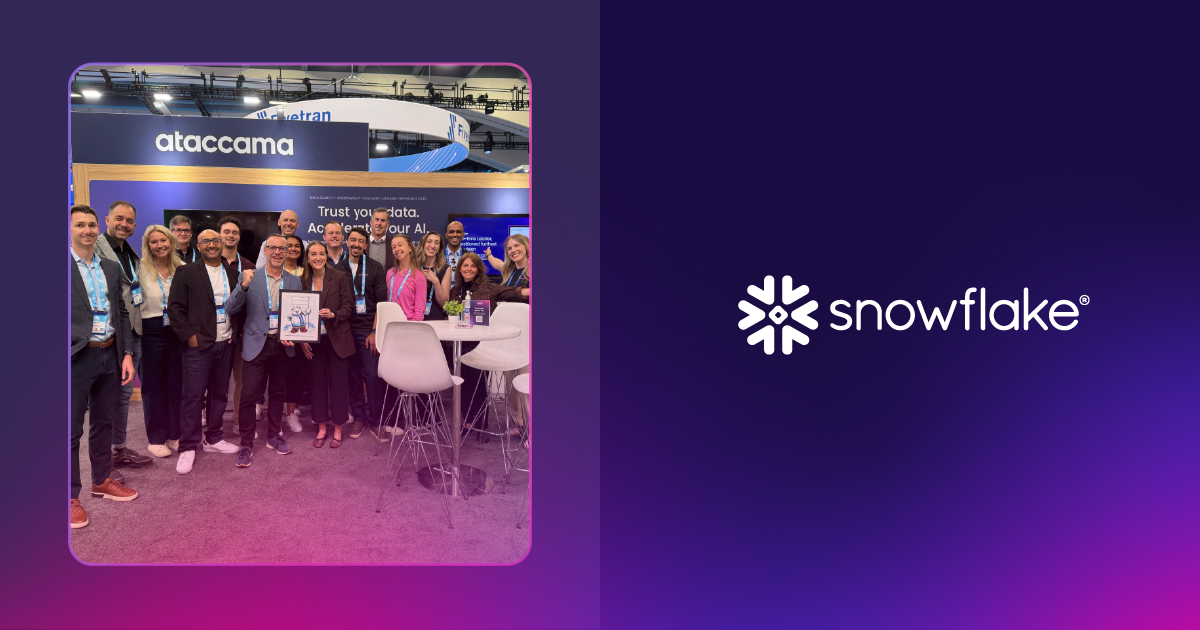
If you talked with us at the booth, this is the conversation we were starting, and if you didn’t make it by, it’s an easy one to open now.
Whether you stopped by our booth at Summit or want to start the conversation now, let’s walk your top Snowflake AI use case against the four readiness questions and show you where your data stands today.
FAQ
AI data readiness is the degree to which your data is trustworthy enough for AI agents and analytics to rely on in production. On Snowflake, it means the data your Cortex CoWork agents, builder workloads, and semantic models consume has enforced quality rules, continuous monitoring through transformation, clear ownership, and provable fitness for its intended use.
Data observability detects that something in your data changed, such as a dropped row count or a shifted distribution. Data quality determines whether the data is fit to use, measured against the rules that define what correct means for your business. Observability tells you what happened, data quality tells you whether you can still rely on the data, and reliable AI needs both.
Pilots run on curated, stable data, while production data shifts hourly, arrives late, and changes shape over time. A pilot proves the concept, and staying reliable as inputs change requires continuously validating the underlying data against business rules and resolving issues before they reach agents or reporting, which is what separates a demo from a dependable production system.
Answer four questions for the data your AI will use. Do enforced quality rules exist for it? Is it monitored continuously as it moves through transformation? Does someone own its trustworthiness with the authority to maintain it? Can you confirm and prove it is currently fit for its intended purpose? Confident answers to all four mean you are ready to scale that use case.
Lauren Ruth
Lauren is the Director of Global Communications at Ataccama. With over a decade in the data industry, she specializes in strategic communications and has helped fast-growth startups define and amplify their data stories. She previously led communications at Alation and Informa Markets and holds a dual B.S. in Business and Communication, with a specialization in Technology, from Cornell University.