What’s new in the 2026 Gartner® Magic Quadrant™ for Augmented Data Quality solutions?
Why this year’s quadrant is different
- AI assistants are now formally evaluated. The research scope expands beyond AI in general to include AI-assistant-enabled interactions as a common feature.
- Innovation now explicitly calls out GenAI and agentic AI automation. Gartner is looking for GenAI/agentic AI driven automation, including conversational agents for rule creation, remediation, and self-service queries.
- Alerts and visualization are now mandatory as a standalone capability. Dashboards, scorecards, mobile access, and systems that learn from user feedback to refine notifications are promoted into a required capability.
- Unstructured data scope adds graph technologies. Gartner’s language now includes graph technologies to identify relationships across extracted entities.
- “AI/ML Development” becomes “Analytics and AI readiness.” The use case now emphasizes monitoring production AI pipelines, not only training data preparation.
- A new Market Evolution section signals the 2026 narrative. Gartner highlights data products, data contract SLAs, enabling nontechnical users, and expanding support for unstructured and semi-structured content.
The 2026 Gartner® Magic Quadrant™ for Augmented Data Quality solutions reflects a clear shift in what “augmented” means. AI is no longer just about automation under the hood. Gartner now expects assisted, conversational experiences that help teams create rules, remediate issues, and answer questions without specialized expertise. At the same time, observability expectations rise: alerts and visualization are treated as a first-class capability, and “Analytics and AI readiness” expands the scope to monitoring production AI pipelines.
Below are the most important scope changes and how they affect how vendors were evaluated in the 2026 report.
Key scope changes in the 2026 Magic Quadrant
Snapshot of the five most significant scope changes
| Scope change | Gartner’s emphasis | What it means for data leaders |
|---|---|---|
| AI-assistant-enabled interactions | AI assistants are formally evaluated; AI-assistant-enabled interactions become a common feature | Look for conversational experiences that reduce friction across rule creation, remediation, and self-service queries. |
| Innovation: GenAI/agentic AI driven automation | Innovation explicitly calls out GenAI and agentic AI driven automation | Prioritize platforms that can automate more of the lifecycle through agentic and conversational interactions, not only recommendations, when evaluating a Gartner data platform. |
| Alerts and visualization as a required capability | Dashboards, scorecards, mobile access, and learning from user feedback to refine notifications | Make monitoring UX and notification workflows a selection criterion, not a nice-to-have under profiling/monitoring. |
| Unstructured data with graph technologies | Graph technologies for identifying relationships across extracted entities are included in scope | Evaluate how unstructured extraction ties to relationship discovery and downstream quality checks. |
| Analytics and AI readiness | Renamed from AI/ML Development with added emphasis on monitoring production AI pipelines | Ensure data quality supports both AI readiness and ongoing monitoring as AI pipelines move into production. |
1. AI-assistant-enabled interactions are now a common feature
In the 2026 scope, AI assistants are formally evaluated, and AI-assistant-enabled interactions are identified as a common feature. This pushes vendors to prove the quality of assisted experiences, not only the presence of AI features.
Gartner wants to see conversational agents that support:
- Rule creation
- Remediation
- Self-service queries
2. Innovation explicitly calls out GenAI and agentic AI driven automation
The 2026 evaluation makes the Innovation criterion more specific by explicitly calling out GenAI/agentic AI driven automation. Gartner is signaling that automation should be driven by GenAI and agentic approaches, including conversational paths that help users act, not only observe.
3. Alerts and visualization are promoted into a mandatory capability
Alerts and visualization move from a sub-element of profiling/monitoring into a standalone mandatory capability. Gartner’s emphasis includes:
- Dashboards
- Scorecards
- Mobile access
- Systems that learn from user feedback to refine notifications
This elevates monitoring UX from “feature coverage” to “must demonstrate.”
4. Unstructured data scope adds graph technologies for entity relationships
Unstructured data expectations now include graph technologies for identifying relationships across extracted entities. The net effect is that quality programs for text and other unstructured sources are expected to move beyond extraction and into relationship-aware checks.
5. “Analytics and AI readiness” expands the AI pipeline story
Gartner renamed the “AI/ML Development” use case to “Analytics and AI readiness” and added emphasis on monitoring production AI pipelines. In practice, this reframes “AI readiness” as an ongoing operational requirement, not just a data preparation stage.
Market Evolution themes Gartner is signaling for 2026
Gartner includes a Market Evolution section that telegraphs the narrative direction and what buyers are expected to prioritize:
- Unstructured and semi-structured content support is expanding as a core expectation
- Data products and data contract SLAs are emerging as a use case for data quality
- AI-assisted technologies for interactive rule creation, remediation suggestions, and result interrogation are becoming differentiators
- Scaling AI ambitions with data quality underpinning AI readiness is a key buyer driver
- Reducing technical complexity and time to value is emphasized, with a focus on enabling nontechnical users
How Ataccama is leading the charge in data quality
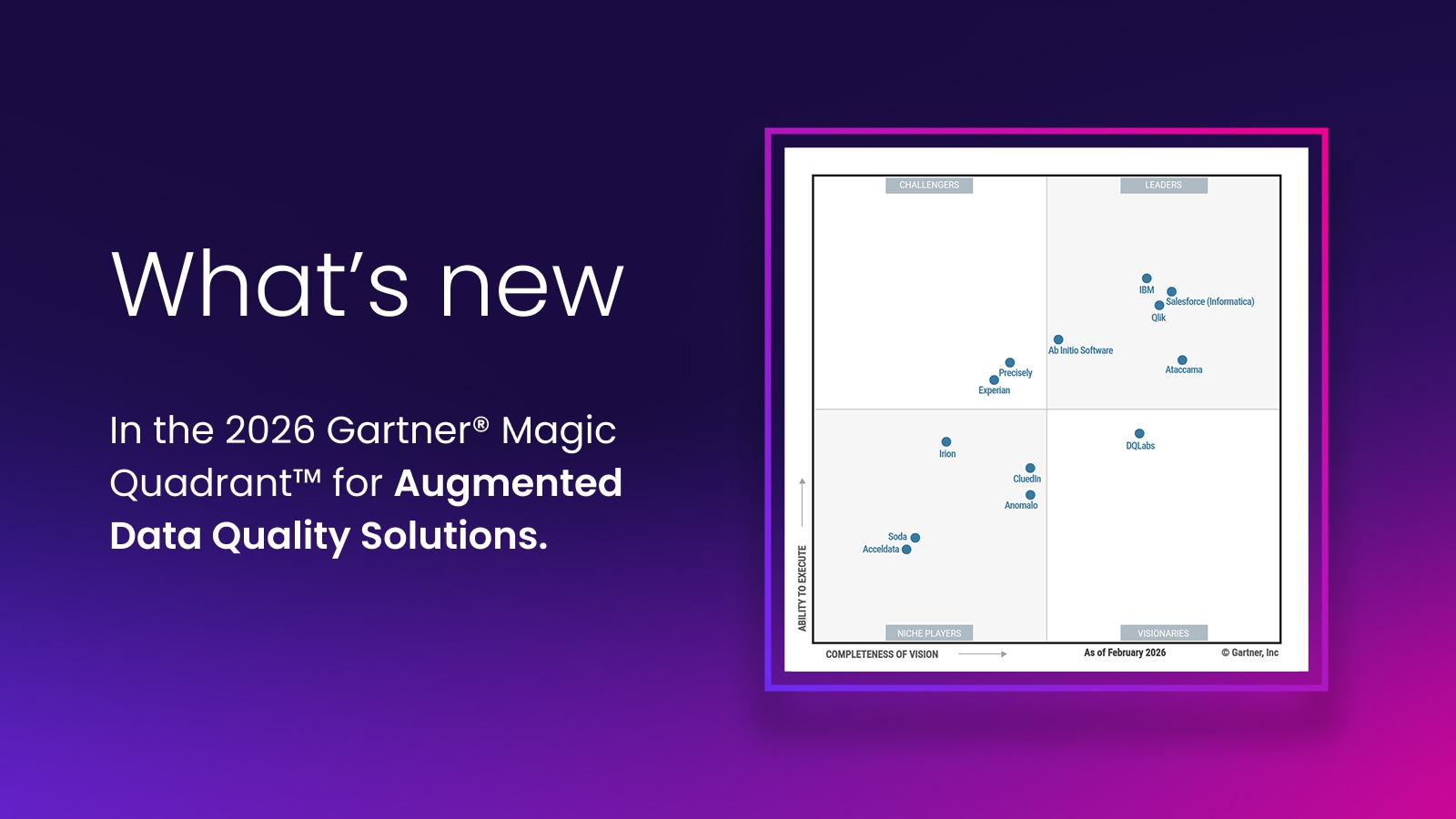
In the 2026 Gartner® Magic Quadrant™ for Augmented Data Quality Solutions, Ataccama was named a Leader for the 5th consecutive time and ranked #1 for completeness of vision.
Vendor with the strongest vision
Ataccama ranked the highest in the critical “Completeness of Vision” dimension in this year’s Magic Quadrant report. Gartner also highlighted strengths in:
- Integrated agentic capabilities
- Data Trust Index functionality for determining the trustworthiness of data sets
- Transparent, capacity-based licensing
Why this positioning matters in 2026
We believe our top positioning reflects:
- Investment into innovating the Ataccama ONE platform
- Deep understanding of how the data quality market is evolving
- Market demand for data trust that accelerates AI readiness
Ataccama ONE delivers all data management capabilities required to establish a data trust layer within a modern AI stack, alongside the ONE AI Agent: a digital data steward that helps teams scale data quality, maximize efficiency, and accelerate ROI.
Key market shifts in 2026
In this year’s report, Gartner highlights several major trends shaping the future of data quality:
- Unstructured and semi-structured content support expanding as a core expectation
- Data products and data contract SLAs emerging as a use case for data quality, with quality assurance being applied to data-as-a-product scenarios
- The rise of AI-assisted technologies for interactive rule creation, remediation suggestions, and result interrogation
- Scaling AI ambitions as a key business driver, with data quality underpinning AI readiness
- Reducing technical complexity and time to value to enable less technical users
Frequently asked questions
What changed in Gartner’s 2026 evaluation scope compared to 2025?
The 2026 scope formally evaluates AI assistants and introduces AI-assistant-enabled interactions as a common feature. It also promotes alerts and visualization into a mandatory capability, expands unstructured data scope to include graph technologies for entity relationships, renames “AI/ML Development” to “Analytics and AI readiness,” and adds a Market Evolution section that highlights data products, data contract SLAs, and enabling nontechnical users.
What does Gartner mean by GenAI/agentic AI driven automation in the Innovation criterion?
In 2026, Gartner explicitly calls out GenAI/agentic AI driven automation within Innovation, and wants to see conversational agents that help users create rules, remediate issues, and run self-service queries.
Why do alerts and visualization matter more in 2026?
Gartner promotes alerts and visualization from a profiling/monitoring sub-element to a standalone mandatory capability and expects dashboards, scorecards, mobile access, and systems that learn from user feedback to refine notifications.
What’s new about unstructured data in 2026?
Gartner’s language adds graph technologies for identifying relationships across extracted entities, expanding expectations beyond extraction into relationship-aware understanding.
What is Gartner signaling with the Market Evolution section?
The 2026 narrative direction emphasizes expanding unstructured and semi-structured support, applying quality to data products and data contract SLAs, making AI-assisted interactive experiences a differentiator, underpinning AI readiness, and enabling nontechnical users by reducing complexity and time to value.
David Lazar
David is the Head of Digital Marketing at Ataccama, bringing eight years of experience in the data industry, including his time at Instarea, a data monetization company within the Adastra Group. He holds an MSc. from the University of Glasgow and is passionate about technology and helping businesses unlock the full potential of their data.