The Rise of the Data Trust Layer in the Modern AI Stack

For the last decade, the modern data stack focused on a single goal: helping organizations understand their business. Companies spent millions consolidating data into storage powerhouses under the assumption that visibility equaled readiness. This architecture functioned primarily because humans were part of the system. When an analyst saw a duplicate or a formatting error on a chart, they mentally corrected it before taking action. In short, humans acted as the safety buffer between messy data and business decisions.
However, the transition to agentic AI has effectively removed that buffer. Today, enterprises are building for autonomous agents that do not just read data, but act on it. These systems lack the human intuition to pause when they encounter an anomaly or debate a conflicting definition across teams. Consequently, information that was once “mostly accurate” for a dashboard becomes a massive liability when it drives real outcomes. If an agent is fed bad data, it will not just produce a confusing report; it will process the wrong refund, email the wrong customer, or trigger a compliance breach at machine speed.
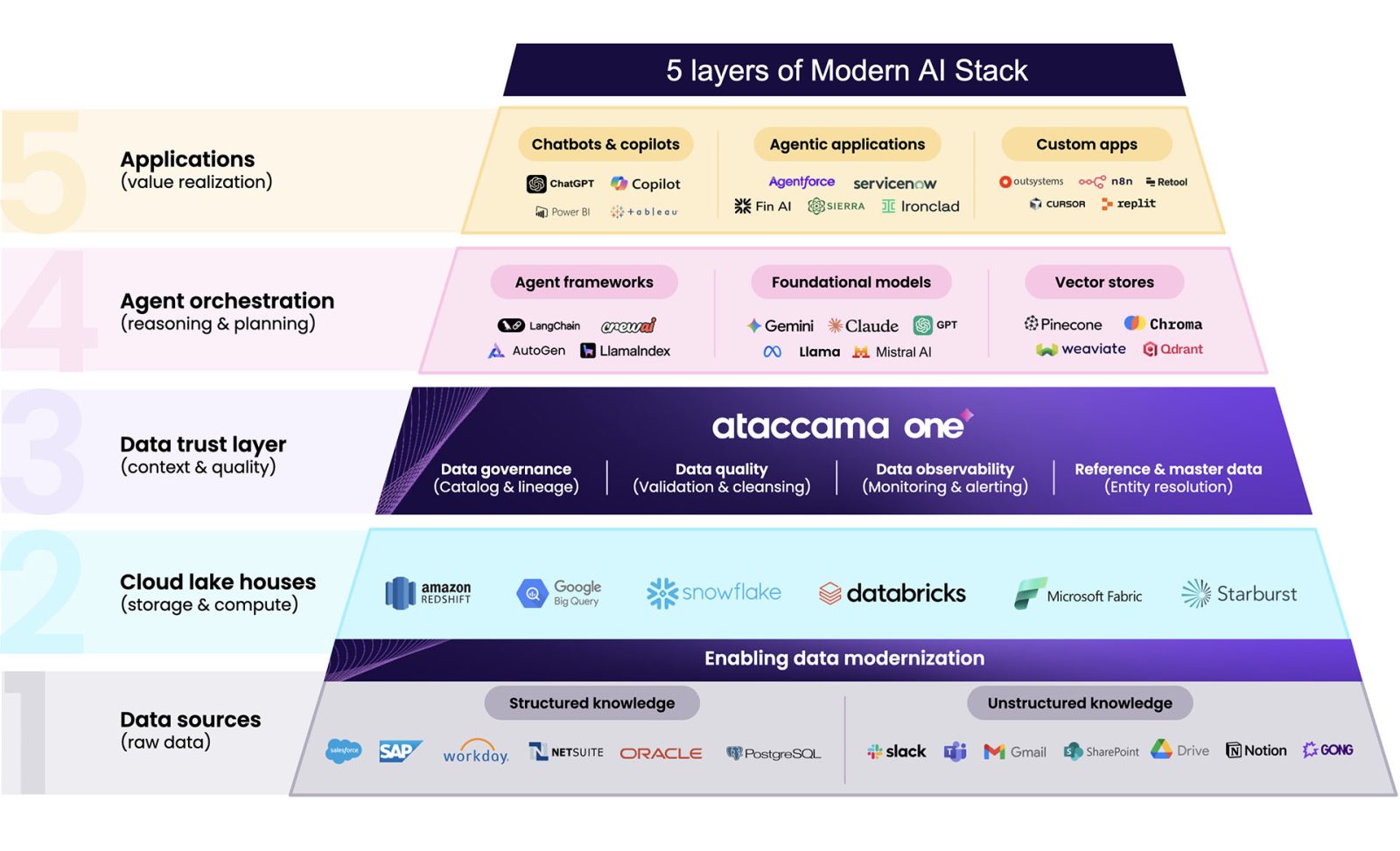
Five layers of the Modern AI Stack
Why the AI Data Cloud Needs a Brain
To meet this challenge, organizations are leaning into the power of the AI Data Cloud. Platforms like Snowflake and Databricks provide a world-class engine for storage and compute. They successfully solve the problem of scale and provide technical catalogs to track where data lives. However, for an AI agent to move from “reading” to “acting,” it requires more than just high-performance storage; it needs business context.
While a data cloud is designed to make information accessible, it is not its role to determine if that data is actually fit for the specific business decision an agent is about to make. This “trust gap” is where many AI initiatives stall because data clouds store bad data just as efficiently as good data.
What is a data trust layer?
To resolve this, organizations need a dedicated trust layer that sits between storage and execution. It acts as the “pre-frontal cortex” for AI infrastructure, validating and governing the data before an agent ever touches it. Put simply, this layer helps enterprises fix bad data and ensure they are only using trusted, high-quality data for AI.
Why trusted AI starts with trusted data
The phrase “trusted AI” has become a stated goal for enterprise AI programs, and organizations spend significant energy on LLM selection, prompt engineering, and model evaluation. But the actual failure point is almost always upstream: the data the model reasons from.
A model is only as trustworthy as the data it receives. If the data feeding an agent is duplicated, incomplete, or ungoverned, the agent’s outputs carry those flaws into production decisions at speed and at scale. A well-tuned model operating on bad data doesn’t produce slightly wrong answers; it produces confidently wrong answers, at volume, faster than any human team can catch them.
The path to trusted AI runs through trusted data. The data trust layer is the infrastructure that makes this achievable, as an active enforcement layer that validates and governs data before execution. Every organization building agentic AI data infrastructure needs this layer in place. Without it, the speed advantage of automation becomes a liability rather than an asset.
The five components of a data trust layer
A data trust layer is not a single technology. It’s a system of five interconnected capabilities, each addressing a different way data can fail an AI agent.
Data quality
Data quality is the foundation. It validates and fixes data against defined standards for accuracy, completeness, consistency, and conformity, so that every record an AI agent acts on meets the requirements the business has set.
Anomaly detection alone is not the same as data quality. Detection identifies that something has changed; data quality rules define what “correct” means for a specific field, domain, or business process. A consent field, a product code, a customer classification: each of these requires deterministic validation, not statistical inference about whether the current value looks different from yesterday’s.
For AI specifically, two properties become critical. Data reliability is the consistency and stability of data over time, ensuring models are not acting on stale or shifted inputs. Data quality for AI means data meets the precision requirements of automated execution, not just human review. Both must be built into the quality layer from the start, not retrofitted after a model fails in production.
Data governance
Data governance defines the policies, ownership, and standards that determine what “good data” looks like for each domain. It answers the question an AI agent cannot answer for itself: who owns this data, what policy applies to it, and what does it mean in this business context?
Without governance, an agent operates in a policy vacuum. It processes data that may be accurate in isolation but incorrect in context: a product hierarchy that violates a classification rule, a customer record that should be flagged for regulatory review, an attribute carrying three different definitions depending on which team sourced it. Governance gives the trust layer its intent. Data quality rules enforce that intent at the field level. In any production environment where data governance for AI agents is a real requirement rather than a checkbox, the two capabilities are inseparable.
Data lineage
Data lineage traces every record from its source through every transformation to its point of consumption. When an AI agent produces an output, lineage is the audit trail that makes the outcome explainable.
In a regulated environment, this is non-negotiable. A financial services firm cannot tell a regulator that “the model didn’t flag an anomaly” when a decision triggers a compliance review. It has to show exactly what data the agent used, where that data came from, and whether it was governed at every step. Lineage also enables impact analysis: if a source system changes upstream, lineage identifies which AI models and automated workflows are affected before the change causes a downstream failure.
Data observability
Data observability is the continuous monitoring of data pipelines and assets for anomalies, schema drift, volume changes, and unexpected shifts. It’s the early warning system of the trust layer.
Where data quality rules enforce what data must be, data observability detects when something is different. The two capabilities work together: observability catches pipeline-level issues before they contaminate governed datasets, while quality rules determine whether a detected change is a problem or an expected variation. For AI, pipeline observability is a prerequisite for reliable model inputs. A schema change in a source table can silently break a feature pipeline. A volume drop can make a model’s training distribution stale without triggering any visible error. Observability catches these issues before they become model failures.
Master data management
Master data management (MDM) matches, deduplicates, and governs records for the enterprise’s most critical shared domains, such as customers, products, employees, and locations, creating a golden record that serves as an authoritative reference for each entity. These records increasingly underpin AI-driven decisions, yet they are also likely to exist in multiple, conflicting versions across enterprise systems.
The duplicate customer scenario from the introduction is an MDM problem. Without a golden record, an agent has no reliable reference point for determining that three different customer records represent the same person or which attributes should make up the trusted representation of that customer. It simply acts on whatever record it receives.
MDM resolves that entity-level ambiguity by matching and merging records into a consistent, authoritative representation. Combined with data quality, governance, lineage, and observability, it gives AI systems not just accurate data, but trusted entities they can reliably act on.
The 5 levels of data trust readiness for agentic AI
Most enterprises know they need better data. Fewer know exactly where they stand or what the next step looks like. This maturity model gives you a way to locate your organization and identify the highest-leverage action to take next.
Level 1: Unmanaged
No formal data quality or governance processes are in place. Data issues are discovered when business users report them, usually days or weeks after they occur. AI initiatives stall at the proof-of-concept stage because the data feeding models is undefined, undocumented, or simply unreliable. Teams spend a significant portion of their time searching for, reconciling, and verifying data before it can be used.
How to advance to Level 2: Start with data profiling across your most critical datasets. Understand the actual state of your data before attempting to fix it. Assign an owner to each key data domain.
Level 2: Reactive
Basic data quality checks exist but are ad hoc and manually triggered. Issues are identified after they cause downstream failures, not before. There is no continuous monitoring. Each data quality effort is a one-off project, and the same problems tend to recur because root causes are not systematically addressed. AI projects can begin but require significant manual data preparation before each run.
How to advance to Level 3: Formalize data quality rules and document them centrally. Begin capturing data lineage for your most critical pipelines, even if coverage is partial. Establish data ownership formally so that policies have named, accountable parties.
Level 3: Defined
Data quality rules are documented and applied consistently across core datasets. Data governance policies exist in written form. Data ownership is assigned. Lineage is partially mapped for key data flows. AI projects can reach production, but they require manual validation checkpoints because trust in the data is not yet quantified or continuously verified. Data reliability and data quality for AI are understood as requirements but not yet systematically measured.
How to advance to Level 4: Implement continuous observability across data pipelines. Publish quality scores so data consumers, including AI models and the people building them, can see the state of the data before acting on it. Move from point-in-time quality checks to always-on monitoring.
Level 4: Monitored
Continuous data observability is in place. Anomalies, schema changes, and pipeline failures are detected proactively and generate alerts before they reach downstream systems or AI models. Quality scores are tracked, visible, and available to data consumers. AI initiatives progress to production. Human checkpoints remain in place, but they are validation steps rather than data-cleaning exercises. AI-ready data is achievable at this level for defined, well-governed datasets.
How to advance to Level 5: Connect trust signals to AI consumers programmatically, via API or MCP Server, so agents can query whether a dataset is reliable before executing. Automate rule generation so that new datasets are governed from day one. Extend lineage and observability coverage to the full data estate, not just the highest-priority domains.
Level 5: Trusted
An end-to-end data trust layer is operational. Data quality, governance, lineage, observability, and master data management work as an integrated system rather than separate tools or projects. Trust signals travel with data to AI consumers via API or MCP Server. Agentic AI can execute without human checkpoints because every dataset it receives has been validated, governed, and is explainable under audit. This is the state of fully AI-ready data: not a one-time achievement, but a continuously maintained operational property of the data estate.
Most enterprises sit between Level 2 and Level 4. The gap between where they are and where their AI ambitions require them to be is exactly what a data trust layer is designed to close.
Find out where your organization sits. Take the data trust assessment.
Why Data Trust Cannot Be “Ruleless” Alone
Implementing this layer requires a shift in how we think about quality. There is a narrative that “ruleless” anomaly detection is a complete substitute for data quality. While these techniques are helpful for catching technical blips and pipeline signals, anomaly detection alone is not the same thing as enterprise trust. Detection identifies that something is different, but it cannot understand intent. It cannot tell you whether a change is harmful to a specific business process or if it violates a strict policy.
In a complex enterprise, “good data” is not a statistical average; it is a deterministic requirement. A consent field must be correct, a product hierarchy must follow policy, and a risk flag must be explainable under audit. Relying solely on ruleless signals can create a state of false confidence, where a team sees no anomalies yet still has data that is unfit for use.
Ataccama bridges this gap by combining detection with agentic enforcement. We use AI to help generate data quality rules quickly, while still grounding trust in the deterministic requirements the business depends on. We believe the future isn’t a choice between rules and AI, but a hybrid model that uses each where it is strongest: observability for pipeline integrity and agentic automation for business intent.
The Competitive Edge of Responsibility
The modern data stack helped organizations understand their business. The modern AI stack must help them run it responsibly. This shift is required in regulated environments, where accountability is non-negotiable and explanations matter as much as outcomes. In sectors like financial services, every automated action must be explainable and defensible under audit. Organizations cannot simply tell a regulator that “the model did not flag an anomaly” and expect to pass.
To operate safely, AI needs deterministic context. Ataccama provides that foundation by removing ambiguity before data reaches the agent. As a result, enterprises can move from risky experimentation to scalable automation, because they can trust what the agent is using, explain what it did, and defend why it did it. It is time to stop treating trust as a manual workflow or a passive dashboard. Instead, it must become the architectural foundation for the enterprise.
How Ataccama ONE functions as the data trust layer
Ataccama ONE is built to operationalize all five components of a data trust layer as a unified platform, not as five separate tools that have to be stitched together.
The ONE AI Agent acts as a digital data steward. It automates the time-consuming work of building data trust: profiling datasets, generating quality rules, suggesting where rules should apply, enriching metadata, and recommending remediation. Your data management team focuses on governance decisions rather than manual rule creation. Data engineers keep control of pipelines; the stewardship work moves to the people best positioned to own it.
The Data Trust Index is how trust is quantified and communicated. It’s not a binary pass/fail; it’s a continuous signal that tells AI consumers which datasets are reliable, at what level of confidence, and for which use cases. That signal travels with the data.
The MCP Server is how those trust signals reach AI consumers without requiring custom integrations. External AI tools, models, and agents can query Ataccama’s governed, context-rich data directly, receiving both the data and its trust status in a single call. This is what makes agentic AI at Level 5 of the maturity model practically achievable: agents don’t just receive data; they receive data that has already been validated, scored, and cleared for the decision at hand.
Build your AI on a foundation of certainty, not anomalies.The modern AI stack is only as powerful as the data that fuels it. If you are ready to move past passive observation and implement the critical trust layer your agents require to execute safely, we can help. Book a demo today.
Jay Limburn
Jay Limburn is Chief Product Officer at Ataccama, where he leads a global team of product managers building a market-leading data quality and data trust platform that helps organizations trust their data. Jay brings deep expertise across data quality, governance, and AI, helping customers reduce compliance risk and improve transparency with capabilities like observability, lineage, and automated remediation, so teams can move faster with analytics and deploy AI with confidence.