FWRD 2026 recap: What data & AI leaders learned in 2026, and what they expect in 2027
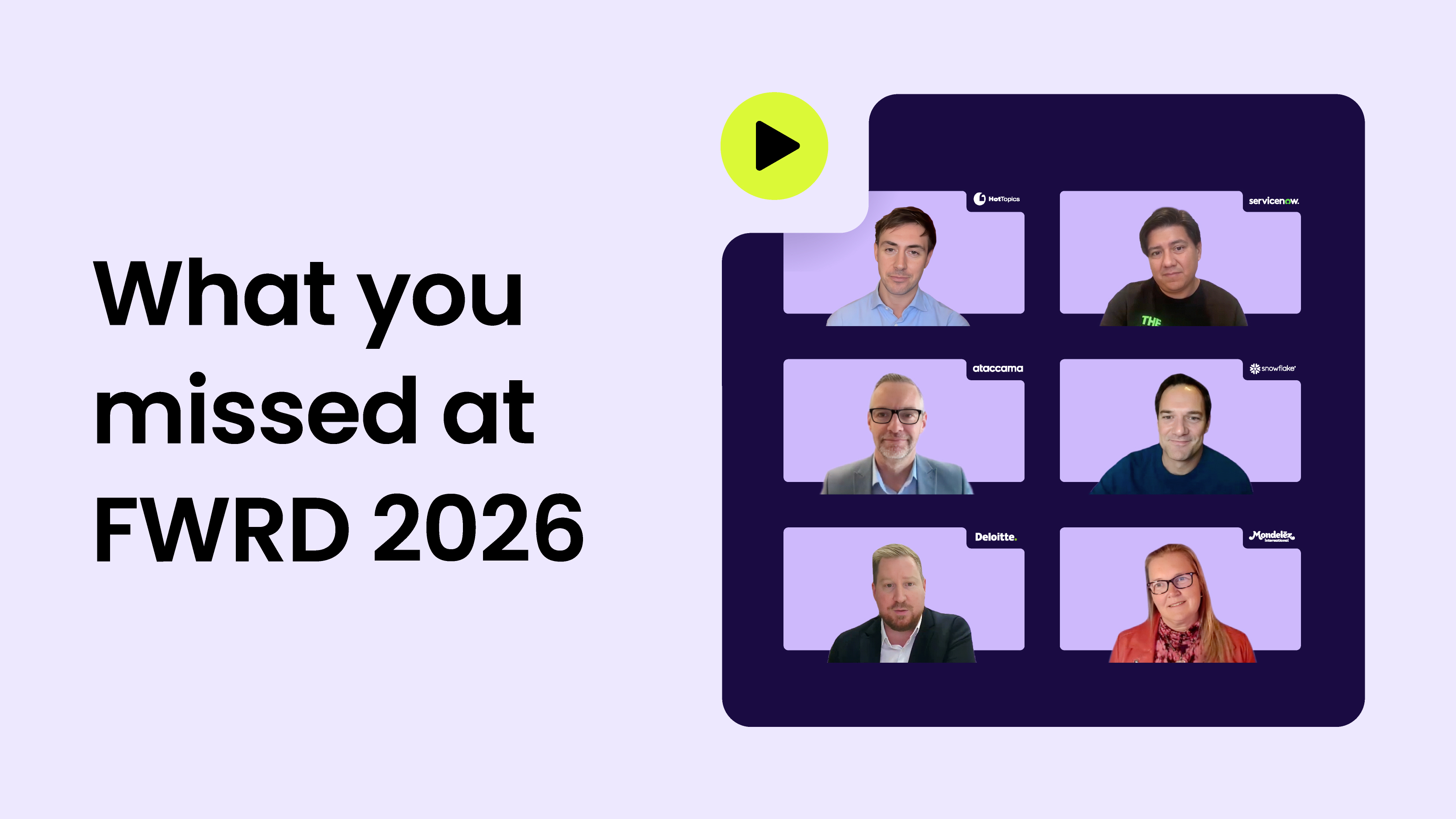
On November 5, data leaders from Lennar, Lloyds Banking Group, iA Financial Group, and Mondelēz International joined experts from Snowflake, Deloitte, and ServiceNow at Ataccama FWRD 2026 to look back at 2026 and ahead to 2027.
Ataccama CEO Martin Zahumensky opened with the tension running through the whole event. Two out of three data leaders don’t fully trust the data in their own organization, yet they’re being asked to deliver trusted data foundations for AI-first operations. As AI moves from a handful of data experts to every person in the business, inaccurate or incomplete data turns into bad automation at scale. “Nothing is safe for AI workloads to use unless the data underneath can be trusted,” he said.
This recap starts with the four customer stories and then turns to the 2027 predictions panel. It closes with the Ataccama ONE demos and Chief Product Officer Jessie Smith’s look at the 2027 roadmap. Every session is now available on demand.
How four data leaders built trust in 2026
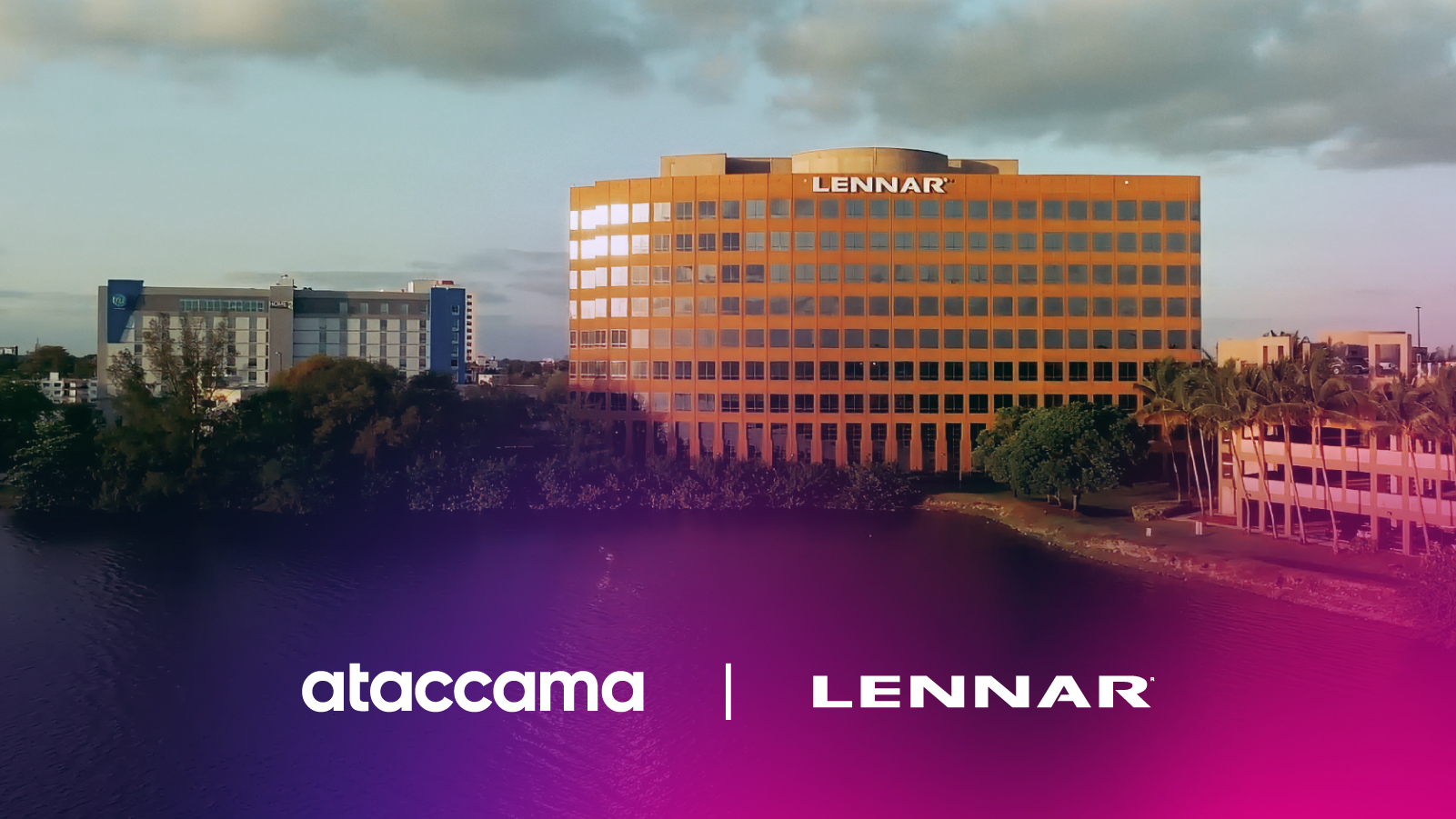
Lennar: A trust score in every AI answer
Isaac Gabay, VP of Data and AI at Lennar, described a starting point many data teams will recognize: little visibility into the quality of the data, which made it hard to know what to fix. His team began by mapping where data lived and measuring it, first in the data warehouse and then upstream in the ERPs and other source systems where issues originate. Lennar now monitors thousands of data assets with Ataccama, and when a rule fails, an incident is created in ServiceNow and routed to the right group with the context already attached. The team catches issues before business users notice them. “In the data quality space, the best indicator that you’re doing your job well is no noise at all,” Isaac said.
That foundation paid off when Lennar built LenAI, a conversational agent that lets the whole company ask questions of Lennar’s data. As soon as people started using it, they asked whether the answers were correct. Today, every LenAI answer comes with a quality score drawn from the Ataccama rules running behind it. In conversation with Ataccama’s Andrea Eaton, Isaac explained why that mattered: “You only get a chance to get it right one time with these agentic solutions, otherwise you lose trust.” Next, Lennar wants agents that help remediate issues and, eventually, self-heal them, built on data the team already trusts.
→ Read more on how Lennar used built-in trust scores to accelerate AI adoption
Lloyds Banking Group: Accountability for the most critical data
Jo Riseborough, Group Data Management and Data Culture Director at Lloyds Banking Group, explained how the UK’s largest bank governs millions of data items with a producer and consumer model. The parts of the business that produce or bring in data are accountable for making sure it’s well governed and fit for purpose. Lloyds identified roughly 1,000 data items as most critical to the bank, and Ataccama checks them automatically so teams are notified of issues in near real time instead of months later.
Jo credited a visible data quality metric, tracked at the executive committee and board level, as the most powerful lever. Lloyds is set to reach 90% coverage of data quality controls on its critical data by the end of 2026, a journey that began in 2021 and 2022. She also pointed to an operating model that brings business and technical colleagues together, along with the work still ahead: running a hybrid control model across on-premises and cloud estates, and exploring how agents could help build data products faster.
→ Read more about data quality at Lloyds Banking Group
iA Financial Group: Master data as the backbone for growth and AI
Nickolaos Mikedis, Leader, Strategy and Data Trust at iA Financial Group, described how growth through acquisitions left the company with many systems, each with its own version of the customer. What started as a mainframe decommissioning project became a business initiative: a trusted golden record for every client. “Now we know that Bob in the individual sector is also the same Bob” in another line of business, he said, along with which products Bob doesn’t yet have. That 360-degree client view is the backbone of iA’s organic growth plans.
iA classifies Ataccama MDM as mission critical. It runs around the clock and feeds operational systems such as the client portal, alongside reference data management that replaces mainframe dependencies with a governed stewardship process. The same MDM now feeds iA’s semantic layers for AI. Before, Nickolaos noted, even the best model predicting a client’s next purchase couldn’t tell whether that client already held the product. Starting in 2027, his team will open an internal Data Trust Hub so other parts of iA can adopt MDM, RDM, and data quality faster.
→ Read more about how iA Financial Group built one trusted view of its clients
Mondelēz International: Ownership in the business before AI
Speaking on the predictions panel, Camilla Björkqvist, Senior Director, Global Data Governance and Transformation at Mondelēz International, shared how Mondelēz moved data ownership into the business before it started building AI agents. Data quality, cataloging, and lineage sit in one environment, and ownership sits with the people who create and use the data. Owners now define where agents are safe to operate and where a human stays in the loop. They also own the data quality rules, because agents consuming those rules need them to be right the first time.
Camilla expects stewards at Mondelēz to shift from manual triage toward handling exceptions and curating the context agents depend on. The stakes are concrete. When consumers ask an AI assistant where to find Oreo products, the right answer depends on product master data governed at the source, with descriptions an AI can understand and updates fast enough to reflect a recall. Wrong allergen information, she said, is non-negotiable for consumer safety and brand trust.
→ Read more about how Mondelēz International rebuilt how it governs data before expanding AI use
Five predictions for 2027, on the record
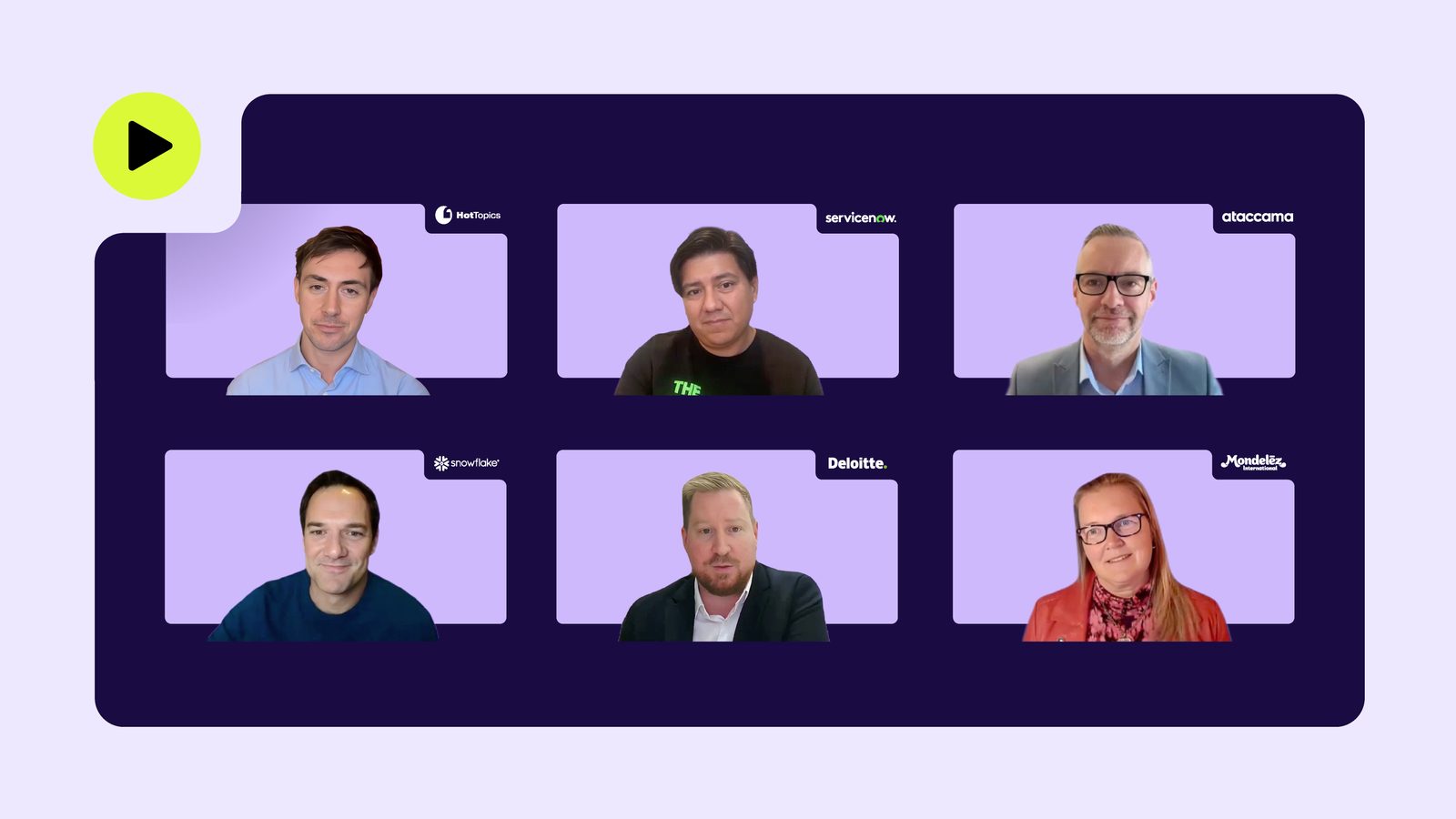
In Fast FWRD, Peter Stojanovic, Editor of HotTopics, asked five panelists to each put one signature prediction for 2027 on the record, then had the rest of the panel stress-test it.
| Panelist | Prediction for the end of 2027 |
| Camilla Björkqvist, Mondelēz International | The enterprises with the most operational AI agents will be the ones that moved data ownership and stewardship into the business first. |
| Juan Sequeda, ServiceNow | Within two years, 20% of organizations will truly succeed with semantics because they invested in strong foundations, and the other 80% will learn from them. |
| Chris Child, Snowflake | The vast majority of data teams will have agents building, maintaining, and optimizing their pipelines without human intervention. |
| Donovan Spronk, Deloitte | Governance will move from AI-assisted to agent-driven, with policies turned into machine-verifiable data contracts. |
| Jay Limburn, Ataccama | Modern AI infrastructure stacks will emerge from beyond the traditional hyperscalers. |
Ownership moves to the business
Chris agreed with Camilla and took her point further. Business teams will need to define the data products they need, including the semantics, context, governance, and quality, much like the contracts between services in a microservices architecture. He expects data teams to flip their starting point from “what data do we have” to the questions the business needs answered and the outcomes it wants agents to drive.
Semantics, and the risk of a “semantic swamp”
Juan warned that organizations chasing a quick fix, letting AI generate glossaries and ontologies on its own, will end up with a semantic swamp that leads to an agent swamp: thousands of agents, each with its own semantic layer, giving different answers to the same question. The organizations that succeed will do the foundational work first, which he compared to going to the gym and eating your vegetables.
Chris thought Juan set the bar too low and predicted adoption well above 80% by the end of 2027. When Snowflake trained models on its own large corpus of SQL queries, they still struggled to generate correct SQL without the business context behind the data. Feeding in semantic information was the unlock, which led Snowflake to start the Open Semantic Interchange, now an Apache project backed by about 35 companies. Jay connected the thread to master data, which gives agents the most trusted view of customers, products, and suppliers. Asked whether MDM is about to have its second act, he answered: “I believe so, but I’m probably biased.”
Data engineers manage agents instead of pipelines
Chris predicted that humans will spend close to zero time writing and debugging pipeline code by the end of 2027. He recalled being woken at 4 a.m. early in his career because a marketing dashboard hadn’t refreshed. In his view, the data engineers who thrive will be the ones who can sit with a business leader, understand their goals, and translate them into instructions for a team of agents. Camilla agreed, quoting a former boss: “Data problems are just people problems in disguise.”
Governance that keeps pace with AI
Donovan argued that the problem is pace: enterprises have governance policies, yet a PDF policy document can’t keep up with how fast AI is moving. He sees regulation such as the EU AI Act pushing ownership up to the CIO, and described the accelerators Deloitte builds with Ataccama to help clients deploy AI while staying compliant. Jay noted that governance has long been the “office of no” and said AI should be used to automate it. Juan offered an analogy for the shift: “Governance is like brakes in a car,” he said, there so you can drive fast safely.
New AI stacks need open standards
Jay expects AI platforms to come from companies such as ServiceNow and Snowflake as well as the hyperscalers, and said those platforms will depend on open standards to plug in specialist capabilities like data quality, MDM, and observability. Ataccama is part of the Open Semantic Interchange for that reason. Camilla agreed, pointing to the agentic commerce work at Mondelēz described above.
The panel closed with a round of thumbs up and thumbs down on each prediction. Peter promised to bring the scorecard back at FWRD 2027 to see who called it.
Ataccama ONE in action, and where it goes in 2027
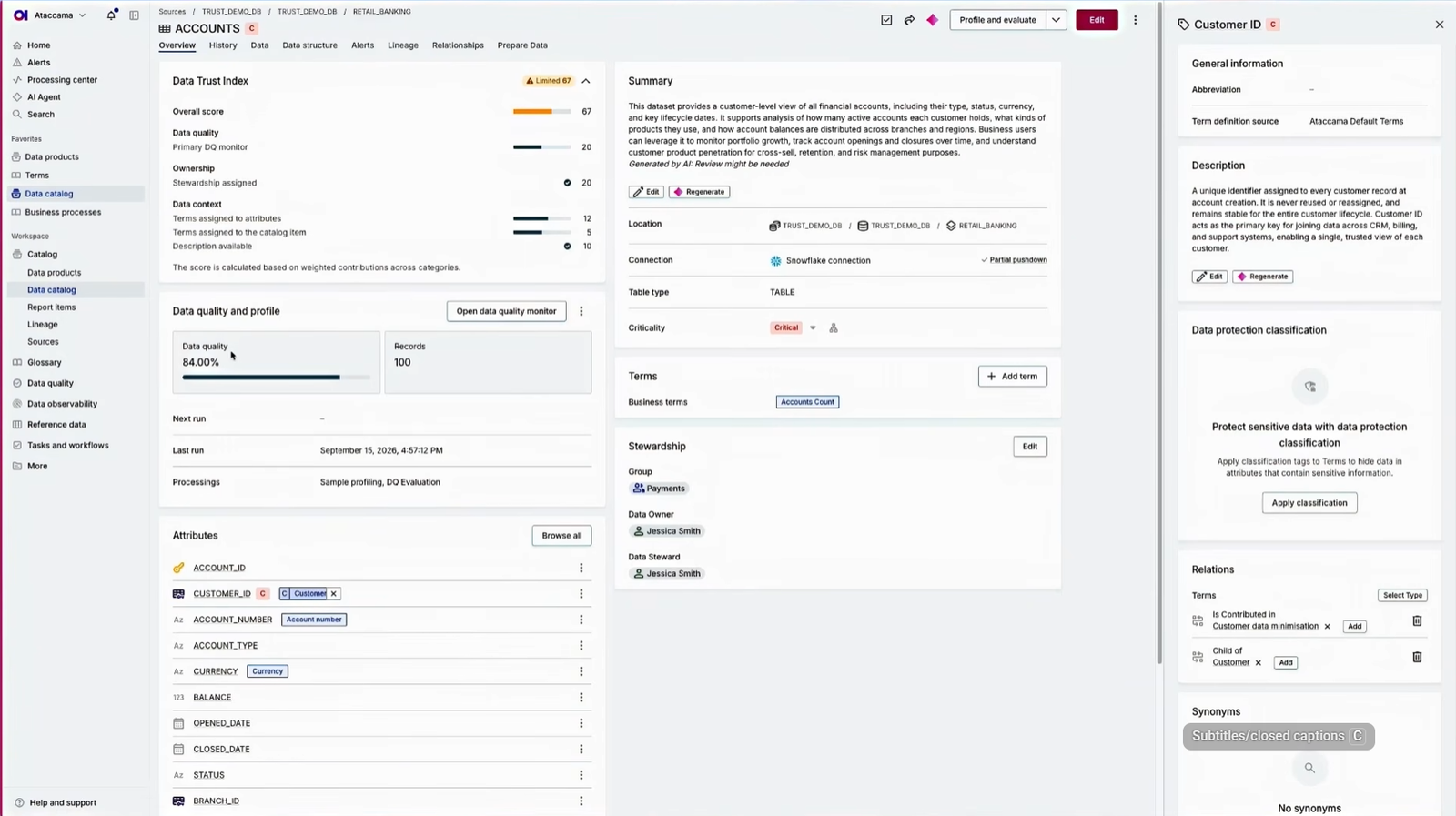
Demos: Trusted data from source to agent
Between the customer stories, Ataccama’s product team showed the newest capabilities in Ataccama ONE, each demo led by the person who builds it.
Shift left with rich connectivity. Lenka Studnicna connected to a self-managed MongoDB database and applied the same rules she would use once the data reached Snowflake or Databricks. Anomaly detection flagged 17 anomalies no one had written a rule for, including a near 50% drop in orders, and a freshness check caught a broken SLA. One alert, explained in plain language by AI, went straight to the ticketing system before the data ever reached the cloud.
Ground agents in quality scores and governed context. Matej Matoulek showed how Ataccama’s new converter packages business descriptions, glossary terms, and quality scores into the open Apache OSI format, with data quality as Ataccama’s contribution to the specification. He used the file to build a Snowflake semantic view, connected an agent to the Ataccama MCP server, and asked a business question. The answer opened with its trust context, noting that the balance field passed only 87% of data quality checks.
Write once, apply everywhere. Mariia Bondarenko walked through a single alerts feed for freshness, schema changes, anomalies, pipeline failures, and data quality issues, with escalation to tools like ServiceNow. Business users can write rules in the rule library by describing them in natural language, then run those same rules inside pipelines with data quality gates, as Snowflake functions, in dbt, or in Python.
Automate data management with agents. Diana Babiac showed the ONE AI agent take an undocumented table to trusted in minutes. It documented every attribute in one request, assigned stewardship, tagged personal data, and reused or created quality rules, following custom skills that encode how the team governs customer data. More than half of Ataccama customers now use its generative AI features every day, and with the agent, a person still approves every change.
Master data with and for AI. Tomas Vytiska introduced a new MDM interface generated automatically from the data model, so it works from day one. Through the new MDM MCP server, an agent can brief a sales rep from a governed golden record with the same permissions as the UI, and help stewards prioritize matching proposals. In his words, “The agent proposes, the steward decides.”
Traceability for audits. Steven Emmel showed lineage extracted automatically across an SAP landscape, with quality insights and anomaly reporting at every hop. AI explains nested SAP transformation logic in natural language, so you don’t need to be an SAP specialist to answer an auditor’s question.
The 2027 roadmap: Getting to trusted data faster
Jessie Smith, Ataccama’s Chief Product Officer, closed the event by tying the panel’s predictions to the 2027 roadmap. She returned to Martin’s opening figure, noting that the share of data leaders who don’t fully trust their data rose to 67% from 55% a year earlier. The roadmap focuses on three areas, all aimed at getting customers to trusted data faster.
MDM with and for AI. When a person sees two versions of the same customer, they stop and check, but an agent picks one and acts on it at scale. To make MDM faster to deliver, agentic configuration will propose the data model, matching rules, and survivorship rules from what Ataccama learns when profiling your data. Your team reviews and approves each step. In the demo, work that typically takes specialists weeks took days.
Faster data quality. Ataccama will combine smart profiling, lineage, and usage data to point teams to their most critical data from day one, then recommend rules to set up in bulk. Teams will be able to upload existing rules for the agent to recreate, and run data quality headlessly from their own tools and agents through the MCP server.
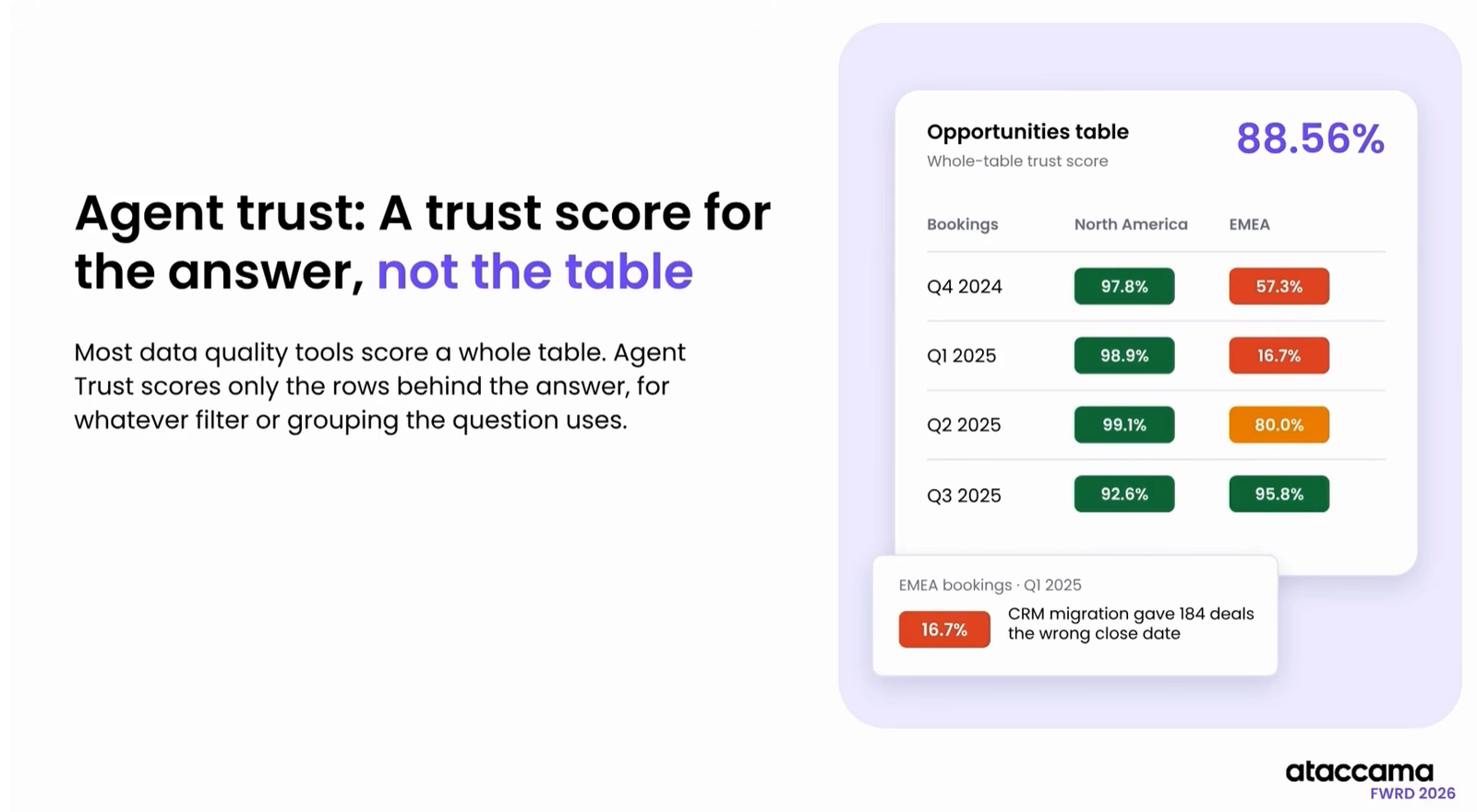
Agent trust. Building on the Lennar story, every agent answer will carry a trust score and a check against grounded truth, with wrong answers routed to the right owner to fix. Nate Reid-Smith previewed trust scores at the segment level: a table that scores 88.56% overall can hide a regional slice that scores 57%, and the agent now says so, along with any documented known issues.
Some of these capabilities are still taking shape, and Jessie invited customers who want to move first to explore early adoption with their Ataccama team.
Across every session, speakers came back to the same idea: AI can only move as fast as the data underneath it can be trusted. Lennar, Lloyds, iA, and Mondelēz each built that trust in different ways in 2026, and the panel expects the pressure to grow as agents move into production in 2027.
Press play on what’s next in data for AI
Watch FWRD 2026 on demand to catch the sessions you missed or share them with your team. If you’d like to see how these capabilities fit your own data and AI plans, talk to our team.
Jay Limburn
Jay Limburn is Chief Product Officer at Ataccama, where he leads a global team of product managers building a market-leading data quality and data trust platform that helps organizations trust their data. Jay brings deep expertise across data quality, governance, and AI, helping customers reduce compliance risk and improve transparency with capabilities like observability, lineage, and automated remediation, so teams can move faster with analytics and deploy AI with confidence.