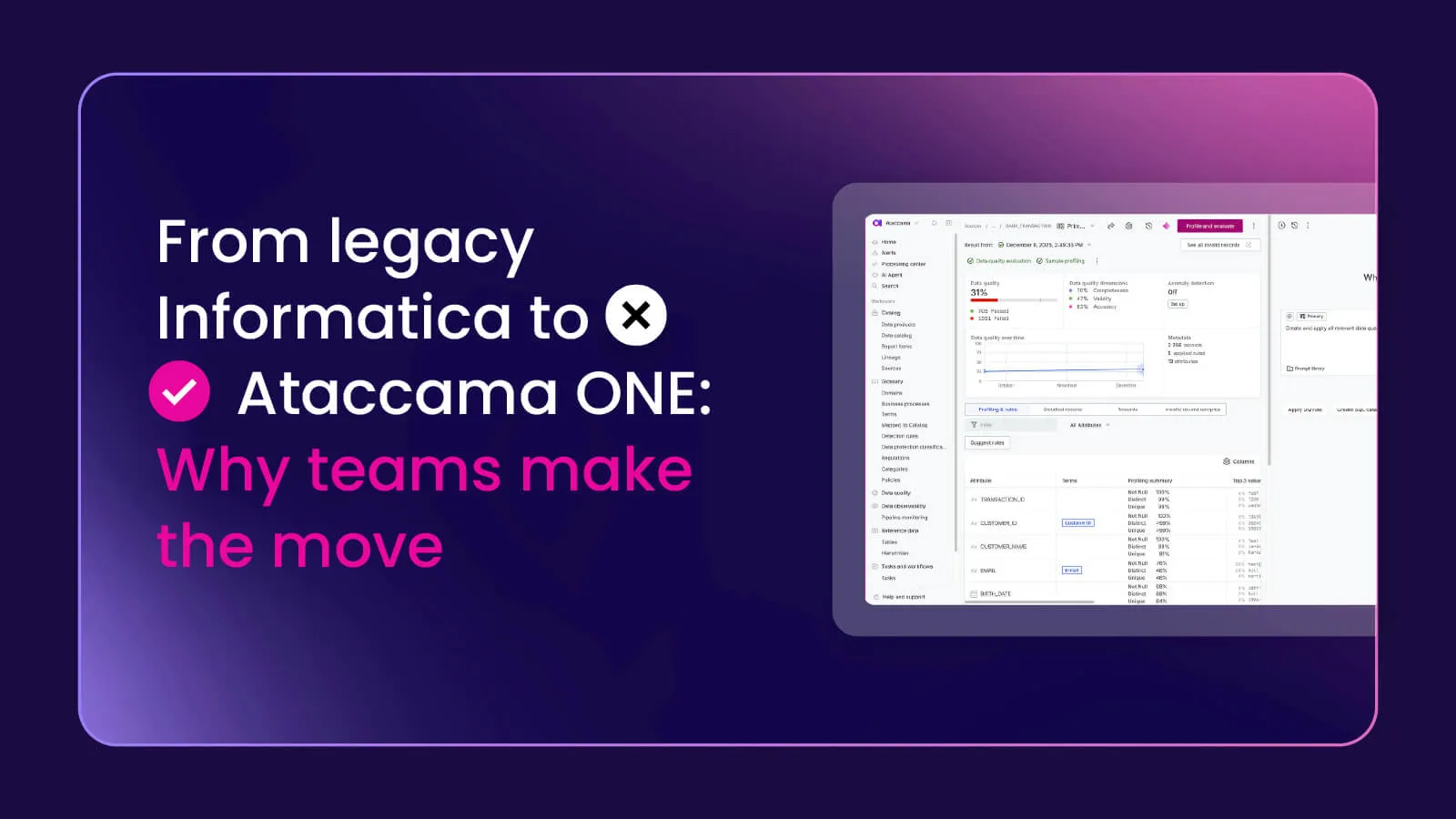
How Lennar used built-in trust scores to accelerate AI adoption

When Lennar launched LenAI, its internal AI assistant, it used existing Ataccama data quality signals to put a visible trust score into every answer, giving Associates confidence in the data behind it.
Results at a glance
1,500+
Tables under active monitoring
5,000+
Rule and anomaly checks run daily
<15 min
Median time to detect and acknowledge an issue
24/7
Continuous monitoring coverage
In brief
Lennar, one of the leading homebuilders in the U.S., built an enterprise data quality program with Ataccama years before AI became a board-level priority. The program monitors more than 1,500 tables with over 5,000 rule and anomaly checks a day, catching problems before they reach a report. When Lennar built LenAI, its internal AI assistant, it fed those same quality signals into every AI answer as a visible trust score, so Associates can judge whether to act on a result rather than guess.
The data quality challenge at Lennar
Lennar has built homes for American families for more than 70 years. Today, the company operates across more than 30 states, each focused on its local market. A buyer in Houston wants something different from a buyer in Orlando, and building codes, weather, suppliers, and trades vary from one market to the next.
That model has produced decades of operational data spanning the entire homebuilding lifecycle, from land and design through construction, supply chain, sales, mortgage, title, and warranty. Few companies have visibility into a customer journey that long or a supply chain that broad, making Lennar’s data valuable for better business insights. But each division had also developed its own workflows, systems, and definitions, creating different versions of the truth depending on which system you asked.
Like many large organizations, Lennar once had reports that didn’t always agree with each other, which meant leaders spent time sorting out which numbers to trust. Lee Slezak, SVP of Data & AI at Lennar, made fixing that a priority. “We wanted leaders to spend their time acting on the data, not questioning it,” he said.
The volume compounded the challenge. Every week, thousands of new home deliveries generate purchase orders, work orders, vendor records, and transactions from divisions across the country flow into a central repository. Before that data could serve the broader business, it needed to be consistent and reliable beyond the division that produced it.
How Lennar’s data quality program began
Lennar responded by bringing in data leaders with enterprise quality experience and selecting the Ataccama ONE platform to help build a more systematic data quality program. Rather than trying to clean every dataset across the company at once, the team prioritized the data the business depended on most and expanded from there.
Today, Lennar monitors more than 1,500 tables with over 5,000 rules and anomaly checks running daily and 24/7 monitoring coverage. Its median time to detect and acknowledge an issue is under 15 minutes. Problems that once surfaced through business escalations can now be identified proactively, before they reach the people and systems relying on the data.
Catching data quality issues earlier
As Lennar expanded its data quality program, it also moved validation closer to where problems originate. “We started where the data was closest to the business customer, in our data warehouse,” Isaac Gabay, VP of Data & AI at Lennar said. “But once we had good coverage there and could guarantee quality, we moved upstream, closer to where the data originates, so we could remediate issues before they induced problems downstream.”
That progression reflected a broader view of where data quality needs to happen. For Lennar, data exists wherever it is stored, used, or transacted, not only once it reaches the warehouse. As a result, the program expanded beyond a single data source to validate data across the systems it passes through.
Often called “shift-left” data quality, the approach moves detection upstream, so a bad record can be caught closer to the system that created it rather than later in a report or application that depends on it.
What changed for the business
Once quality had a measurable standard, conversations became more concrete. Instead of debating whether a number could be trusted, teams could see where quality fell short, identify who owned the issue, and decide what to fix.
That also changed Lennar’s starting point for AI. “ When the organization started looking at how to bring AI into our work, we could run at 100 miles an hour from the beginning because the data feeding our agentic solutions already supported high-quality outcomes,” Gabay said.
How the trust score turns an AI answer into something you can act on
Lennar’s data quality program became the foundation for LenAI, which associates across the business use to ask plain-language questions of Lennar’s data. From the beginning, Lennar knew that producing an answer was only part of the challenge. “You only get one chance to get it right with these agentic solutions,” Gabay said. “Otherwise, you lose trust, and regaining it is complex.”
That became clear early on. “Initial challenges we had were more related to whether I, as a user, could trust the answer the agent was giving me,” Gabay said. “So we paired a trust score with the data quality scores we already had from Ataccama, and we exposed that directly in the agent’s answers, so the user could immediately understand whether they could trust the data behind it. That drove real adoption because there was no hesitation about whether I could use the answer. We were proactively telling the user that they could.”
Every LenAI answer now carries a trust score that brings together the signals Lennar already uses to monitor its data, including quality and freshness scores from Ataccama and whether the process that produced the data completed successfully. Lennar supplements those signals with AI-specific checks, including whether the underlying source data supports the answer and whether it passes additional validation before reaching the user.
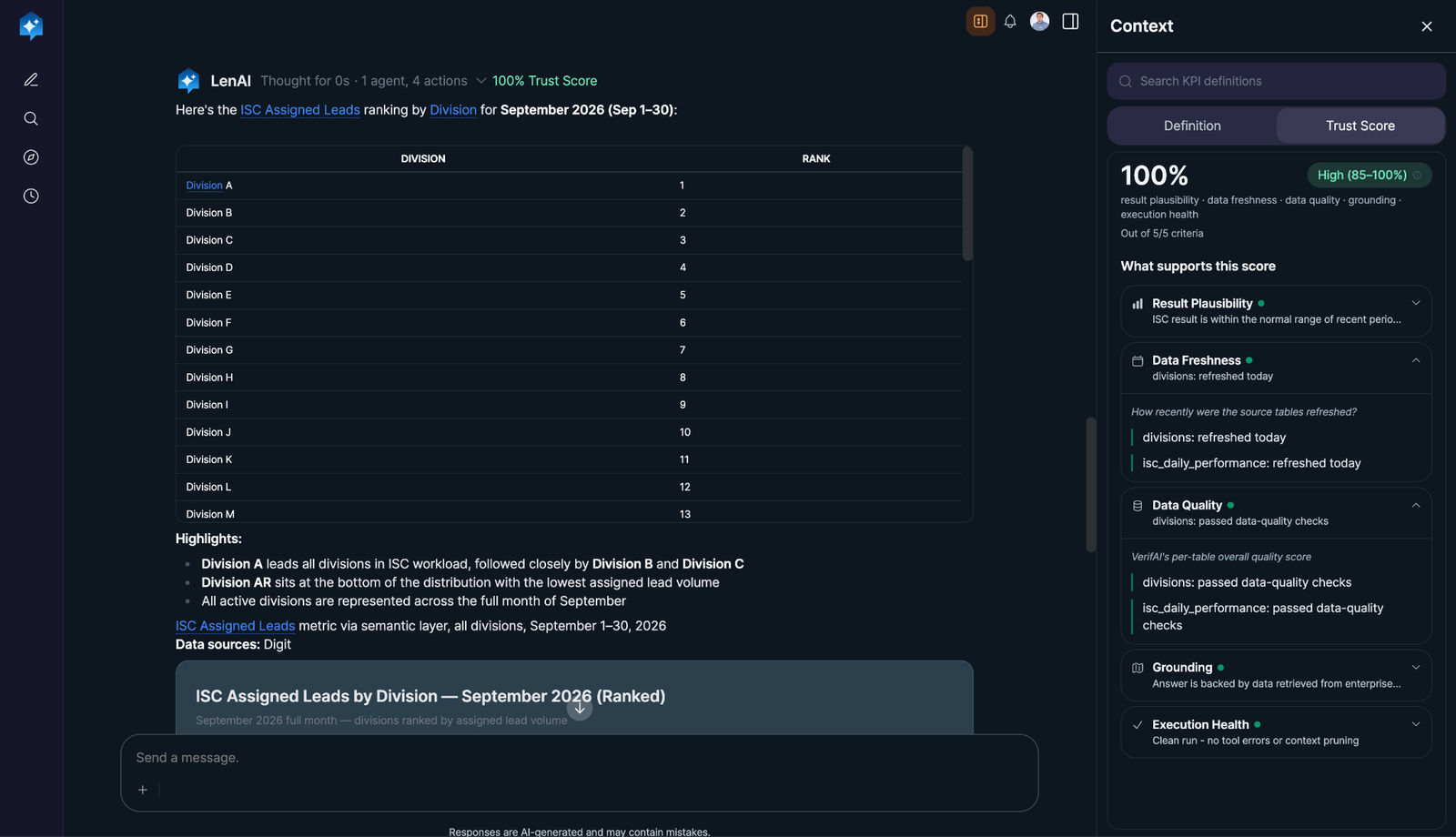
That has changed how people use AI inside Lennar. Without it, an agent could provide an answer, but the user might still need to ask the data team whether the number behind it is trustworthy. LenAI brings that verification into the answer itself, giving associates the evidence they need to judge whether the underlying data is reliable enough to act on without starting a separate conversation to find out.
What’s next: from catching problems to fixing them automatically
Lennar is now building autonomous agents and applying predictive AI inside its data operations, using the quality history it has accumulated to shorten the work required when something goes wrong. “We’re pushing further into the supply chain,” Gabay said. “First, understanding the data and the quality behind it. Second, using agents to help us remediate faster, giving us context on what an issue might be, what the risk is, and where it likely originated. We want to push the boundary further and use agents to self-heal and self-remediate, so we can take humans out of the loop and reduce time to resolution to the minimum possible. We’re also working on predictive quality: based on historical runs, can we predict with a high degree of accuracy whether a failure is going to happen, so our teams can take preventative action before it does.”
Lennar is still developing those capabilities and sees them as the next phase of an ongoing data quality program, not a finished project. The company has also deliberately avoided tying its AI strategy to a single model provider. Models will continue to change, but Lennar’s data, quality standards, ownership, and history remain its own. By investing in that foundation, the company can change the AI technology on top without rebuilding the trust required to use it.
— Isaac Gabay, VP of Data & AI, Lennar
See how Ataccama can help you build the trusted data foundation your AI initiatives depend on
Chat with an expert from our team.

Decades of operational data spanning the entire homebuilding lifecycle, from land and design through construction, supply chain, sales, mortgage, title, and warranty; multiple divisions with different versions of the truth.
Often called “shift-left” data quality, the Lennar approach moves detection upstream, so a bad record can be caught closer to the system that created it rather than later in a report or application that depends on it.
Lennar’s teams can now pinpoint data quality gaps and route them to the right owner for a fix, which let the company move at full speed on agentic AI from the beginning.
When Lennar launched LenAI, its internal AI assistant, it used existing Ataccama data quality signals to put a visible trust score into every answer, giving Associates confidence in the data behind it.
Results at a glance
1,500+
Tables under active monitoring
5,000+
Rule and anomaly checks run daily
<15 min
Median time to detect and acknowledge an issue
24/7
Continuous monitoring coverage
In brief
Lennar, one of the leading homebuilders in the U.S., built an enterprise data quality program with Ataccama years before AI became a board-level priority. The program monitors more than 1,500 tables with over 5,000 rule and anomaly checks a day, catching problems before they reach a report. When Lennar built LenAI, its internal AI assistant, it fed those same quality signals into every AI answer as a visible trust score, so Associates can judge whether to act on a result rather than guess.
The data quality challenge at Lennar
Lennar has built homes for American families for more than 70 years. Today, the company operates across more than 30 states, each focused on its local market. A buyer in Houston wants something different from a buyer in Orlando, and building codes, weather, suppliers, and trades vary from one market to the next.
That model has produced decades of operational data spanning the entire homebuilding lifecycle, from land and design through construction, supply chain, sales, mortgage, title, and warranty. Few companies have visibility into a customer journey that long or a supply chain that broad, making Lennar’s data valuable for better business insights. But each division had also developed its own workflows, systems, and definitions, creating different versions of the truth depending on which system you asked.
Like many large organizations, Lennar once had reports that didn’t always agree with each other, which meant leaders spent time sorting out which numbers to trust. Lee Slezak, SVP of Data & AI at Lennar, made fixing that a priority. “We wanted leaders to spend their time acting on the data, not questioning it,” he said.
The volume compounded the challenge. Every week, thousands of new home deliveries generate purchase orders, work orders, vendor records, and transactions from divisions across the country flow into a central repository. Before that data could serve the broader business, it needed to be consistent and reliable beyond the division that produced it.
How Lennar’s data quality program began
Lennar responded by bringing in data leaders with enterprise quality experience and selecting the Ataccama ONE platform to help build a more systematic data quality program. Rather than trying to clean every dataset across the company at once, the team prioritized the data the business depended on most and expanded from there.
Today, Lennar monitors more than 1,500 tables with over 5,000 rules and anomaly checks running daily and 24/7 monitoring coverage. Its median time to detect and acknowledge an issue is under 15 minutes. Problems that once surfaced through business escalations can now be identified proactively, before they reach the people and systems relying on the data.
Catching data quality issues earlier
As Lennar expanded its data quality program, it also moved validation closer to where problems originate. “We started where the data was closest to the business customer, in our data warehouse,” Isaac Gabay, VP of Data & AI at Lennar said. “But once we had good coverage there and could guarantee quality, we moved upstream, closer to where the data originates, so we could remediate issues before they induced problems downstream.”
That progression reflected a broader view of where data quality needs to happen. For Lennar, data exists wherever it is stored, used, or transacted, not only once it reaches the warehouse. As a result, the program expanded beyond a single data source to validate data across the systems it passes through.
Often called “shift-left” data quality, the approach moves detection upstream, so a bad record can be caught closer to the system that created it rather than later in a report or application that depends on it.
What changed for the business
Once quality had a measurable standard, conversations became more concrete. Instead of debating whether a number could be trusted, teams could see where quality fell short, identify who owned the issue, and decide what to fix.
That also changed Lennar’s starting point for AI. “ When the organization started looking at how to bring AI into our work, we could run at 100 miles an hour from the beginning because the data feeding our agentic solutions already supported high-quality outcomes,” Gabay said.
How the trust score turns an AI answer into something you can act on
Lennar’s data quality program became the foundation for LenAI, which associates across the business use to ask plain-language questions of Lennar’s data. From the beginning, Lennar knew that producing an answer was only part of the challenge. “You only get one chance to get it right with these agentic solutions,” Gabay said. “Otherwise, you lose trust, and regaining it is complex.”
That became clear early on. “Initial challenges we had were more related to whether I, as a user, could trust the answer the agent was giving me,” Gabay said. “So we paired a trust score with the data quality scores we already had from Ataccama, and we exposed that directly in the agent’s answers, so the user could immediately understand whether they could trust the data behind it. That drove real adoption because there was no hesitation about whether I could use the answer. We were proactively telling the user that they could.”
Every LenAI answer now carries a trust score that brings together the signals Lennar already uses to monitor its data, including quality and freshness scores from Ataccama and whether the process that produced the data completed successfully. Lennar supplements those signals with AI-specific checks, including whether the underlying source data supports the answer and whether it passes additional validation before reaching the user.
That has changed how people use AI inside Lennar. Without it, an agent could provide an answer, but the user might still need to ask the data team whether the number behind it is trustworthy. LenAI brings that verification into the answer itself, giving associates the evidence they need to judge whether the underlying data is reliable enough to act on without starting a separate conversation to find out.
What’s next: from catching problems to fixing them automatically
Lennar is now building autonomous agents and applying predictive AI inside its data operations, using the quality history it has accumulated to shorten the work required when something goes wrong. “We’re pushing further into the supply chain,” Gabay said. “First, understanding the data and the quality behind it. Second, using agents to help us remediate faster, giving us context on what an issue might be, what the risk is, and where it likely originated. We want to push the boundary further and use agents to self-heal and self-remediate, so we can take humans out of the loop and reduce time to resolution to the minimum possible. We’re also working on predictive quality: based on historical runs, can we predict with a high degree of accuracy whether a failure is going to happen, so our teams can take preventative action before it does.”
Lennar is still developing those capabilities and sees them as the next phase of an ongoing data quality program, not a finished project. The company has also deliberately avoided tying its AI strategy to a single model provider. Models will continue to change, but Lennar’s data, quality standards, ownership, and history remain its own. By investing in that foundation, the company can change the AI technology on top without rebuilding the trust required to use it.
— Isaac Gabay, VP of Data & AI, Lennar
See how Ataccama can help you build the trusted data foundation your AI initiatives depend on
Chat with an expert from our team.