Why AI agents need master data, not just clean data

Five layers of your data stack get a record ready for AI. Only one tells the agent what that record actually represents.
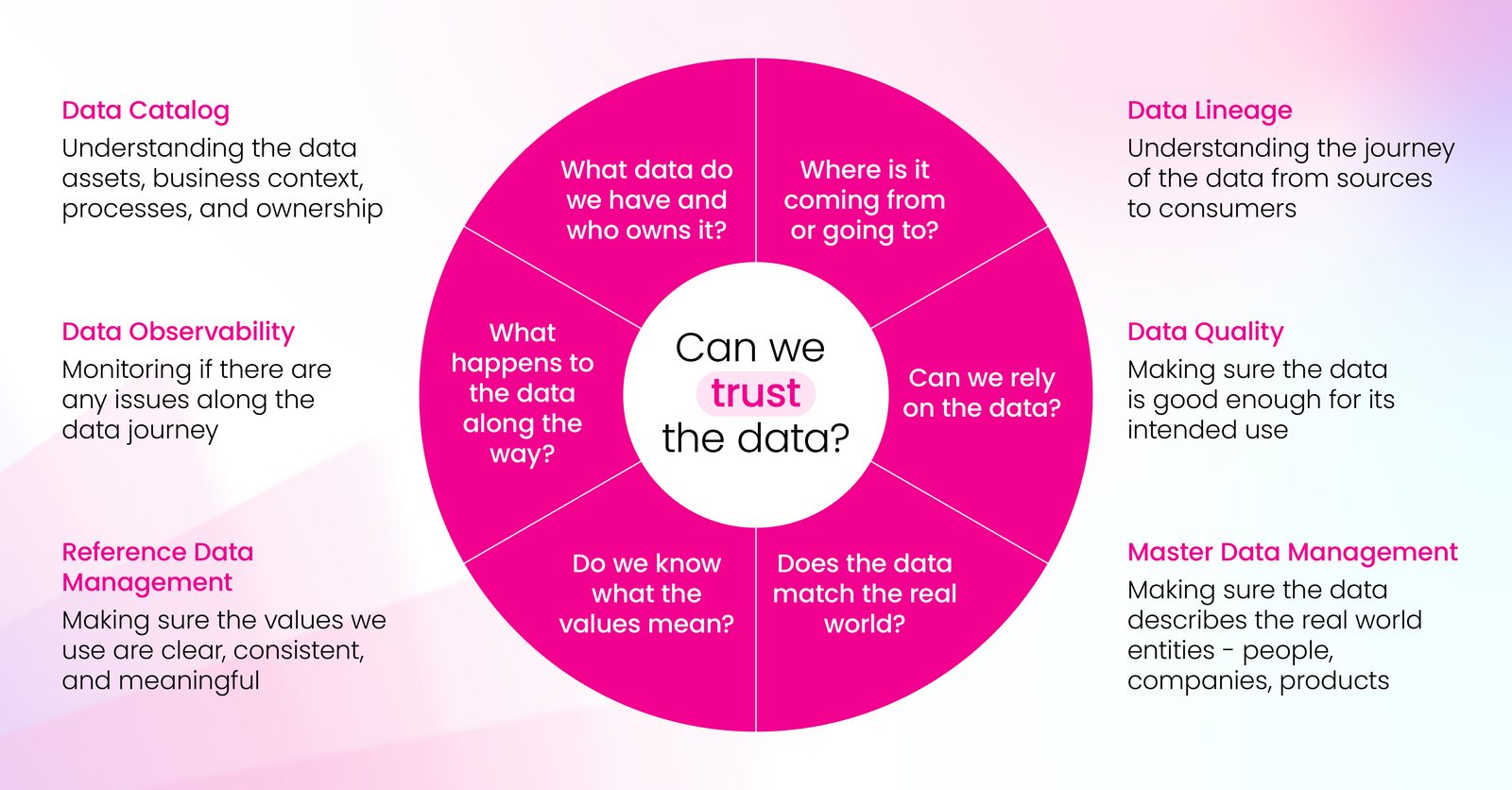
In our last post, we argued that AI agents are turning master data into something closer to a live input than a static reference table, and that this raises the bar for what “trustworthy” means. It’s worth being specific about where that bar sits, because most of what makes data AI-ready happens across five disciplines, and each one is necessary. None of them, on its own, answers the one question that matters most once an agent starts acting on what it reads instead of just reporting it.
What four data disciplines actually solve
A catalog, paired with its metadata, establishes what a piece of data actually is and who owns it. Lineage covers where that data came from and where it travels afterward. Observability picks up from there, watching whether the pipeline behind it is still running on schedule or has quietly broken somewhere upstream. Reference data management keeps the values everyone relies on clear, consistent, and meaningful: the country codes, currency codes, and status values that other systems assume mean the same thing everywhere they appear. Underneath all of it sits data quality, checking whether the values themselves hold up against the rules that define correctness. That last one is genuinely foundational, since the other four don’t mean much if the underlying values are wrong.
It’s also exactly why data quality gets treated as shorthand for trust generally. It’s the most mature and measurable of the five, so when someone asks whether data can be trusted, quality scores are usually the first thing anyone points to, and that’s a reasonable instinct as far as it goes. But necessary isn’t the same as sufficient, especially for the one question an AI agent increasingly needs answered before it acts: whether this record is the same real thing as that one over there.
Gartner makes the same argument, if a little less bluntly. In How Master Data Management Boosts the Context Layer for AI Agents, Gartner analyst Stephen Kennedy describes a data trust layer sitting between raw data sources and the agents built on top of them, one spanning governance and cataloging, quality and observability, business context, and master data together, with no single discipline standing in for the rest. The report treats getting that layer right as the precondition for trusting an agent to act on whatever it retrieves.
The question none of them can settle alone
A catalog entry can show that a table is owned by finance and was updated an hour ago, and still say nothing about whether “Acme Corp” in that table and “ACME-4471” three systems over describe the same company. A pipeline can run successfully end to end without observability ever raising a question about it either. Reference data can guarantee that every system agrees on what “active” or “USD” means, which says nothing about whether two customer records describe the same customer. Data quality can confirm both records are accurate and complete, and an agent can still act on the wrong entity because accuracy was never the issue.
Master data is the layer built to resolve it. It asserts that a specific collection of fragments spread across your systems corresponds to one real thing: a real customer with a real name and a real history with your business, or a real supplier providing a real component that ends up in a real product you ship. In the end, master data is what’s written on the invoice, the one place where a system’s internal record has to match something a real person or business will actually see and hold you accountable for. Catalog, lineage, and observability describe a process. Reference data and data quality describe values. Master data is the layer that steps outside the system entirely and makes a claim about the world.
AI can’t take this particular job over on its own. An agent is genuinely good at finding patterns in whatever data it’s handed, but it has no independent way to step outside that data and check it against the world the way a person eventually can. It can’t confirm, on its own authority, that two records describe the same living business, only infer a probability from how similar they look. Mastering is the discipline that makes that call on purpose, using rules a person can inspect and explain, precisely because nothing else in the stack is positioned to make it.
How Ataccama builds master data into the platform
Mastering doesn’t establish what a record represents in isolation, and treating it as a separate tool bolted onto everything else is the more common way this breaks than any weakness in the matching logic itself. Ataccama runs catalog, lineage, observability, data quality, reference data, and master data on shared metadata and rules, so the mastering process draws on governed quality and reference values directly instead of guessing at them from the outside. That’s the difference between mastering built on those shared foundations and mastering that treats them as someone else’s job downstream.
That still leaves the question of how an agent actually reaches a mastered entity once it exists. Ataccama’s MCP server handles that part, exposing governed master data through scoped, read-only tools rather than open database access, so an agent reasoning about a customer or supplier gets the same entity every person and every other system does, resolved once and trusted everywhere it’s used.
Why this has to be part of your AI plan
Catalog, lineage, observability, reference data, and data quality all have to be true before an agent can act on data responsibly, and none of that work goes away. But an AI initiative that stops there is still missing the piece that tells an agent what it’s actually looking at. Gartner’s research goes further than making that case in the abstract, laying out concrete measures for evaluating whether an agent is actually using its context well once the pieces are in place, not just whether governance, quality, and master data exist somewhere in the organization.
If you’re making the case internally that AI needs master data working alongside data quality, not a quality program stretched to cover a job it wasn’t built for, send them the report.
Access the Gartner research
See how Gartner maps the context layer for AI agents, and where MDM fits into the architecture.
Joellen Koester
JoEllen is the Director of Content Strategy at Ataccama and has worked in the AI and data spaces since 2015. She holds bachelor's degrees in English and Philosophy from Seattle University, a master's degree in Transatlanic Studies from Charles University, and was awarded a Fulbright Scholarship to teach English in the Czech Republic.