What is Data Enrichment? Process, Techniques, Benefits, and Examples

What is data enrichment?
Data enrichment is the process of adding depth and detail to existing data. If a customer record in your CRM holds only a first name, last name, and email address, enriching it means appending a postal address, phone number, company, job title, or other relevant attributes from internal or external sources.
Enrichment is not only about adding fields. It also covers transforming existing values into more usable forms, such as converting a street address into GPS coordinates, or standardizing a free-text industry description into an official classification code.
Enrichment is also not limited to customer data. Organizations enrich product records with specifications and hierarchies, supplier records with registration numbers and risk ratings, location records with geocodes, and datasets in a data catalog with descriptions, classifications, and business terms.
Data enrichment is distinct from data cleansing. Cleansing corrects or removes errors, duplicates, and incomplete values. Enrichment makes accurate data more complete, usable, and segmentable for a specific purpose. In practice the two go together: enriching poor-quality data only produces more poor-quality data.
How data enrichment works
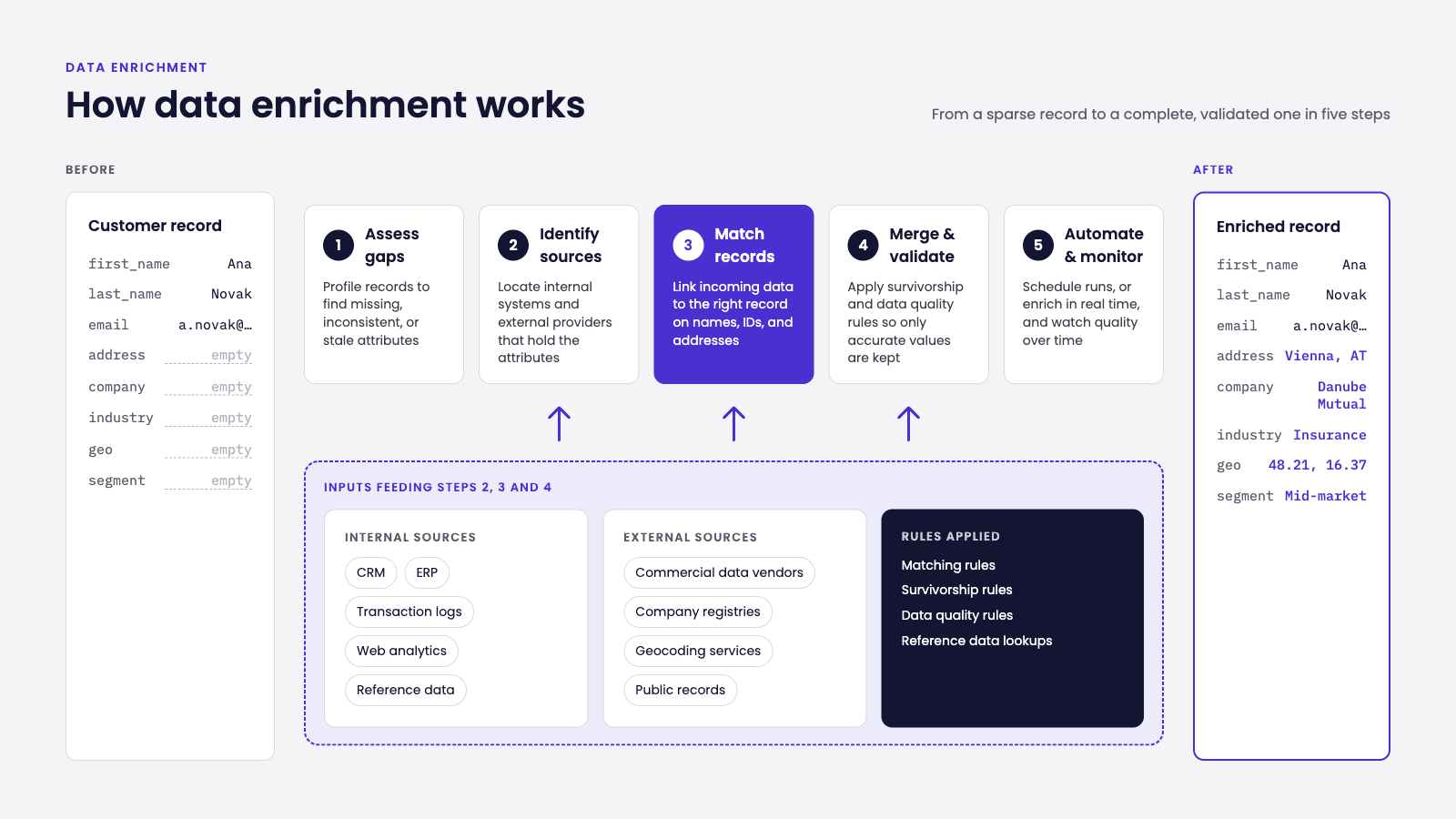
The enrichment process turns basic records into complete, trusted profiles. It typically follows these steps:
- Assess gaps. Profile your existing data to see which records are incomplete, inconsistent, or out of date, and which attributes matter for the intended use.
- Identify sources. Locate internal systems (CRM, ERP, transaction logs, web analytics) or external providers (commercial data vendors, public registries, geocoding services) that hold the missing attributes.
- Match records. Use matching rules to link incoming data to the correct existing record. This is the core of enrichment and where master data management does the heavy lifting: matching on names, identifiers, addresses, and other keys, even when formats differ or values contain errors.
- Merge and validate. Combine the matched attributes into a single record, resolve conflicts between sources using survivorship rules, and apply data quality rules so that only accurate, well-formatted values are kept. A data quality platform automates this validation.
- Automate and monitor. Schedule the process to run at set intervals or in real time via APIs, and monitor the results so that enriched data stays fresh as source data changes.
Types of data enrichment
All enrichment techniques either add attributes to a record or transform existing values into more usable ones. The main types are:
| Type | What it adds or transforms | Typical attributes | Example |
| Demographic and firmographic | Person-level and company-level attributes | Job title, seniority, age range; industry, employee count, revenue, legal entity ID, corporate hierarchy | Appending an industry code and parent company to an account record |
| Geographic | Location detail, added or transformed | Latitude and longitude, ZIP+4 or postcode extension, sales territory, tax jurisdiction, regulatory region | Converting a street address into coordinates |
| Behavioral and transactional | Activity and purchase context | Page views, product usage, email engagement, campaign response; transaction category, readable merchant name | Categorizing a card transaction as groceries, travel, or utilities |
| Metadata and AI-assisted | Context about the data assets themselves | Data classification, sensitivity, business terms, descriptions, filled or standardized values | A catalog auto-tagging a column as containing payment card numbers |
Demographic and firmographic enrichment
Demographic enrichment adds person-level attributes such as job title, seniority, age range, or “customer since” date.
Firmographic enrichment adds company-level attributes such as industry, employee count, annual revenue, legal entity identifiers, or corporate hierarchy.
A fuller view of the person or organization supports better segmentation, cross-selling, and risk decisions.
Geographic enrichment
Geographic enrichment adds or transforms location detail. Examples include converting a street address into latitude and longitude, appending a ZIP+4 or postcode extension, or assigning a record to a sales territory, tax jurisdiction, or regulatory region.
Behavioral and transactional enrichment
Behavioral enrichment appends records of user actions to a profile: page views, product usage, email engagement, or campaign responses. This supports propensity models and next-best-action decisions.
Transactional enrichment adds context to individual transactions. A common example is categorizing card transactions into groceries, travel, or utilities, and replacing cryptic merchant strings such as “TG 987654321” with a readable merchant name.
Metadata and AI-assisted enrichment
Metadata enrichment adds context to data assets themselves rather than to business records. Modern data catalogs use AI to scan tables and columns, detect what they contain (names, emails, national IDs, payment card numbers), classify sensitivity, suggest business terms, and generate descriptions. This makes data easier to find, govern, and trust.
AI-assisted enrichment can also fill missing values, standardize inconsistent entries, and summarize large datasets. Because AI models depend on the data they are given, this type of enrichment is only as reliable as the underlying AI-ready data feeding it. Gartner predicts that through 2026, organizations will abandon 60% of AI projects that are not supported by AI-ready data.
Knowing how the data will be used downstream is what determines which enrichment types are worth the effort.
Data enrichment examples
There are many ways that data enrichment is proving useful in data pipelines. The pattern is the same across industries: a record that is technically valid but not complete enough for the decision it has to support.
In the financial world, adding data points like credit scores, financial statements, and payment history to a corporate customer record helps a banking institution decide if lending money is worth the risk to the bank. The same record can be enriched with legal entity identifiers, beneficial owners, and sanctions screening results, so KYC and AML checks run on a complete profile rather than a form with three fields on it.
When adding firmographic data, such as industry classification, employee count, and corporate hierarchy, an insurer can roll counterparty exposure up to the parent company and answer the questions regulators actually ask, such as total exposure to a single group across underwriting, claims, and reinsurance.
If an organization focuses on product data, a manufacturer can enrich ERP part numbers with specifications, classification codes such as UNSPSC or ETIM, compatible parts, and images from supplier catalogs and PLM systems, so the same part is described identically in procurement, sales, and the online catalog.
Supplier enrichment turns a payables list into a risk view. Adding registration numbers, ownership, country of operation, financial health scores, and sustainability ratings gives procurement a basis for vendor risk decisions and ESG reporting a defensible data foundation.
Geographic enrichment lets a logistics company geocode delivery addresses that arrive in dozens of formats, append postal extensions, and assign depot, route, and tax jurisdiction, so route planning and duty calculation run on consistent, machine-readable location data.
Metadata enrichment helps a data platform team migrating hundreds of undocumented tables. AI-assisted enrichment scans the data, detects what each column contains, flags personal and sensitive fields, proposes business terms, and drafts descriptions, so stewards review rather than document from scratch.
These are just a few examples of how data enrichment can work for companies trying to gain a competitive edge. In each case the value comes from matching incoming data to the right record and validating it before it is merged; enrichment without those two steps only produces a larger set of unreliable data.
Benefits of data enrichment
- Improved targeting. Complete profiles allow precise segmentation and more relevant outreach.
- Increased context. More attributes per record make a true 360-degree view of a customer, product, or supplier possible.
- Better AI outcomes. Models and agents working from complete, consistent data produce more accurate forecasts, recommendations, and decisions.
- Operational efficiency. Enriched, standardized data lets automated processes and AI agents handle routine tasks, freeing teams for higher-value work.
- Stronger compliance and risk management. Enriching entity records with identifiers, ownership structures, and jurisdictions supports regulatory reporting and due diligence.
Not all enrichment is equal. If the data you add is inaccurate, unverified, or stale, the result is no better than the incomplete data you started with.
The stakes are not small. Gartner estimates that poor data quality costs organizations an average of $12.9 million a year, and enrichment that skips validation adds to that bill rather than reducing it.
Data enrichment challenges
- Privacy and consent. Appending personal data creates obligations under GDPR, CCPA, and similar laws. Your organization is accountable for how data was collected by your vendors and for how you use it.
- Source data quality. If existing records are riddled with errors or duplicates, matching fails and enrichment compounds the problem. This is the norm, not the exception: a study of 75 data quality assessments by Nagle, Redman, and Sammon found that 47% of newly created records contained at least one critical error, and only 3% scored at an acceptable level. Cleanse first.
- Third-party data quality. Vendor data must be vetted for accuracy, coverage, and freshness before it enters your systems.
- Integration complexity. Connecting internal databases, external APIs, and data warehouses requires technical expertise and connectors that speak to many systems.
- Governance and lineage. Without tracking where each enriched attribute came from and when, it becomes impossible to audit, trust, or correct the result.
How to choose a data enrichment solution
Start with an honest assessment of your current data. If you do not know where your data lives or what condition it is in, a data quality and master data management foundation should come before any enrichment program.
When evaluating solutions, look for:
- Matching quality. Configurable and AI-assisted matching that handles typos, format differences, and missing identifiers.
- Built-in data quality. Validation and standardization rules applied automatically to incoming attributes.
- Connectivity. Native connectors to your databases, cloud platforms, SaaS applications, and external data providers.
- Governance and lineage. Visibility into the origin of every attribute and every change.
- Flexible data models. Support for customer, product, supplier, location, and reference data, not only one domain.
- Automation. Scheduled and real-time processing so enriched data stays current without manual effort.
Implementing data enrichment: A step-by-step checklist
- Define scope. Start with one domain and one use case. Expand once results are proven.
- Identify consumers. Determine who will use the enriched data (analysts, customer service, AI agents, downstream applications) and what attributes they need.
- Choose sources. Decide which internal systems and external vendors will supply the missing attributes, and vet them for reliability and consent.
- Map attributes. Define how fields in each source map to your target data model.
- Standardize and validate. Remove duplicates, resolve errors, and cleanse the consolidated data before merging.
- Enrich. Run matching and merging, pulling external data in batch or real time as needed.
- Monitor and iterate. Track data quality over time, review results, and expand the program as it matures.
How Ataccama supports data enrichment
Ataccama ONE brings the components of data enrichment together in a single platform:
- Master data management matches and merges records from multiple sources into a single golden record, with configurable survivorship rules that decide which source wins for each attribute. External data can be pulled in through lookups and integrations to fill gaps.
- Reference data management standardizes values against governed lists such as country codes, industry classifications, and product categories, so enriched data is consistent across systems.
- Data quality rules validate and standardize incoming attributes automatically, and monitoring flags issues before enriched data reaches consumers.
- Data catalog with AI enriches metadata by detecting and classifying data, suggesting business terms, and generating descriptions, making data easier to find and govern.
- Broad connectivity links databases, cloud data platforms, files, and applications, so enrichment runs where the data already lives.
Because these capabilities share one platform, enrichment, quality, and governance are applied consistently across the whole data estate rather than in separate tools.
Explore how Ataccama’s master data management and data quality capabilities can support your data enrichment program. Book a demo to see it in action.
FAQ
Data enrichment means adding missing information to your data, or transforming it into a more useful form, so that it gives a complete and accurate picture for a specific purpose.
Data cleansing finds and fixes errors, duplicates, and incomplete values so data is accurate. Data enrichment adds new attributes or transforms existing ones so data is more complete and useful. Cleansing should come first, since enriching inaccurate data only spreads the inaccuracy.
Internal sources include CRM and ERP systems, transaction records, marketing databases, and web analytics. External sources include commercial data providers, public government and company registries, geocoding services, and social media platforms.
Look for strong matching capabilities, built-in data quality rules, connectivity to your existing systems and external providers, lineage that shows where each attribute came from, support for multiple data domains, and automation so enriched data stays current in real time.
David Lazar
David is the Head of Digital Marketing at Ataccama, bringing eight years of experience in the data industry, including his time at Instarea, a data monetization company within the Adastra Group. He holds an MSc. from the University of Glasgow and is passionate about technology and helping businesses unlock the full potential of their data.