Bringing the trust layer to your semantic layer: Ataccama’s open-source converter for Apache Ossie (Incubating)

TL;DR
- Semantic layers define what data means. Ataccama’s trust layer proves whether data can be trusted. Both matter, and now they can travel together.
- We will open-source a converter that pushes governed business context and data quality signals directly into any semantic layer built on Apache Ossie (Incubating) previously known as Open Semantic Interchange (OSI).
- It will ship open source, with a documented field mapping, a README, and tests that anyone can fork and run.
- For teams building AI pipelines, this is the difference between an agent that guesses what a field means and an agent that knows whether it can act on it.
Every semantic layer promises meaning. Not all of them prove the truth.
Every semantic layer announcement this year has made the same implicit promise: get your data’s meaning right, and the AI built on top of it will be right too. That promise is only half true.
It’s a reasonable promise to make. For a long time, the hardest part of getting AI to reason correctly over enterprise data wasn’t the model. It was the ambiguity underneath it. Is “revenue” calculated gross or net of refunds? Summed at the line-item level or the order level? Does it include deferred contracts, or only recognized revenue? Semantic layers exist to settle exactly this kind of question once — not just what a metric means, but how it’s calculated — in one place, so every downstream tool — dashboard, agent, or analyst — inherits the same logic instead of reimplementing it.
That’s real progress, and it’s why the market has converged on it so quickly. But settling how a metric is calculated is a different job from proving it’s true. A semantic layer can tell an agent exactly how revenue is calculated — which tables to join, which filters to apply, whether refunds are netted out. It cannot tell the agent whether last month’s transaction records are actually complete, whether a source system silently dropped a batch, or whether the field feeding that calculation has quietly drifted out of the range it’s supposed to be in.
The result is a familiar shape: a semantic layer that defines what data means and how it’s calculated, a context layer that governs how that meaning gets used — which policies, permissions, and workflows apply when an agent reaches for it — and beneath both, an open question about whether the underlying data was ever verified in the first place.
The stakes are rising in step with adoption. Gartner expects more than 60% of enterprises to integrate agentic AI within the next two years, up from 17% in 2026. IDC projects a 15% productivity loss by 2027 for organizations that don’t prioritize AI-ready data. The budget behind that growth is sitting in AI infrastructure, not governance line items, which means the open question about trust needs an answer that lives in the same place the rest of the stack does: in the semantic layer itself and as part of the agent reasoning process, not in a separate report nobody opens before building an agent.
This is the layer Ataccama has spent years building through data quality, governance, observability, lineage, reference and master data. Today, we’re making it possible to carry that layer directly into the semantic layer and agent instructions you’re already standardizing on.
What we’re launching: the Ataccama converter for Apache Ossie (Incubating)
Ataccama will open-source a converter that reads catalog items and quality scores via the Ataccama API and emits Ossie-compliant YAML — ready to load into a Snowflake Semantic Views, a Databricks metric view, a dbt Semantic Layer, or anything else that reads Apache Ossie’s open format.
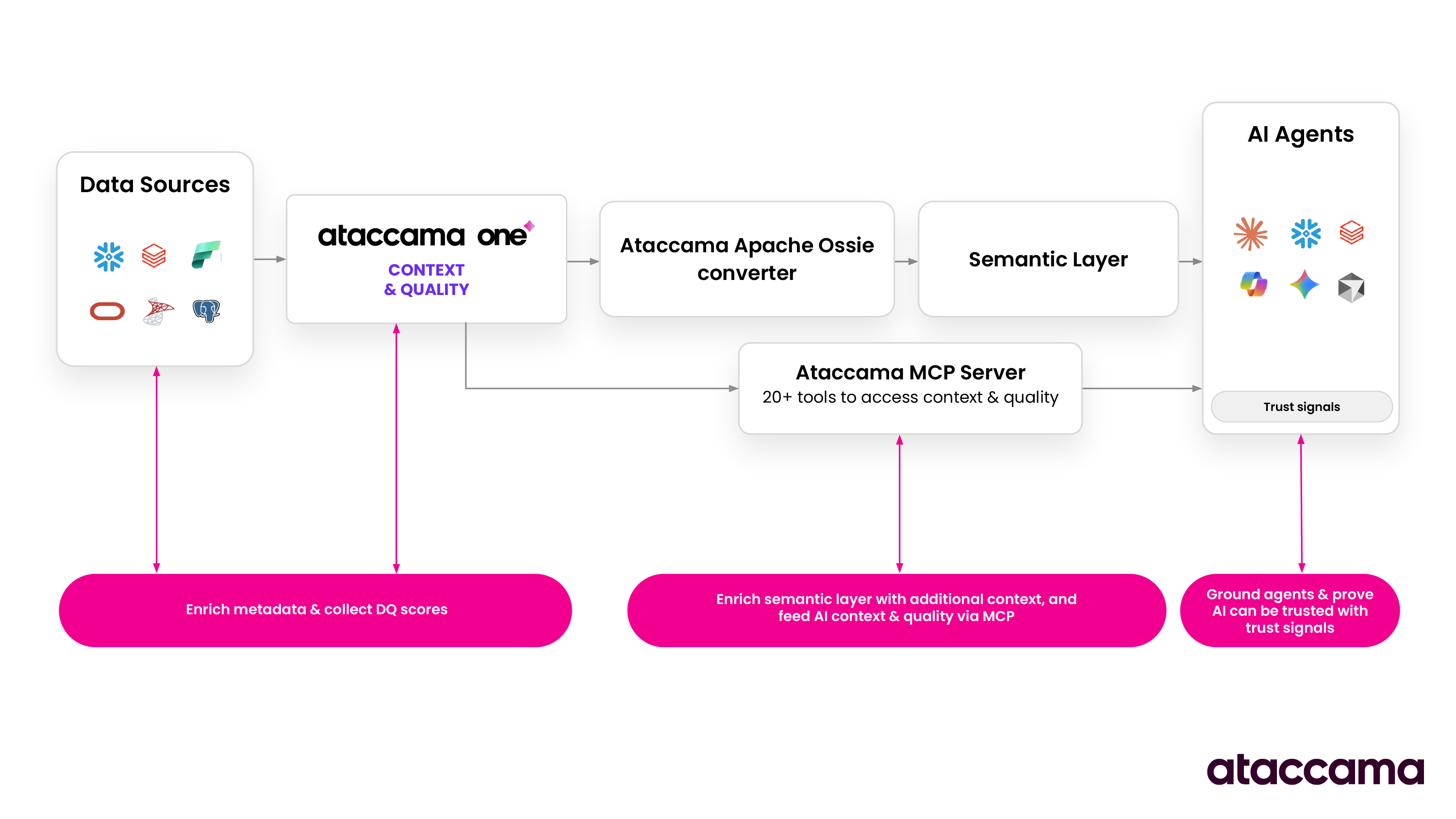
This is the integrated route to AI-ready data: rather than standing up a separate trust dashboard that teams have to remember to check, governed business context and quality signals travel with the semantic view itself, in the same file the semantic layer already reads.
Here’s what the converter carries into every Ossie definition it produces.
- Business metadata enrichment: Business terms that stewards have already curated in Ataccama’s data catalog — centralized business definitions that make up a company vocabulary — are mapped into Ossie’s ai_context field, exactly where the spec expects synonyms and usage instructions to live. Nobody has to re-tag “active customer” a second time for the semantic layer; the label governance already applied simply shows up there.
- Data quality enrichment via Ataccama extension: Alongside the business context, the converter appends a structured block containing the dataset’s DQ state, its pass rate percentage, the threshold it’s measured against, a below-threshold flag, and the count of active findings. This is the piece most semantic layers are missing today: not just what the data means, but a structured signal for whether it’s currently meeting its own bar.
- Data quality AI warnings: When enabled, the converter appends a plain-language caveat to the AI instructions for any dataset Ataccama flags as having quality issues. As a result, a downstream AI tool reading the model is told to treat that number with caution.
- Automated refresh: The converter is designed to run as a scheduled job — an Airflow DAG, a GitHub Action, or a step appended to an existing dbt job chain — so the Ossie export refreshes at the same cadence as your data quality runs. Trust signals that are current only on launch day aren’t trust signals; this keeps them live.
However, not everything belongs in that file. A pass rate, a threshold, and a below-threshold flag are condensed enough to sit in every semantic view without inflating it. The specifics behind that flag — which checks failed, on which records, with what detail — aren’t. Combining that into the file would mean duplicating a growing quality log across every semantic view that references the dataset. That’s better served live, from the Ataccama MCP server, at the agent instruction level: an agent that hits a below-threshold flag in the semantic view can query the MCP server for the specifics only when it needs to explain or act on one, rather than every semantic view carrying that detail whether or not anything ever reads it.
None of this is about replacing the layers the industry is building. It’s about making sure they can be believed.
This is also why the approach is deliberately platform-agnostic. Ataccama applies data quality checks directly at the source systems — where defects are actually introduced — rather than waiting until data has already landed in a warehouse or lake. That means the trust signal carried by the Ossie converter holds even for agents built directly on source systems, outside any single data cloud’s walls.
Joining an open standard
Ataccama’s converter joins a growing list of contributions to the Apache Ossie (Incubating) project, alongside Snowflake, Databricks, dbt, and others. Being one of the contributors offers a concrete answer to “how do I get governed context and quality into my semantic layer,” sitting next to the platforms enterprises are already standardizing on.
Get started
Curious how Ataccama enables trusted data for AI, from source to agent? Join us for a webinar demoing the Apache Ossie converter and how we power trusted data for AI agents.
Anja Duricic
Anja is our Product Marketing Manager for ONE AI at Ataccama, with over 5 years in data, including her time at GoodData. She holds an MA from the University of Amsterdam and is passionate about the human experience, learning from real-life companies, and helping them with real-life needs.