Ataccama and Snowflake: A complete path to AI-ready data

An AI agent capable of querying your Snowflake environment is not, by that fact alone, an agent worth trusting with what it finds there. Snowflake has spent the past year closing the first problem, and closing it well. Horizon Context builds semantic views that agents read from a single, shared definition, and that context increasingly travels outward too, reaching Claude, Power BI, Tableau, and other external agents through MCP rather than staying confined to Snowflake’s own surfaces. Cortex AI Guardrails, now generally available, defend CoWork and CoCo against prompt injection and jailbreak attempts, while AI Agent Identity assigns every agent a cryptographic identity and an audit trail. On access, scale, runtime security, and now interoperability, the platform has done the work.
None of it, however, tells you whether the number the agent is reasoning over is actually correct.
That is the distinction most Snowflake-plus-AI architectures quietly elide: the gap between an agent permitted to read a column and an agent that ought to trust what sits inside it. Access control settles who may see the data. Quality settles whether the data deserves to be seen. Snowflake resolves the first at the platform level. Resolving the second, across an estate that spans Snowflake, Databricks, the mainframe, and a dozen operational systems, calls for a layer purpose-built for exactly that task.
Ataccama is that layer, not a substitute for anything Snowflake already does well, but the piece that makes the rest of the stack worth acting on.
Why governed access isn’t governed quality
Two Snowflake capabilities are relevant here, and they’re easy to conflate.
Horizon Catalog is the governance layer. It classifies sensitive data automatically, applies tag-based policies that travel wherever the data goes, gives administrators a dashboard for AI governance, and generates the semantic views on which CoWork and CoCo depend. Data Metric Functions (DMFs) and the newer Snowsight Data Quality tab live under that same catalog, letting teams confirm a table looks healthy without writing SQL. Five connectors to sources outside Snowflake were added recently, though they remain in private preview.
Horizon Context is a different undertaking: the newer effort to extend that shared meaning to agents operating beyond Snowflake’s own surfaces, via MCP, as described above.
Where data engineering owns quality end to end, or where some tolerance for imperfect data is acceptable, this catalog-and-DMF baseline is a legitimate, capable foundation.
Its limitation lies in what it actually certifies. A DMF confirms that a column’s null rate or freshness sits within range. It does not confirm that the values are accurate, complete, or fit for a particular business decision, nor does it produce the audit trail a regulator would expect to see. External reach, too, remains narrow: five connectors, all still in private preview.
For data that lives inside Snowflake and stays there, that boundary rarely matters. For an agent drawing context from Snowflake, an ERP system, and a mainframe within a single reasoning chain, it matters considerably.
Snowflake’s native tooling, in short, monitors whether data looks healthy inside its own platform. Proving that data is fit for a decision across a heterogeneous estate sits outside that scope, and Snowflake doesn’t claim otherwise.
What “fit for decision” actually requires
Proving data is fit for a decision, in a way that holds up under audit and travels across systems, takes a few things a monitoring layer doesn’t provide on its own:
- A quality rule defined once and reused everywhere, with versioning and governance attached, rather than redefined per object or per platform.
- Business context that outlives the engineer who wrote the pipeline: a glossary tying technical fields to business terms, with an owner attached to each.
- A score, not just a pass/fail flag, that an agent or a human can reason with when deciding how much to trust a given dataset.
- Lineage that crosses system boundaries, including the mainframe and on-prem sources most enterprises still run critical data through.
- A resolved identity for shared entities, so the same customer, product, or code means the same thing whether it’s read in Snowflake or somewhere else.
Ataccama builds this layer. Its central data quality rule library carries dimension attribution; its enterprise business glossary links terms to rules; cross-system observability, end-to-end lineage down to the column level, and governed match-and-merge for master data complete the picture. The whole runs source-agnostically across Snowflake, Databricks, BigQuery, on-prem systems, and the mainframe, and rolls the resulting signals into a Data Trust Index, a single score an agent can reason with instead of treating every input as equally reliable.
The practical difference: Snowflake measures quality and governs meaning largely within its own platform. Ataccama verifies that data is accurate as it lands and as it moves through the medallion architecture, lets non-technical stewards rather than engineers own governance by default, and produces a trust score that holds across every source feeding the agent, not merely those that happen to live inside Snowflake.
Enforcing quality in motion, not after the fact
Monitoring a table after the fact tells you that something broke. It does nothing to stop a bad record from reaching a dashboard, a compliance report, or an agent before anyone has noticed. Snowflake’s native tooling surfaces failed records and offers a SQL primitive for acting on them, but no governed workflow carries that failure from detection through to a resolved, audited fix.
Ataccama’s Data Quality Gates close precisely that gap by enforcing rules on data while it’s still in motion. Rules are authored once, centrally, in Ataccama ONE, then deployed as native functions that execute locally, whether through pushdown execution inside Snowflake or at the edge for other sources, so unfit records are caught before they move from bronze to silver to gold and on into analytics, reporting, or an agent’s context window.
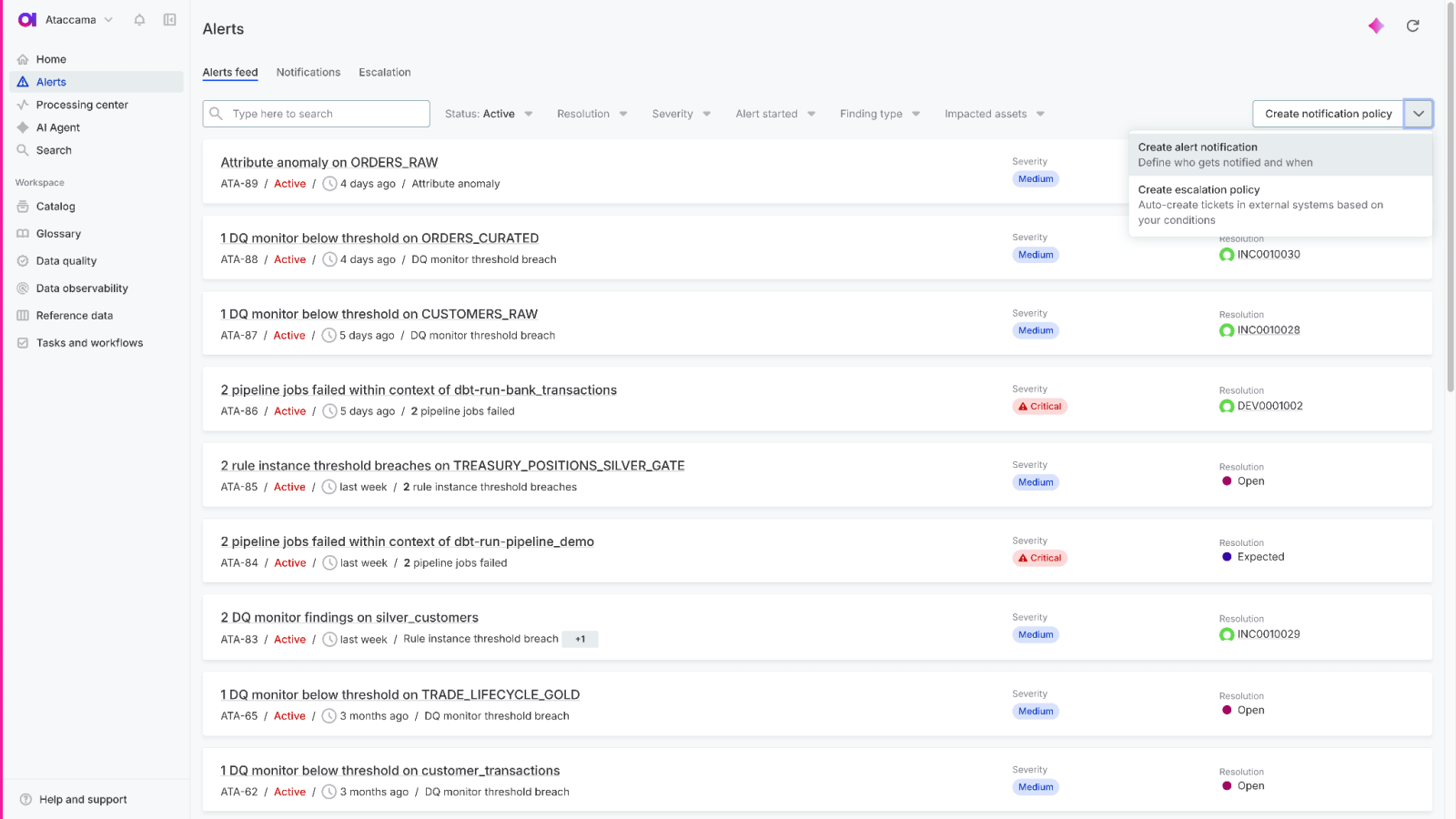
Estate-wide alerting on quality thresholds, anomalies, and pipeline failures
The remediation loop that follows unfolds in three stages.
| Stage | What happens |
| Detect | Estate-wide alerting on quality-threshold breaches, anomalies, and pipeline failures, surfaced the moment they occur |
| Triage | The issue routes to the right steward as a ticket carrying full context: the failing records, the rule violated, affected assets, and lineage |
| Fix | Stewards apply governed corrections; gating quarantines or blocks unfit records before they propagate; every action is logged |
The alert feed itself carries specific, actionable finding types rather than a generic warning that something is amiss: attribute anomalies, DQ monitor threshold breaches, pipeline job failures, rule instance threshold breaches, each tagged with severity and a resolution status capable of auto-creating a ticket in an external system.
That closed loop, not a one-off SQL query, is what separates data quality as a compliance exercise from data quality as an operational discipline, one with an owner, a context, and a record behind every fix.
Who does the maintenance work
A trust layer holds up only if someone keeps its rules current, triages its anomalies, and documents what has changed. Left entirely to manual effort, that maintenance burden is often exactly what causes governance programs to stall.
Ataccama’s ONE AI Agent exists to absorb much of that burden. It generates and suggests rules, detects anomalies, documents catalog assets, root-causes issues, and recommends fixes, rather than leaving each step to manual setup. At one global bank, this reduced catalog documentation time from weeks to hours across 100 items and automated 170 rule modifications and 47 debugging tasks, cutting manual effort by close to 90 percent.
Snowflake’s own Cortex Data Quality, still in preview, reads metadata and returns a suggested check on request: a useful starting point, but one that stops there. The ONE AI Agent instead reasons over metadata, lineage, usage history, and past issues to run the workflow that surrounds a check: creating the rule, monitoring it, catching and root-causing the anomaly, and routing it to a steward.
The same agentic foundation exposes governed data through the Ataccama MCP Server, letting downstream agents read four specific fields for any dataset automatically, rather than requiring a person to look them up on request.
| Field | What it tells the agent |
| Origin | Where the data came from |
| Quality verification | How and when it was checked, and against which rules |
| Owner | Who is accountable for it |
| Approved use | What it’s cleared to be used for |
Alongside those four fields, an agent also receives the Data Trust Index itself, letting it weigh a dataset’s reliability rather than treat it as a black box.
What this looks like as a stack
Laid end to end, the architecture resolves into five layers: raw data sources at the base, cloud lakehouses and warehouses above them, a trust layer spanning governance, quality, observability, and reference data, a semantic layer serving agent frameworks and foundational models, and applications at the top consuming all of it.
Snowflake anchors layers two, four, and five for data native to its platform, running the agent surfaces (CoWork, CoCo), the semantic views, and the storage and compute beneath them. Ataccama occupies layer three, source-agnostic, feeding trust and context upward regardless of where the underlying data resides.
The trust layer also sits ahead of ingestion, not merely above it. Ataccama can identify and fix issues before they ever land in Snowflake, a capability that matters as much to organizations mid-migration as to those already running at steady state.
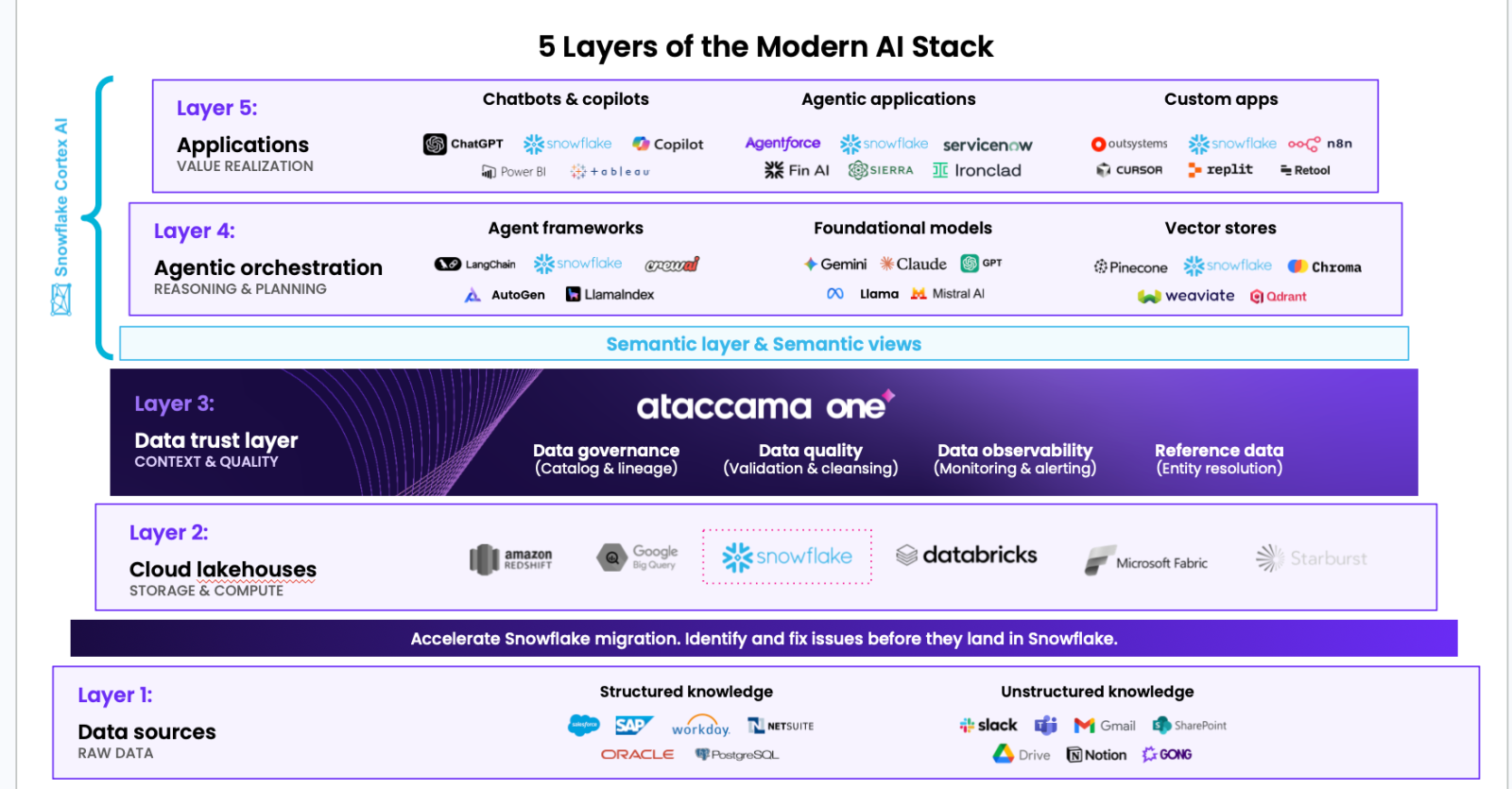
“5 Layers of the Modern AI Stack” diagram
The capability breakdown, laid out side by side, looks like this.
| Capability | Snowflake (native) | Ataccama ONE |
| Coverage / scope | Snowflake objects, connected Iceberg tables, 5 external metadata connectors (private preview) | Source-agnostic with 200+ connectors, across Snowflake, Databricks, BigQuery, on-prem, mainframe, operational systems; Data Quality Gates in pipelines |
| Quality checks | DMFs (system and custom); Snowsight Data Quality tab (preview); checks defined without SQL; manual setup per object | Source-agnostic, reusable rule library with full governance and versioning. Metadata-driven automation: rules bind to business terms and apply at scale. Pushdown execution in Snowflake, edge execution at the source, DQ Gates in Snowflake pipelines |
| Business glossary | H2 roadmap; currently, Horizon covers technical/security metadata within Snowflake | Enterprise-wide glossary, terms, trust signals, term-to-rule binding |
| Anomaly detection | Volume and freshness only (preview) | AI/ML anomaly detection across the data estate and observability of pipeline failures upstream and in Snowflake |
| Lineage | Column-level within Snowflake; Snowflake’s OpenLineage connectors remain largely table-level | End-to-end, cross-system, including mainframe, column-level, with DQ scores and business term overlays |
| Reference data / master data management | Not natively packaged | Governed match and merge, managed reference data |
| Alerting | In-platform monitoring | Unified estate-wide alerting on quality thresholds, anomalies, and pipeline failures |
| Remediation workflow | Failed-record surfacing; SQL scan primitive | Governed detect → triage → fix loop; enterprise ticketing integration (confirm named connectors before publishing). Exports of invalid records across custom business rules |
| AI-powered data management | Cortex Data Quality suggests checks (preview), scoped to Snowflake | ONE AI Agent: autonomous steward that governs, monitors, evaluates quality, finds issues, root-causes, and recommends fixes across the estate |
| AI enablement | Horizon: access governance, RBAC, audit trails, semantic views | Governed data products with DQ scores, Data Trust Index, and governance context delivered into the AI stack, including CoCo/CoWork via MCP Server. OSI collaborator; portable governed data products that hold their meaning across platforms |
Read across any row and the pattern holds. Snowflake’s native capability is real, but scoped to what lives inside its own platform. Ataccama’s extends the same function across everything else the enterprise runs, then hands the result back into Snowflake’s own agent surfaces.
Where the two connect without lock-in
Ataccama delivers its trust signals into CoCo and CoWork through the Ataccama MCP Server, as an Open Semantic Interchange (OSI) collaborator and a launch partner for Snowflake’s Agentic Data Sharing program. The governed data products it produces carry a consistent semantic definition and remain portable across platforms, so a dataset’s meaning, and the trust score attached to it, doesn’t shift depending on whether an agent reads it inside Snowflake or from Databricks, on-prem systems, or the mainframe.
That portability matters more than it might first appear. An enterprise that standardizes its semantic layer entirely within a single platform has, in effect, tied its AI strategy to that platform’s roadmap. Extending trust and context through an interoperable layer instead means the architecture holds even as the estate grows, is re-platformed, or takes on sources Snowflake has yet to natively connect to.
Here’s what that looks like inside an agent’s own reasoning. A catalog item might carry a Data Trust Index of 60.4 percent, flagged amber, built from a weighted blend of signals rather than a single pass-or-fail judgment.
| Category | Score | Weight | Weighted contribution |
| Data quality | 1% | 40% | 0.4% |
| Stewardship | 100% | 20% | 20% |
| Avg. term count per attribute | 100% | 20% | 20% |
| Catalog item terms | 100% | 10% | 10% |
| Description | 100% | 10% | 10% |
The diagnosis, in this example, is immediate. Stewardship and documentation are in excellent shape, yet the data quality score is nearly zero, and because quality carries the heaviest weight, it drags the overall index down to amber despite everything else being complete. That’s a far more useful signal for an agent to act on than a flat, undifferentiated “82% governed” would be.
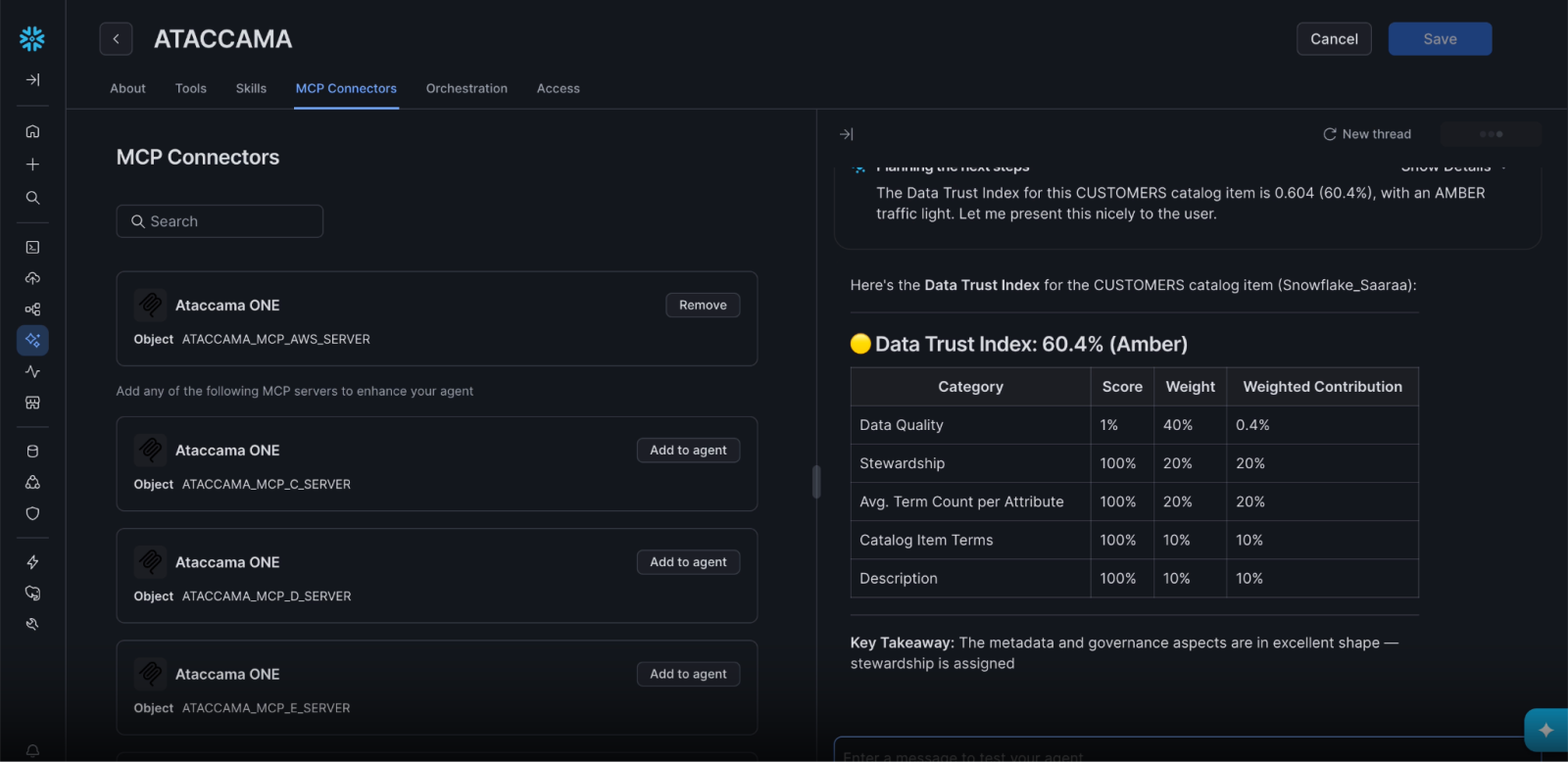
MCP Connectors panel showing the Data Trust Index surfaced inside an agent’s own reasoning thread.
Where to start, by architecture
| If your situation is… | Native Snowflake tooling likely covers it | You need Ataccama’s trust layer |
| Every source lives in Snowflake, data engineering owns quality end to end | Yes | Optional, but adds cross-check on fit-for-decision proof |
| Agents reason across Snowflake plus Databricks, mainframe, or operational systems | No — Horizon’s external reach is 5 connectors, private preview | Yes — source-agnostic across the full estate |
| Governance and stewardship sit with business teams, not engineering | Partial — glossary is roadmap, not shipped | Yes — glossary and rule ownership are core to the platform |
| Regulated reporting needs an audit trail proving values are accurate, not just present | No — DMFs confirm the table looks healthy, not that it’s fit for decision | Yes — DQ scores, lineage, and Data Trust Index carry the audit trail |
| An agent needs to weigh how much to trust a given dataset before acting | No — RBAC governs access, not reliability | Yes — Data Trust Index gives agents a reliability score to reason with |
| The semantic layer needs to mean the same thing if the estate re-platforms later | No — tied to Snowflake’s own semantic views | Yes — OSI-based, portable across platforms |
Migrating onto Snowflake is, on its own, a natural point of entry: Ataccama can identify and fix data issues before they ever land, rather than after.
The essential data trust layer for Snowflake and beyond
See how Ataccama ONE makes Snowflake data validated, governed, and AI-ready from day one.
FAQ
Yes. Ataccama uses pushdown execution, so quality rules and profiling run on Snowflake’s own compute and the data itself never leaves the environment. The same layer also runs across Databricks, BigQuery, on-prem systems, and the mainframe, so rules and governance travel with the data as the estate extends beyond Snowflake.
CoWork and CoCo govern who may read data and log what an agent did with it, but governed access is not governed quality. Ataccama surfaces DQ scores, a Data Trust Index, and governance context such as ownership and certification status through the Ataccama MCP Server, so agents act on data that’s accurate and fit for the decision at hand, not merely accessible.
DMFs measure individual metrics on Snowflake tables, useful for lightweight, in-platform checks. Ataccama offers a governed rule lifecycle instead: a central library with versioning and dimension attribution, no-code and low-code rule building, cross-system execution, and a closed remediation loop. The difference lies in governance depth and scope, not in whether a check can run at all.
Yes. Ataccama governs data across Snowflake, Databricks, BigQuery, on-prem databases, operational systems, and the mainframe from a single platform, with lineage that crosses the Snowflake boundary. This is typically why organizations add Ataccama alongside Snowflake in the first place: one trust layer over a heterogeneous estate, rather than a separate tool for each platform.
Data Quality Gates enforce quality on data in motion, inside the pipeline, before unfit records can move downstream. Rules are authored once in Ataccama ONE, then deployed as native functions that execute locally wherever the data runs, catching invalid records as they move from bronze to silver to gold and on into analytics, reporting, or an AI agent.