What is the SAP Data Quality Accelerator? Deploy trusted SAP data up to 80% faster

Most SAP data quality implementations take months before they produce a single usable result, and the delay rarely comes from writing rules. It comes from rebuilding knowledge about SAP’s data model that the industry already has, one engagement at a time. Every new project spends time defining business rules for each of the SAP domains like material, customer, vendor, enterprise asset management, human capital management, and financial master data, re-engaging subject matter experts, and validating scenarios that have already been solved on previous implementations.
The SAP Data Quality Accelerator, built by Emisha on Ataccama ONE, exists to remove that repeated work. Instead of starting SAP data quality initiatives, S/4HANA migration projects, or SAP master data governance programs from a blank page, teams begin with a logical catalog, business mappings, and pre-built rule libraries that reflect how SAP data behaves in practice.
That shifts the work from months of discovery to weeks of deployment and validation.
This article explains what’s included in the accelerator, how it works within the Ataccama agentic data trust platform, and why packaging SAP knowledge, rather than writing faster rules, is what actually shortens implementation. It also covers where SAP data quality work continues to matter after go-live, as AI systems and automated processes increasingly run directly on SAP master data without a person checking the output first.
In this article, you’ll learn:
- What the SAP Data Quality Accelerator is
- How it works within the Ataccama ONE data trust platform
- Why SAP data quality implementations take so long
- What’s included in the accelerator
- How the SAP Data Quality Accelerator can reduce implementation time by up to 80%
- Why continuous monitoring matters after go-live
Why do SAP data quality implementations take so long?
SAP runs the parts of a business that cannot tolerate ambiguity: what’s on hand in a warehouse, what a customer owes, what a vendor is contracted to deliver at what price under what tax treatment. For most of SAP’s history, that data didn’t need to be perfect. It needed to be good enough that a person could catch the exception before it became a decision. A buyer noticed an odd quantity before issuing a purchase order. A finance analyst caught a stray valuation entry during month-end close.
That buffer is gone. Automation now acts on SAP data directly, without a person reviewing each transaction. Analytics and forecasting models consume SAP master data at scale, and a model trained on inconsistent material valuations doesn’t know its inputs are wrong; it just produces a confident, wrong forecast. S/4HANA migrations force the issue further, since two decades of accumulated exceptions can’t move into a new data model without being confronted first.
The consequences were always financial. A mis-tagged VAT classification creates audit exposure across every jurisdiction it touches. A duplicate business partner record means a vendor gets paid twice, or a customer’s credit exposure is understated because two records are splitting one relationship. What’s changed is how quickly those consequences surface, and how little time exists between a data error and a system acting on it.
Most of the calendar time in a typical engagement goes into discovery, requirements gathering, business workshops, field mapping, and rule design. Some of that work is specific to the customer, but much of it starts from recurring SAP structures and business objects. Every customer still applies its own configuration, extensions, and operating rules, so the accelerator packages the common foundation while leaving project teams to calibrate it to the customer’s SAP version, configuration, and business processes.
The value lies in reducing how much established SAP knowledge has to be reconstructed at the start of each engagement. Teams can begin with reusable definitions, mappings, and rule logic, then focus their effort on the customer-specific decisions that still require validation.
What is the SAP Data Quality Accelerator?
The SAP Data Quality Accelerator is a pre-built package of SAP-specific data models, business definitions, data quality rules, and predefined data quality dashboards developed by Emisha and deployed on Ataccama ONE. It was built specifically to remove the discovery and rule-design work that otherwise repeats on nearly every SAP data quality implementation, SAP master data management initiative, and S/4HANA migration readiness project.
Rather than starting with a blank rules engine, teams start with a logical catalog that already describes SAP tables in business terms, attribute mappings that already connect SAP field names to language a business owner recognizes, and rule libraries developed from Emisha’s SAP data quality implementation experience. The content is purpose-built for SAP. It’s organized specifically around SAP Material Master, SAP Business Partner, SAP Finance, SAP Enterprise Asset Management, and SAP Human Capital Management, the domains that generate the most recurring data quality problems.
A typical five-week deployment focuses on up to two domains, selected according to the customer’s priorities and available validation resources.
The difference this makes is structural, not cosmetic. A discovery phase that used to require weeks of workshops with SAP functional experts becomes a scoping exercise: confirm which domains matter, adapt the pre-built content to this customer’s configuration, and move into validation. That’s why implementation time drops. The accelerator doesn’t make rule-writing faster. It removes the need to write most of the rules from scratch in the first place.
Why SAP data quality starts with business context
SAP master data is highly interconnected. Whether a value is correct often depends on the relationship between multiple business objects, organizational structures, and configuration settings rather than on the value in a single field. That means validating SAP data requires more than checking individual fields. It requires understanding the relationships between business objects, organizational structures, and customer-specific configuration.
A business partner record can carry customer attributes, vendor attributes, or both, and which fields are mandatory shifts by role and country. Fixing one record can ripple into open sales orders, credit limits, and tax registers that reference it, so a change that looks like simple cleanup can quietly break processes that depended on the old value.
This is why SAP data quality work has historically depended on a small number of people who understand the business semantics behind the tables, not just the tables themselves. This is why SAP data quality projects depend heavily on business and functional expertise. Rules often need to account for organizational structures, business partner roles, plant-specific configuration, and customer-defined processes. The accelerator packages much of that recurring SAP knowledge so teams can focus on validating what is unique to their own environment rather than rediscovering common patterns from scratch.
What’s included in the SAP Data Quality Accelerator
The accelerator is built from four layers of reusable SAP knowledge:
- A logical catalog. SAP tables and fields translated into business-friendly definitions so business users can understand what a field represents without interpreting SAP’s technical metadata.
- Business semantics and mappings. Attribute-level mappings that connect SAP’s internal structure to the business concepts they represent, capturing the context (plant, procurement type, account determination, customer or vendor role) that generic tools miss.
- Pre-built data quality rules. Rule libraries for Material Master, Business Partner, Finance, Enterprise Asset Management, and Human Capital Management, covering recurring data quality patterns across SAP landscapes.
- Reusable SAP domain knowledge. Pre-built SAP-specific content developed from Emisha’s implementation experience so teams begin with reusable knowledge rather than creating everything from scratch.
- Pre-built data quality dashboards. Leveraging Ataccama’s dashboarding capabilities, prebuilt domain-wise dashboards provide senior management insights on key DQ metrics and trends.
These layers turn the earliest, slowest phase of an SAP data quality implementation, figuring out what to check and why, into a starting point rather than a research project.
A closer look at the rule libraries
SAP Material Master
- Mandatory field completeness: Depending on the customer’s configuration, incomplete material records can interrupt procurement, inventory management, manufacturing, or financial processes.
- Unit-of-measure consistency: Inconsistent units of measure can create downstream discrepancies in inventory, planning, procurement, and reporting when the same material is used across multiple plants or business processes.
- Valuation validation: Validating valuation classes and related master data helps ensure inventory is classified according to the organization’s configured accounting and valuation rules.
SAP Business Partner (Customer and Vendor)
- Duplicate detection: Duplicate customer or vendor records can result in duplicate payments, fragmented customer views, inconsistent reporting, and operational inefficiencies.
- Referential integrity: Checks identify invalid or inconsistent relationships across relevant SAP business objects and organizational structures before they disrupt downstream processes.
- Tax and VAT validation: Validates tax identifiers and related master data against expected formats and business rules, helping reduce compliance risk.
SAP Finance
- Mandatory field completeness: Ensures required financial master data is populated before it affects downstream accounting and reporting processes.
- Value and code validation: Validates financial codes, account classifications, currencies, and other configured values against approved business rules.
- Posting and date consistency: Identifies inconsistent posting dates, validity periods, or timing anomalies that can affect financial reporting and operational processes.
Cross-domain
- Organizational alignment: Confirms that master data aligns with configured company codes, plants, organizational units, and other business structures to support consistent reporting and downstream processing.
None of these rule categories is unique to a single SAP implementation.
They represent recurring data quality patterns found across SAP landscapes. The value of the accelerator isn’t that it introduces new kinds of validation; it’s that organizations begin with these proven patterns already modeled, then calibrate them to their own SAP configuration rather than designing every rule from scratch.
How the accelerator works inside Ataccama ONE
The rule libraries execute within Ataccama ONE, leveraging the platform’s data quality capabilities to validate SAP data without requiring it to be replicated into a separate data quality repository. Current implementations run checks in batch, with the frequency determined by the customer’s operational requirements.
Current implementations run the checks in batch. Where point-of-entry validation is required, the same quality logic can also be integrated into a real-time DQ Firewall architecture, subject to the customer’s SAP landscape and implementation design.
Connectivity meets SAP landscapes where they already are. The accelerator supports JDBC, OData and RFC connectivity to SAP and its satellite systems. The connection method is selected according to the customer’s SAP architecture, available interfaces and security requirements.
When a rule identifies a problem, the platform flags it for remediation through monitoring, workflow integrations, and governance capabilities, and integrations with Teams, Slack, Jira, and ServiceNow that put it in front of whoever owns that data. Current implementations do not automatically write corrections back into SAP. Automatic write-back is technically possible if a customer’s governance model supports it, but it isn’t the standard approach: SAP master data feeds too many downstream financial, logistics, and operational processes for an automated system to silently alter it without a person confirming the change is correct. Configurable thresholds, monitoring dashboards, governance reporting, and audit trails exist to make that human decision faster and better informed, not to remove it.
How does the SAP Data Quality Accelerator reduce implementation time?
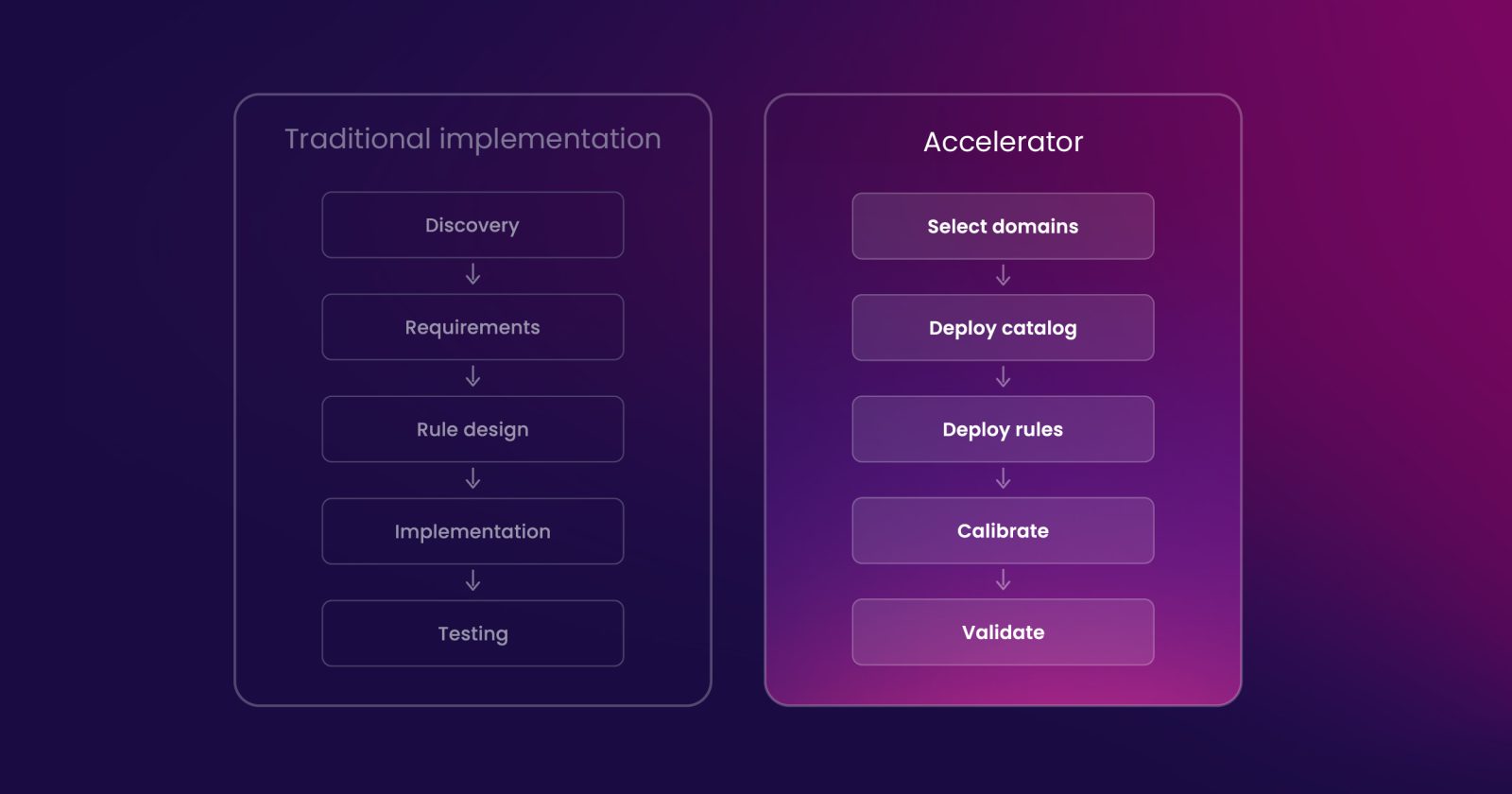
A typical rollout using the accelerator runs five weeks.
- The first week scopes which data domains and business rules matter for that customer, selecting and adapting from pre-built content rather than building from nothing.
- The second week deploys the catalog and rule sets for those domains, largely a configuration exercise rather than a development one.
- Weeks three and four calibrate those rules against the customer’s real data, tuning alert thresholds and setting up the dashboards a team will use day to day.
- The fifth week covers user acceptance testing and handover.
That timeline typically covers up to two data domains, and the constraint is worth being explicit about, because it isn’t a platform limitation.
The pace is set by how much validation capacity a customer’s own team can dedicate, since someone on the customer side has to confirm a calibrated rule is actually catching the right problems before it goes live. A customer that allocates more people to validation can cover more domains in the same five weeks. The accelerator removes the discovery and rule-design bottleneck; it doesn’t remove the step where a human confirms the result is correct.
The commonly cited figure that implementations run up to 80% faster is measured against the traditional lifecycle, done from scratch: discovery, requirements gathering, design, implementation, and testing. With the accelerator, teams spend their time deploying, calibrating, and validating rules that already reflect known SAP patterns, rather than creating that logic for the first time. The acceleration comes from eliminating rediscovery, not from writing the same rules faster.
From technical capability to business outcome
Every capability in the accelerator maps to a specific, practical outcome for the team implementing it:
| Capability | Business outcome |
|---|---|
| Pre-built SAP knowledge | Less time spent on discovery, lower consulting cost, and earlier business value |
| Logical catalog and business mappings | Less time required from SAP subject matter experts, usually the scarcest resource on any implementation |
| Pre-built rule libraries | Faster deployment, since teams configure existing content instead of writing and testing new rules from scratch |
| Native SAP connectivity (JDBC, RFC, OData) | Lower implementation complexity, since the accelerator adapts to a customer’s existing landscape instead of requiring a new integration layer |
| Continuous monitoring and dashboards | Better governance, since data quality issues surface as part of normal operations instead of during an audit or a migration |
| DQ Firewall (real-time deployment option) | Better operational data quality for organizations that need to catch problems at the point of entry, not after the fact |
The pattern underneath all of it is the same: technical depth exists to remove effort from a team’s calendar, not to add new things for them to manage.
Continuous value after go-live
Framing this purely as an implementation accelerator undersells what it becomes once deployed. The same rule libraries that shortened the initial rollout continue running as continuous monitoring, catching new data quality issues as they appear rather than waiting for the next audit or migration to surface them.
That ongoing visibility supports several initiatives organizations are already investing in:
- SAP data governance, providing the trusted data needed to turn governance policies into day-to-day operational practices.
- S/4HANA migration readiness, helping teams start from a landscape that has already been profiled and assessed rather than a black box.
- AI readiness, ensuring models and automated processes are built on trusted SAP master data that is continuously monitored over time.
Continuous monitoring is what turns “we cleaned this up once” into master data that stays reliable as SAP configurations, business rules, and integrations continue to change. As organizations automate more SAP-driven decisions with AI, maintaining trusted master data becomes an operational discipline rather than a one-time migration activity.
Organizations looking to quantify progress can also measure improvements in trusted data over time using approaches such as Ataccama’s Data Trust Index.
The practical takeaway
Organizations aren’t slowed down by the mechanics of implementing data quality rules. They’re slowed down by the work required to understand, define, validate, and calibrate those rules for an individual SAP landscape.
The SAP Data Quality Accelerator turns years of SAP implementation experience into reusable content, allowing teams to spend their time validating their own data instead of rebuilding SAP logic from scratch. As AI, automation, and S/4HANA modernization continue to raise the cost of poor-quality master data, reducing implementation effort isn’t just about saving time; it’s about establishing trusted data sooner so the business can move faster with confidence.
Whether you’re preparing for an S/4HANA migration, improving SAP master data quality, or building a trusted foundation for AI, the SAP Data Quality Accelerator helps reduce implementation effort and accelerate time to value. Through Ataccama’s expanded partnership with Emisha, organizations across India, Sri Lanka, and Bangladesh now have local access to the accelerator and the implementation expertise needed to put it into practice.
Connect with our team to discuss how the SAP Data Quality Accelerator can be applied to your environment.
FAQ
The SAP Data Quality Accelerator is a pre-built package of SAP-specific data models, business definitions, mappings, and rule libraries developed by Emisha and deployed on Ataccama ONE. It helps organizations reduce implementation time by starting with reusable SAP knowledge rather than building data quality rules from scratch.
Typical implementations can be completed up to 80% faster than traditional SAP data quality projects by reducing discovery, requirements gathering, and rule design. A standard deployment typically takes around five weeks for up to two SAP data domains.
The accelerator includes pre-built content for:
- Material Master
- Business Partner
- Finance
- Enterprise Asset Management
- Human Capital Management
Most initial deployments focus on one or two domains before expanding over time.
The accelerator can support organizations preparing for or operating SAP S/4HANA environments. It is commonly used for S/4HANA migration readiness, ongoing master data quality, and SAP data governance initiatives.
No. By default, identified issues are surfaced for review and remediation through Ataccama ONE’s monitoring, governance, and workflow capabilities. Automatic write-back is technically possible but is not the standard implementation approach.
The accelerator runs within the Ataccama ONE Agentic Data Trust Platform, using its data quality capabilities alongside governance, monitoring, workflow, and integration services. The accelerator adds SAP-specific catalogs, mappings, and rule libraries that accelerate implementation while benefiting from the broader capabilities of Ataccama ONE.
AI systems are only as reliable as the data they consume. By continuously monitoring SAP master data and identifying quality issues before they affect downstream processes, the accelerator helps organizations establish a trusted data foundation for analytics, automation, and AI.
Jessica Goulart
Jessica Goulart is Vice President of Partnerships at Ataccama, where she leads the company's global partner ecosystem, helping technology partners, system integrators, and distributors deliver trusted, AI-ready data to enterprise organizations. She works closely with partners to accelerate data modernization, improve data quality and governance, and help customers build trusted data foundations for AI. Before joining Ataccama, Jessica led strategic partnerships at Bloomreach and Adobe, building high-impact alliance programs that expanded market reach and accelerated customer success.