Key takeaways from the Gartner Data & Analytics Summit Orlando 2026
The Gartner Data & Analytics Summit in Orlando was all about how organizations need to adapt in the age of Agentic AI.
This year’s theme, “Value at AI Velocity: Navigating the Now and Next,” captured a challenge many organizations now face. Most companies already have momentum with AI initiatives, but turning that momentum into measurable business value, trusted decisions, and scalable operations remains difficult.
Across the keynote session, one message stood out: success in the age of Agentic AI will depend on AI ambition, strong foundations, and people to achieve ROI, which Gartner describes as return on intelligence.
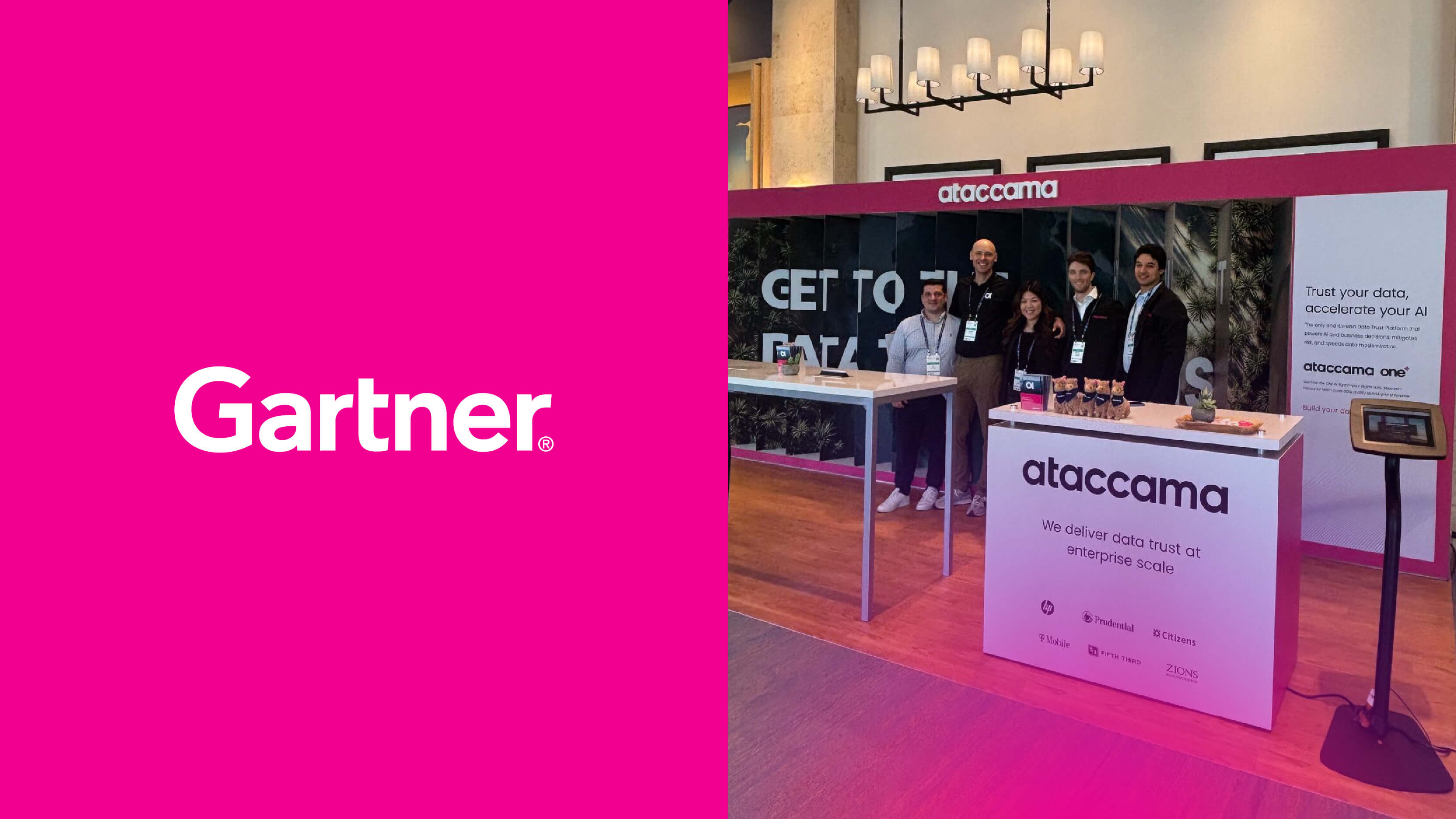
The Ataccama team was on the ground in Orlando, and our conversations with CDOs throughout the week confirmed what we hear from our customer base every day. The organizations moving fastest on AI have made data trust a strategic priority, and it shows in the confidence with which they deploy and scale AI systems.
Below are the biggest takeaways from the event.
1. Organizations must define their AI ambition
One of the most important strategic decisions leaders face today is how aggressively to adopt AI.
Gartner outlined three broad approaches organizations are taking:
- AI-first organizations that move early and experiment aggressively
- AI-opportunistic organizations that adopt once initial lessons are learned
- AI-cautious organizations that wait for technology to stabilize
There is no universal “correct” path. Each organization must align its AI strategy with its risk tolerance, resources, and long-term priorities.
However, the message from Gartner was clear: doing nothing is not an option. “If you don’t lead AI, AI will lead you.”
What we are seeing from many enterprise data leaders is that defining AI ambition quickly exposes another reality: AI strategy and data strategy are now inseparable.
Organizations cannot scale AI without also addressing the quality, governance, and accessibility of the data that feeds it. Without trusted inputs, AI systems risk producing unreliable outcomes, introducing operational risk rather than competitive advantage.
This pressure is especially acute in regulated industries such as financial services, insurance, and healthcare, where unreliable AI output carries both operational and regulatory consequences. Organizations in these sectors are learning that AI readiness is fundamentally a data readiness problem. Before a model can generate reliable decisions, the data feeding it needs to be validated, governed, and trusted, and that responsibility sits squarely with CDOs. Solving it is exactly what Ataccama is built to do.
2. AI investments must balance ambition with cost discipline
Cost remains one of the biggest concerns surrounding AI initiatives, reflecting a growing tension between AI ambition and financial uncertainty.
Many organizations recognize the transformative potential of AI, yet they struggle to predict the true cost of scaling it.
Gartner highlighted a notable divide in perception:
- 6 out of 10 IT leaders are concerned about AI cost overruns
- Only 2 out of 10 data and AI leaders believe uncertain AI costs will limit AI’s value
This gap suggests that while financial oversight is necessary, the teams closest to AI development often see long-term value outweighing short-term uncertainty.
However, one challenge organizations consistently acknowledge—but rarely address structurally—is the hidden operational cost of preparing and maintaining AI-ready data.
Beyond infrastructure and model development, AI programs require significant ongoing effort in areas such as:
- Data preparation and cleansing
- Continuous data quality monitoring
- Governance, compliance, and policy enforcement
- Observability and lifecycle management for data pipelines
These activities are widely recognized as major cost drivers for AI initiatives. Yet in many organizations, they are still handled through manual processes and fragmented point solutions across quality, governance, catalog, and observability tools.
As AI adoption accelerates, this fragmented approach becomes increasingly expensive. Data teams spend significant time reconciling issues across systems, responding to data incidents, and manually maintaining governance controls, creating operational overhead that slows innovation and inflates the real cost of AI.
Forward-looking organizations are beginning to address this problem differently. Instead of treating data quality, governance, and observability as separate tooling categories, they are investing in a unified data trust layer that brings these capabilities together across the data ecosystem. As such, data trust becomes more than a technical capability. It becomes a cost-mitigation strategy for AI. By automating data quality enforcement, governance controls, and pipeline monitoring within a single platform, organizations can reduce operational inefficiencies, contain the hidden costs of AI programs, and deliver trusted, AI-ready data at the scale required by modern AI initiatives.
Ataccama addresses this by unifying data quality, observability, governance, lineage, and master data management in a single platform. Customers who consolidate on Ataccama spend significantly less time on manual remediation and avoid the downstream rework costs that accumulate when AI models encounter data that was never properly validated.
The Ataccama Data Trust Index sits at the center of this approach, providing data teams and AI models with a real-time, continuous signal of dataset reliability. It gives everyone consuming a dataset an immediate, measurable read on whether that data meets the quality threshold required before it is used. Issues surface before they reach a model, enabling teams to address problems early rather than diagnose failures after the fact.
3. AI governance must expand beyond data teams
Another major theme from the summit was the evolution of governance in the age of AI.
Traditional governance frameworks have focused primarily on trusted data, asking questions like:
- Is this dataset accurate?
- Is it fit for purpose?
But in the AI era, the conversation is expanding from trusted data to trusted decisions.
Organizations must now ask:
- Should AI be used for this decision?
- Under what constraints?
- Who is accountable for the outcome?
To address these questions, governance can no longer live exclusively within data teams.
Gartner emphasized the need for cross-functional governance models, bringing together:
- Data governance
- Information governance
- Cybersecurity governance
- Corporate risk management
Together, these disciplines form a unified governance framework capable of managing both data trust and AI accountability.
In many organizations today, governance still relies heavily on manual processes—spreadsheets, documentation, and human review. This makes governance slow to update, difficult to enforce consistently, and prone to gaps as data environments grow more complex and distributed. As AI initiatives scale, these limitations become even more visible, since governance rules must continuously evolve and apply across a wide range of datasets, pipelines, and AI workloads. Platforms that establish a unified data trust layer with agentic AI capabilities can help close these trust gaps by automating governance tasks, continuously validating data quality and policies, and enforcing rules directly within data workflows, ensuring governance stays current, scalable, and consistently applied.
Ataccama makes this practical through a write-once, apply-anywhere approach to data quality rules and governance policies. Standards are defined once by the data team and automatically enforced across Snowflake, Databricks, and every downstream system, with no manual re-implementation needed at each layer. For organizations in regulated industries, automated, continuously enforced governance removes the audit risk associated with relying on documentation and human review cycles that lag the pace of AI deployment.
4. Human-AI fusion teams will reshape data organizations
AI will change how teams operate, but not necessarily by shrinking them.
While 32% of CIOs expect overall workforce reductions in the next three years, the opposite trend is emerging within data and AI teams:
- 45% of data leaders have increased team sizes
- 47% have kept them stable
- Only 8% have reduced them
This signals an important reality: AI increases the demand for data expertise rather than replacing it.
Gartner described the rise of “human-in-the-lead” fusion teams, in which people collaborate with AI agents to assist with analysis, automation, and operational tasks. In theory, this model allows smaller teams to deliver greater impact.
In practice, however, many data organizations are already operating under heavy pressure. Data teams are expected to support growing AI initiatives while managing core responsibilities such as data quality, governance, lineage, and data product delivery.
Without the right foundation, this creates a scaling problem.
If every dataset requires manual validation, documentation, and monitoring, even well-resourced teams struggle to keep pace with AI experimentation. Fusion teams can only deliver their promised productivity gains if the underlying data ecosystem can support them.
This is why many organizations are focusing on building a data trust layer that can automate large portions of the data management lifecycle, from detecting issues in data pipelines to enforcing data quality rules and maintaining context through catalog and lineage.
By operationalizing trust across the data estate, organizations can ensure that both humans and AI systems are working with agent-ready data, allowing fusion teams to focus on delivering insights and innovation rather than constantly fixing data problems.
Ataccama’s ONE AI Agent, an organization’s digital data steward, is built for exactly this challenge. It acts as a digital data steward, continuously monitoring pipelines, detecting anomalies, generating and applying data quality rules, and maintaining lineage across the data estate. By handling the high-volume, repetitive data management work that currently consumes most of a data team’s time, the ONE AI Agent frees human professionals to focus on defining quality standards, resolving edge cases, and connecting data products to business outcomes. Fusion teams become more productive faster when the underlying data foundation already does the work of keeping itself clean and governed.
Final thoughts
The Gartner Orlando summit reinforced a clear message: the age of Agentic AI has arrived, but enterprise success will depend on far more than technology alone.
Organizations that succeed will be those that:
- Define a clear AI ambition
- Build strong data foundations
- Establish scalable governance models
- Equip teams to collaborate with AI systems
Across industries, we are seeing a growing recognition that achieving these outcomes requires more than individual tools or isolated initiatives.
Enterprises increasingly need a unified data trust layer. A foundation that ensures the data feeding AI systems is reliable, governed, and ready for use across the organization.
When organizations can trust their data, they can trust the AI decisions built on top of it.
AI velocity alone isn’t enough. What matters is turning that velocity into value.
We’re helping organizations reach that outcome. Our platform spans data quality, observability, governance, lineage, and reference data management, sitting at the data trust layer of the modern AI stack and ensuring everything your AI models consume has been validated, governed, and traced. If the themes from this year’s Gartner Summit are shaping your 2026 roadmap, we would welcome the opportunity to continue the conversation. Talk to our team today!