Gartner Magic Quadrant for Data and Analytics Governance platforms 2026 explained: What changed this year
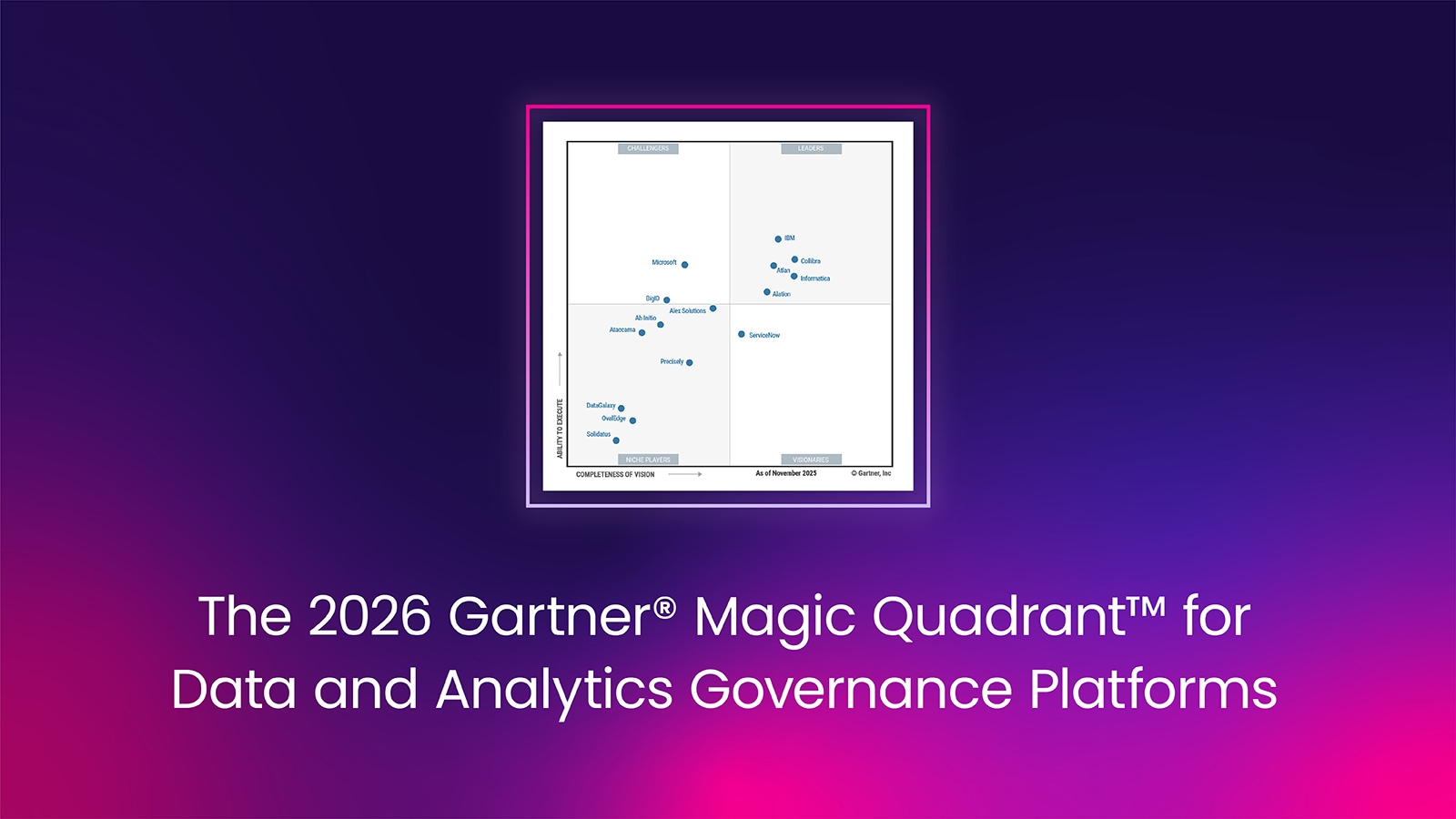
Gartner has published the second edition of the Magic Quadrant for Data and Analytics Governance Platforms, a category created in January 2025 to evaluate solutions that help organizations establish, operationalize, and automate data and analytics governance. This second edition reflects a more mature understanding of the market, new buyer expectations, and the growing need for governance across a broader set of assets, including unstructured data and AI models.
Below is an overview of what the research covers, why this category continues to rise in importance, and how the MQ has evolved in its second year.
What the Magic Quadrant evaluates
The Gartner Magic Quadrant for data and analytics governance platforms assesses vendors that provide integrated business and technology capabilities to support governance policy setting and policy enforcement. These platforms help business users—not just technical teams—define, manage, and operationalize governance across a wide range of data and analytics assets.
In the 2026 edition, Gartner continues to focus on how platforms support:
- Policy setting by governance boards, data owners, and business leaders
- Policy enforcement by stewards, analysts, and distributed data teams
- Automation of governance workflows, decision making, and documentation
Integration with modern data management technologies for policy execution
While these pillars remain consistent with the inaugural MQ, Gartner refined definitions and added clarity around emerging use cases and mandatory capabilities.
How the Magic Quadrant evolved since last year
The 2026 Magic Quadrant builds on the foundation of the 2025 edition but introduces several important changes that reflect a more mature and better defined market.
1. Clearer separation between governance and data management
While last year introduced the distinction between policy management and policy execution, this year formalizes it. Platforms are expected to serve business roles first, with deeper integrations to data management tools for automated enforcement.
2. Stronger emphasis on automation and AI
AI agents, active metadata, and ML-powered automation play a larger role in how Gartner evaluates vendors. Governance is increasingly expected to be continuous and automated, not a manual documentation exercise.
3. Expansion of governed assets
The 2025 MQ focused heavily on structured data. The 2026 edition expands significantly into unstructured data, analytics models, and data products. This reflects real-world buyer demand for unified governance across all analytical assets.
4. More refined use cases and persona expectations
Gartner formalized expectations for governance personas, workflows, and control planes across operational, analytical, and experimental environments.
5. Increased buyer focus on unified platforms
Customers are seeking single platforms that support the widest policy coverage and governance workflows. The MQ highlights this shift more explicitly than last year.
Together, these changes signal a market that is stabilizing around a clearer definition of what data and analytics governance truly requires.
Understanding the market definition
Gartner defines a data and analytics governance platform as a unified set of capabilities that help organizations develop, manage, and enforce governance policies across business and data management systems. These platforms differ from traditional data management tools because they are used primarily for policy management rather than policy execution.
The definition in the 2026 MQ continues to emphasize:
- Broad coverage across governance personas and workflows
- Integration with data management systems for enforcement
- Business accessibility, enabling nontechnical roles to participate in governance activities
- Support for multiple types of governed assets, including data, KPIs, analytics, and AI models
Gartner notes that the market definition may evolve as research advances, but the core distinction between governance (policy setting and enforcement) and data management (policy execution) remains foundational.
Mandatory and common capabilities
The 2026 report maintains a structured view of the capabilities required for a complete data and analytics governance platform. These include the same three mandatory solution groups introduced last year:
Policy-setting capabilities
Platforms must support:
- Business-level policy modeling and representation
- Organizational and role models that map people to responsibilities
- Governance workflow automation
- Business KPI and benchmarking support
Policy-enforcement capabilities
This includes:
- Business glossary and semantic modeling
- Deep and broad data lineage for impact analysis
- Orchestration and automation using AI, ML, active metadata, and AI agents
- Stewardship-friendly user interfaces
- Task management and exception handling
- Low-level rule management tied to data assets and metadata
Connectivity and integration
Platforms must import and export metadata, roles, and lineage quickly and accurately, enabling interoperability with third-party tools.
Common capabilities
The 2026 MQ reaffirms the importance of data cataloging, data classification, data observability, metadata management, analytics model governance, and support for data product curation.
However, Gartner highlights a few capabilities with increased weight this year, reflecting the evolution of customer needs. These are outlined below.
New capabilities added in the 2026 edition
The second edition of the MQ brings several refinements based on Gartner’s deeper understanding of vendor strategies and customer priorities. While the overall structure remains consistent, three emerging needs gained prominence:
Support for unstructured data governance
Organizations increasingly need to govern not only structured assets but also documents, messages, logs, multimedia, and other unstructured sources. Platforms are now evaluated more closely on their ability to classify, curate, and apply governance to these formats.
Data product curation and governance
As more companies adopt data mesh or data product-centric architectures, the MQ now emphasizes marketplace experiences, data contracts, and lifecycle governance for data products.
AI model governance
Governance of AI models is now a central requirement. Gartner evaluates vendors on both data-centric and model-centric governance capabilities, including lineage to model endpoints, metadata capture, versioning, and governance workflows for model promotion.
These additions reflect the expanding scope of governance, moving beyond data to include the full range of enterprise analytical assets.
Why this Magic Quadrant matters for data and analytics leaders
Data and analytics leaders who are investing in operationalizing and automating governance can use this research to evaluate which platforms deliver:
- End-to-end support for policy setting and enforcement
- Consistent governance across structured, unstructured, and analytical assets
- Strong automation capabilities powered by active metadata and AI
- Integration with modern data management, pipeline tooling, and cloud platforms
- A governance experience that business users can actually adopt
As governance becomes more central to data strategy, the MQ provides an independent view of how vendors are addressing the challenges of scale, complexity, and business engagement.
Gartner, Magic Quadrant for Data and Analytics Governance Platforms, By Anurag Raj, Guido De Simoni, Sarah Turkaly , 6 January 2026
Gartner does not endorse any company, vendor, product or service depicted in its publications, and does not advise technology users to select only those vendors with the highest ratings or other designation. Gartner publications consist of the opinions of Gartner’s business and technology insights organization and should not be construed as statements of fact. Gartner disclaims all warranties, expressed or implied, with respect to this publication, including any warranties of merchantability or fitness for a particular purpose
Gartner and Magic Quadrant are trademarks of Gartner, Inc., and/or its affiliates.
Lauren Ruth
Lauren is the Director of Global Communications at Ataccama. With over a decade in the data industry, she specializes in strategic communications and has helped fast-growth startups define and amplify their data stories. She previously led communications at Alation and Informa Markets and holds a dual B.S. in Business and Communication, with a specialization in Technology, from Cornell University.