Data quality + data observability: One unified strategy for data trust

At Ataccama, our perspective is simple: if your goal is AI-ready data at the speed and scale your business demands, observability alone won’t get you there.
Data quality and data observability work better together. You need data observability to monitor the health of your ecosystem, including checking for freshness, schema drift, volume shifts, and pipeline failures, so you can catch issues early. But you also need data quality to support deep validation and define what “good” looks like for the business, and to validate whether your data meets that standard.
Data trust is the confidence that data is accurate, reliable, governed, and fit for use in business decisions, analytics, and AI. In other words, it’s the assurance that when someone uses data, whether a human or an AI, the information is correct and consistent. Alongside observability and quality, governance and lineage context are critical pieces of the data trust puzzle, as they draw the connection between data issues and business impact and ownership.
Data observability has earned its place at the data management table because it gives teams fast signals in fast-moving environments, but observability alone doesn’t equal data trust.
The data observability illusion: Why observability alone falls short
Standalone data observability is not the villain in this story. It’s a practical response to modern data estates, where pipelines change frequently, and data products serve dozens of downstream teams.
But many standalone tools stop at detection. When monitoring runs without deep data quality checks and business context, you still spend days chasing symptoms, debating impact, and trying to identify owners. It’s also why so many teams feel stuck in data downtime, even after they invest in data observability.
The real problem is a deeper one: Pipeline health is not the same thing as business correctness.
Standalone observability checks tend to focus on five pillars:
- Freshness (is the table up to date?)
- Volume anomalies (did row count suddenly drop or spike?)
- Distribution (did the shape of the data change?)
- Schema drift (did the structure change?)
- Lineage (Where did the data come from, and where does it go next?)
Those signals matter, but they don’t tell you whether the data is right. Business harm shows up in places like:
- Regulatory reporting mismatches
- Duplicate customer records
- Negative sales values
- Impossible values, such as a customer age of 180
With a platform like Ataccama ONE that goes beyond standalone observability to offer data quality, governance, and lineage, you can connect data issues to business impact, then prove and maintain data trust across the entire data estate.
From tables to pipelines: Four checks to prove and maintain data trust
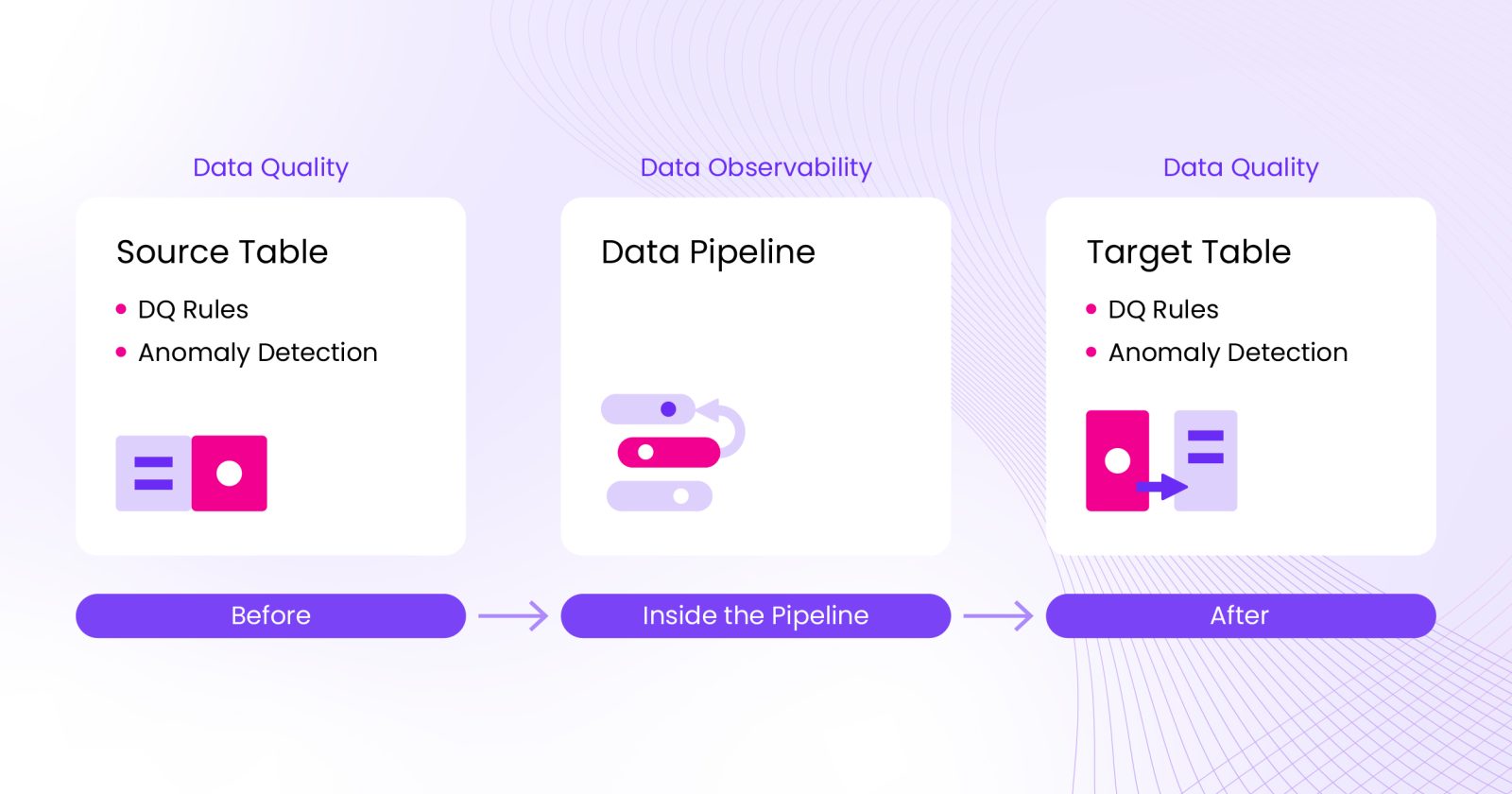
If you’re looking for data trust that holds up under pressure, you need two modes of control.
Mode 1: Control at rest
This is where you validate critical data assets with deep, rule-based checks. We call this Data Quality Monitoring (Data quality at rest), with validation across key data quality dimensions such as validity, completeness, uniqueness, accuracy, and timeliness.
Alongside that deep validation, you also want broad, structured monitoring of data sources to enable table observability (Data observability at rest) checks, such as freshness, schema drift, and volume anomalies, so you can see issues early without building hundreds of rules for every dataset.
Mode 2: Control in motion
This is where you stop bad data before it spreads. Ataccama supports this with data quality gates (Data quality in motion), which apply validation checks in transit, and pipeline monitoring (Data observability in motion), which watches structural integrity as data moves.
This is also where the reality of “data trust breaks in motion” becomes very real. The faster your pipelines run and the more teams consume outputs, the less time you have to notice a problem before it hits the business.
What you really need to check
Here’s the simplest way to connect the two:
- Data quality is like testing the water running through your pipes to confirm and ensure it’s clean, safe, and drinkable
- Data observability is like checking the plumbing: It tells you whether the pipes are connected, and confirms that the water is flowing and there aren’t any leaks.
If you only check the plumbing, you might end up celebrating flow while serving up contaminated water. Bad data can look “healthy” because it arrives on time and in the expected shape. If you only test the water, you can prove the sample is clean, but might still miss a leak upstream. Even the best data quality rules won’t help if the pipeline stalls or a schema change breaks transformations.
With data observability and data quality working together, you can be confident that every decision is built on truly trusted data.
The unified loop that turns issues into action
The biggest difference between “tools” and “trusted operations” is what happens after an alert.
Ataccama ONE is designed to run a closed loop: Detect → Triage → Remediate across the data estate.
It does that by connecting four things that usually live in separate places:
- Data observability (signals and early warnings)
- Data quality (deep validation and correction)
- Data lineage (root cause and impact analysis)
- Business context from catalog and governance (definitions, ownership, criticality)
Because our observability offering is built into Ataccama ONE, it uses the same metadata, rules, and governance frameworks as the data quality, lineage, and catalog modules. That shared foundation is what turns “we detected something” into “we know what to do next.”
Here’s how the loop works when you run it as a single system:
Detect: See issues early across the full estate
Monitor data at rest and in motion, including pipelines. Use automated profiling, anomaly detection, and pipeline monitoring to surface issues upstream of critical assets.
- Ataccama Data Observability continuously tracks freshness, schema stability, and anomalies, including pipeline failures upstream of critical assets
- Ataccama Data Quality adds profiling and rule-based checks that validate whether the data is actually correct
- Together, this closes a common gap: “The table loaded” is not the same thing as “the numbers are right”
Triage: Turn alerts into clarity, not noise
Alerts become useful when they come with context and answers, such as:
- What changed, and how far did it deviate?
- What is impacted downstream?
- Who owns the data?
- Has this happened before, and what fixed it last time?
If marketing owns marketing data and finance owns finance data, your alerts should follow that ownership model. This set up reduces noise, speeds response, and makes accountability clear.
Ataccama ONE supports smart notifications (Slack, Microsoft Teams, and email), a centralized alerts view for prioritization, and Issue management with escalation into Jira or ServiceNow.
Remediate: Fix root cause and prevent repeat incidents
Instead of treating incidents as isolated “table problems,” we recommend tracing lineage to see where the issue originated and which reports, dashboards, and models were affected downstream.
That way, you can apply the right fix:
- Use data quality remediation to correct recurring patterns
- Add or tighten a governed data quality rule to prevent the issue from repeating
- Shift the check upstream with data quality gates so the pipeline enforces the rule during execution
This is also why Ataccama’s observability is not just another dashboard. It’s an operational workflow designed to reduce firefighting and focus effort where it matters most.
Business outcomes you can measure
A unified approach only matters if it changes outcomes. Below are some practical wins you can drive when data quality and data observability work as one.
Reduce data downtime
Data downtime signals something much more than just a failed pipeline. From the business perspective, it’s the time to remediation, or the gap between “something changed” and “teams can confidently use the data again.”
The most effective ways to reduce data downtime include:
- Detecting anomalies early across the estate (before consumers report them)
- Routing alerts to the right owners and prioritize based on business impact
- Resolving faster with lineage-driven root cause analysis
- Preventing repeats by enforcing checks upstream
- Tracking closure in the tools teams already use
Actions to take include defining SLOs for freshness and availability, setting severity levels, and routing alerts to the right channel (Teams, Slack, or email) so response starts immediately. You can then escalate high-severity issues into Jira or ServiceNow so they don’t disappear into chat threads.
Minimize blast radius when issues occur
When data changes, two questions matter most:
- What will break downstream?
- How do we limit spread?
Lineage makes impact visible, and catalog context makes ownership clear. That combination helps teams from what they think might affect things like regulatory reporting or other strategic business initiatives, to being confident that they know which dashboards, data products, and teams are at risk.
Actions to take include using lineage to trace impact, then quarantining or pausing promotion of data that fails critical checks. The shift-left model makes this clear: applying data quality gates at the right points reduces blast radius.
Provide actionable alerts that improve collaboration
Most teams have a handle on setting up and delivering alerts, but still struggle to get alerts that lead to the best next action to take. By attaching the missing context, triage becomes much more effective. This context includes:
- What changed
- What it impacts
- Who owns it
- How it should be handled
This matters for collaboration because engineers and data owners need different views of the same issue. While engineers need pipeline run context and failure points, data owners and stewards need to understand definitions, policy implications, and business impact. A unified platform makes those perspectives aligned, so teams can work together without rehashing the basics.
Turn incidents into prevention, not repeat work
We like to say that the best incident is one that never happens twice.
This is where data quality in motion becomes essential. Ataccama Data Quality Gates is a Python library designed to embed governed data quality rules directly into ETL/ELT, streaming, and orchestration pipelines, including environments like Snowflake and dbt.
Because rules are managed centrally, updates can sync across pipelines so teams avoid rule drift and duplicated logic. That connection between business-defined rules and engineering enforcement is what makes prevention scalable.
Actions to take: When an incident occurs, add or refine a rule, then enforce it as a gate in the pipeline. Over time, you’ll see fewer downstream incidents, and faster resolution when something does change.
Shift left with trust boundaries
Shift-left is often described as “catch issues earlier,” but that’s not specific enough for teams to operationalize. A more useful framing is to think of it as trust boundaries: clear points in the lifecycle where expectations are enforced before data moves forward.
These boundaries might look like:
Trust boundary 1
Data capture and ingestion
Validate schemas, required fields, and reference values early, then reject or quarantine invalid records so bad data doesn’t become normal.
Trust boundary 2
Pipelines and transformations
Treat transformations like software builds, where checks must pass before the pipeline is considered healthy. Add proactive pipeline monitoring and route alerts with clear ownership and follow-through.
Trust boundary 3
Storage and consumption
Make trust visible, detect anomalies quickly to limit downtime, trace impact to reduce blast radius, and close the loop so upstream teams improve rather than patching downstream symptoms.
This is exactly where a unified approach shows its advantage: Data quality gates help prevent bad data from landing, data observability catches issues that still slip through in real time, and lineage with catalog context makes ownership and impact visible when it matters.
From observability to data trust
If your goal is AI-ready data at the speed and scale your business demands, observability alone is not enough. You need more than alerts. You need confidence that your data is accurate, reliable, governed, and fit for use across decision-making, analytics, and AI.
Catch issues, route, and resolve them before they reach the business, impact strategic AI initiatives, and increase overall risk.
When you bring together data observability and data quality backed with lineage and governance context, you reduce data downtime, understand the blast radius, and contain its impact, moving beyond detection into building real data trust.
Adrian Vicol
Adrian is our Product Marketing Manager for Master Data Management at Ataccama. With a sales and marketing background, he always strives to solve business needs and put clients first in everything he builds.