
Your board wants AI. Your legacy
tool is nearing end-of-life.
Every board is demanding AI. But if your data quality runs on Informatica,
there are compounding barriers between you and that future.
A stack of complex point products
Acquired over decades, every point product has its own interface, license, and failure mode. Every integration raises risk and liability.

IT as a bottleneck
Any configuration needs IT resources and blocks business users from what they need. Requests pile up and time to value drags out.

Manual DQ rules
Every quality rule is manually scoped for a single dataset, while anomalies go unnoticed between the cracks.

More tools, more blind spots
To avoid more legacy debt, users take new requirements to other tools to solve. This creates more blind spots across your estate, and more friction between your data and the agents that will act on it in real time.
Now that Salesforce owns Informatica
The Salesforce acquisition proved a point: data management is essential
infrastructure for agentic AI. But that proof came with a catch.
Roadmap shaped by a parent
company agenda
Informatica now answers to Salesforce. Its roadmap may be shaped to power Agentforce, Salesforce's own agent platform. However open it stays, its direction is shaped by an owner's priorities — not yours.

Direction set by customers,
not a parent company
Ataccama's roadmap is shaped by one thing: what you need. Independent by ownership, answerable to no platform agenda, shaped by you.
The trust layer between your data and your AI
Ataccama works across your entire data estate. It makes your data governed, validated, observable, and certified anywhere. Then it carries those trust signals, from your catalog to your agents to your teams. Everything they act on is data you can stand behind.


Applications
Value realizationThis is the layer enterprises actually feel. Agents don't surface outputs for human review here, they execute inside operational systems. Refunds are issued. Compliance escalations are filed. Service requests are routed and resolved, all at machine speed.
What lives here:- Autonomous AI agents built on platforms like Agentforce, ServiceNow, and Ironclad
- Copilots powered by ChatGPT, Microsoft Copilot, and Power BI
- Chatbots and self-service applications like Fin AI and Sierra
- Custom-built AI apps using Cursor, Replit, and Bolt
The foundation decides the outcome
The quality of everything below this layer determines whether this layer is an asset or a liability. Agents can only be trusted to act autonomously when the data they act on has been validated, certified, and cleared, before execution, not after.
Agent orchestration
Reasoning & planningThis is where large language models, agent frameworks, and retrieval systems take trusted data and turn it into action. Agents reason over enterprise context, plan sequences of steps, and coordinate execution across systems, without a human authorizing each move.
What lives here:- Agent frameworks like LangChain, CrewAI, AutoGen, and LlamaIndex
- Foundational models including GPT, Gemini, Claude, Llama, and others
- Vector stores for retrieval-augmented generation
- MCP as the interface connecting agents to governed data sources and tools
Probabilistic reasoning needs a deterministic foundation
LLMs are powerful precisely because they handle ambiguity well. But when agents trigger financial transactions or compliance actions, that same flexibility becomes a risk. Orchestration can't resolve data conflicts on its own, it needs certified, governed context passed up from the layer below.

Data trust layer
Context & quality
Most AI initiatives have Layers 1, 2, 4, and 5. What they're missing is this one. The Data trust layer sits between consolidated data and the systems that act on it, validating, governing, resolving, and certifying data before any agent is permitted to execute against it.
What lives here:- Data quality validation and automated remediation at the source
- Entity resolution that produces a single authoritative master record
- Data governance including catalog, lineage, and business definitions
- Continuous observability that detects anomalies as they emerge
- The Data Trust Index: a real-time, machine-readable signal that tells agents whether a dataset is cleared for autonomous action
Available data isn't trusted data
The gap between available and trusted is exactly where agentic AI breaks down. Data that loads without errors and passes schema checks can still carry duplicates, stale values, and missing context. This layer closes that gap, continuously, across the entire data estate. Ataccama ONE delivers this layer as a unified platform, combining data quality, observability, governance, lineage and reference & master into a single environment purpose-built for trusted agentic AI.
Cloud lake houses
Storage & computeBefore AI can operate at scale, enterprise data needs to live in one place. Cloud lakehouses consolidate fragmented source data into a scalable, compute-capable environment built for modern AI workloads, eliminating the infrastructure barriers that make coordinated AI deployment nearly impossible.
What lives here:- Cloud data platforms like Snowflake, Databricks, Amazon Redshift, and Google BigQuery
- Native Python execution for data science and ML pipelines
- Open table formats like Apache Iceberg for cross-platform flexibility
Consolidation solves infrastructure. It doesn't solve quality
Centralizing data is the necessary first move, and the return is substantial. But migrating data to a modern cloud platform doesn't clean it, resolve duplicate entities, or certify it for AI use. That work happens in the layer above.
Data sources
Raw dataEvery enterprise AI program starts here, with the operational systems that run the business. ERP platforms, CRMs, billing systems, document repositories, and data feeds that were built for process efficiency, not AI consumption. The data is there. The problem is what it carries.
What lives here:- Structured sources like SAP, Workday, Oracle, Salesforce, NetSuite, PostgreSQL
- Unstructured sources like Slack, Gmail, SharePoint, Notion, Google Drive
- Operational and transactional feeds across business functions
Years of quality debt come with the territory
Source systems accumulate inconsistent entity definitions, duplicate records, incomplete fields, and business logic that varies by region, system vintage, or the migration that last touched them. That's not an exception at enterprise scale. It's the expected condition of raw data, and it's exactly what the layers above are designed to address.
Why teams choose Ataccama
over Informatica:
Eight concrete differences that matter when you're
running data for AI-ready enterprises.

One platform, less friction
Data quality, observability, catalog, lineage, and reference data in one simple UI. Quality scores and business metadata sit right where you work. Anomaly detection catches what rules miss.

Federate data governance with self-service
The ONE AI Agent, no-code workflows, and a simple UI put DQ in business hands, without queuing for IT.

Deploy anywhere
One platform, deployed in the cloud, on-prem, or hybrid, and managed as one.

Let AI write the rules
Say it in plain language. ONE AI writes the rule, no expression syntax required.

Get the end-to-end data quality in one UI
Profiling, rule-based checks, anomaly detection, plus pipeline observability, routed straight into stewardship to fix what breaks, all in one platform.

Ground AI in quantifiable data trust signals
Quality, governance, and context signals reach any agent through MCP.

Know your cost before the bill
Transparent, capacity-based licensing that Gartner named a strength, with unlimited read-only users and connectors at no extra cost.

Independent by ownership, shaped by you
Roadmap set by customer needs, not a parent company's agenda. One focus: your data trust.

Move off Informatica with confidence
Leaving a system you've relied on for years is challenging.
You don't have to do it alone, or from scratch.
Our professional services team and system integrator partners know both platforms. They carry over your existing IDQ rule logic, so years of work move with you. You keep what you built and skip the rebuild.
What you keep
- All existing IDQ rule logic, carried over
- Years of data domain expertise preserved
- No rebuild from scratch — skip the rework
- Partner-led guidance from both-platform experts

Trusted data, real outcomes
Enterprises in financial services, insurance, and banking rely on Ataccama
to govern and certify the data their AI acts on.
$30–40M
In value from more trusted,
more usable data.

97%
quality pass rate — 9,000+ CDEs governed, 55+ data sources covered.

$1.4M
saved — 11,000+ items cataloged, 1,400+ DQ rules built

Build on the fastest-moving leader
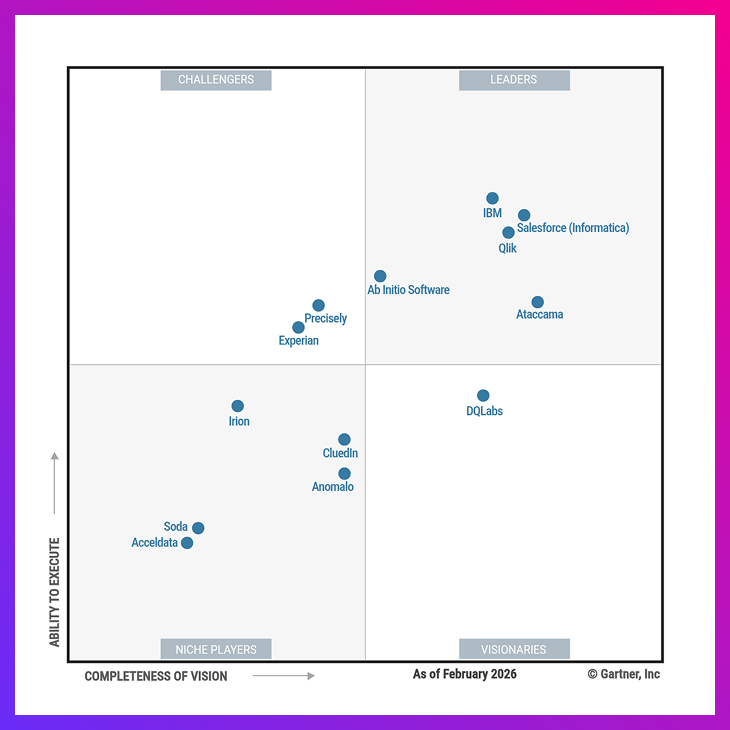
Both Ataccama and Informatica are Leaders in the Gartner Magic Quadrant for Augmented Data Quality Solutions, but Ataccama ranks furthest in Completeness of Vision. We've earned it by shipping agentic capabilities that simplify and speed up data management. A proven leader, and a partner invested in where you're going.